


A dead smartphone battery during a busy commute creates instant stress, leaving you without maps or emergency communication. Determining what is a good mah for a power bank depends on your device size, daily charging routines, and how much weight you want to carry. A rating between 10,000mAh and 20,000mAh hits the ideal balance for most mobile users, delivering several recharges without burdensome bulk. While a massive milliamp-hour rating provides extended reserve power, it adds physical weight that can weigh down daily carry bags.
Reviewing a specs comparison of power bank features helps clarify how nominal capacity translates into usable device runtimes. Stored energy also depends on watt-hour ratings and conversion efficiency, as internal voltage stepping consumes a portion of total power. Users on extended camping trips or running specialty electronics often favor high-capacity bricks or multi-voltage units. Identifying your exact portable power requirements ensures you avoid carrying excess bulk or running out of charge unexpectedly.

Pros
- Massive 60,000 mAh nominal capacity provides days of off-grid power for mobile devices
- Equipped with 4 output ports to charge multiple smartphones or small gadgets simultaneously
- Clear numeric digital display replaces vague indicator lights with an exact battery percentage
- Built-in LED flashlight adds practical value for camping trips and emergency outage kits
Cons
- Exceeds standard airline carry-on capacity limits and cannot be carried on commercial airplanes
- Not compatible with charging USB-C laptops according to manufacturer specifications
- Bulky 1.5-inch thick profile makes it better suited for gear bags than pocket carry
The Nuxgal Power 60000mAh Power Bank is an ultra-high-capacity external battery pack engineered primarily for extended outdoor recreation, multi-day camping, road trips, and residential storm backup. Built for users who spend long stretches away from conventional electrical outlets, this unit supplies substantial reserve energy to keep essential personal electronics operational. It prioritizes sheer energy longevity over pocket-sized portability, serving as a dependable charging hub for outdoor enthusiasts and emergency-conscious households.
Charging performance centers on a versatile multi-port layout comprising one bidirectional USB Type-C port and three USB-A output ports, allowing up to four devices to charge at once. The USB-C connection supports fast charging protocols with an output rating of up to 22.5W, which the manufacturer states can charge a compatible smartphone from 20 percent to 60 percent in approximately 40 minutes. The ports are well suited for mobile phones, tablets, wireless headphones, and small electronic accessories. However, the manufacturer explicitly notes that this power bank is not compatible with charging laptops, reflecting its focus on handheld mobile gear.
In terms of physical design, the battery pack measures 6 by 1.5 by 3.5 inches, presenting a solid and utilitarian rectangular form factor in black. A standout physical feature is the integrated digital LED display on the front panel, which reveals the exact remaining battery percentage so users can accurately track remaining reserves. The housing also incorporates a built-in flashlight, turning the battery into a functional dual-purpose tool for navigating dark campsites, vehicle breakdowns, or power blackouts.
Operating and maintaining the power bank is straightforward, with the bidirectional USB-C port handling both device charging and pack replenishment using the included USB-C cable. Managing multiple cords is relatively simple due to the tidy port grouping along the edge of the enclosure. Because the 1.5-inch thickness and substantial internal cell volume make it too bulky for standard pockets, it travels best tucked inside a backpack, glove compartment, or emergency storage tote.
Several clear limitations should be evaluated before purchasing this model. Most significantly, the manufacturer explicitly highlights that this 60,000 mAh battery pack cannot be carried on airplanes, as its capacity far exceeds typical FAA and airline carry-on battery limits. Additionally, users who require high-wattage laptop charging will need a different class of charger, and the vast capacity means that fully replenishing the power bank itself requires a patient recharge cycle from an appropriate wall adapter.
The Nuxgal Power 60000mAh charger is an excellent option for campers, off-grid road trippers, and emergency-kit planners looking for massive reserve power to keep multiple phones and accessories running for days. Shoppers who travel frequently by commercial air or who need to recharge a USB-C laptop should seek an airline-compliant power bank with higher wattage delivery. For dedicated ground travel and home storm preparation, its combination of high capacity, four-device output, and built-in flashlight offers strong practical utility.
The Nuxgal Power battery pack features a manufacturer-listed nominal capacity of 60,000 mAh, placing it among the largest consumer power banks available. This ultra-high capacity is intended to supply multiple recharges across phones, tablets, and mobile accessories over several days without requiring a wall outlet.
As with all lithium-based power banks, nominal battery capacity does not translate directly to identical delivered energy at the device due to standard voltage conversion losses and device circuitry. Nevertheless, the substantial energy storage makes this unit especially valuable for basecamp setups, festival weekends, and prolonged storm-related outages where outlet access is unavailable.
A critical consideration for travelers is that this 60,000 mAh power bank cannot be taken aboard commercial aircraft. The product specifications explicitly state that this unit is prohibited from airline travel due to aviation safety rules restricting large lithium battery capacities in both carry-on and checked luggage.
For ground transportation, however, this battery pack is well matched to vehicle travel, RV trips, overlanding, and cabin getaways. Users should reserve this charger strictly for vehicle, outdoor, and home emergency use while choosing an airline-approved model under 100 watt-hours for commercial flights.
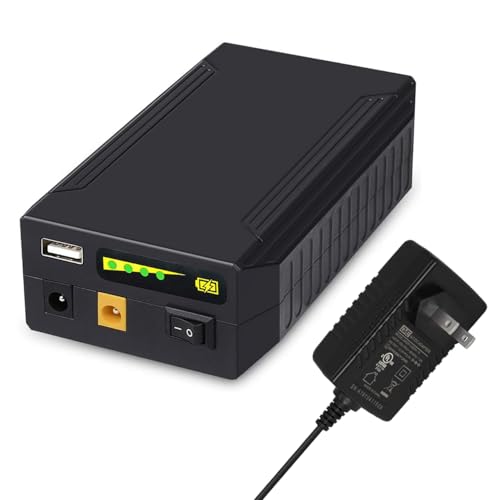
Pros
- Versatile multi-voltage outputs support simultaneous DC barrel-jack and standard 5V USB power delivery.
- Substantial 99.9Wh energy rating provides extended continuous runtime for lights, pumps, and field equipment.
- 12V DC port supports heavy current loads up to 6A max for demanding 12V electronics.
- Standard center-positive polarity works natively with many CCTV cameras and Spectra breast pumps.
Cons
- Standard 5V USB port is limited to 2A output without modern USB-C Power Delivery fast-charging support.
- Requires manually toggling the power switch to the on position (-) for the battery to accept an incoming charge.
- Does not include a USB charging cable or center-negative polarity reversal cable for guitar pedals.
The Talentcell 99.9Wh Multi-Voltage Power Bank is a specialized portable DC power pack engineered for users who require direct 12V and 9V barrel-jack connections alongside standard 5V USB power. Unlike mainstream consumer power banks designed exclusively for smartphones and tablets, this multi-voltage unit serves as a self-contained DC power supply. It is an effective solution for DIY electronics builders, nursing parents using the Spectra S2 breast pump away from wall outlets, mobile security technicians, and hobbyists operating field equipment.
Regarding power output and capacity, the battery provides a nominal 11.1V 9Ah setup that totals 99.9Wh of energy. Its primary 12V DC output uses a standard DC5521 connector, delivering up to 6A maximum with an operating voltage curve between 12.6V and 9.0V as the battery discharges. A secondary 9V DC output utilizes a DC5525 connector supporting up to 1A, while the standard 5V USB port provides up to 2A output for mobile phones and low-draw USB accessories.
The physical construction measures 5.39 by 3.11 by 1.54 inches in a durable black enclosure suited for equipment bags, camera rigs, or desktop setups. Both DC barrel ports feature a center-positive polarity layout with an inner positive and outer negative configuration. This layout natively matches equipment like 12V LED light panels, CCTV surveillance setups, car DVRs, essential oil diffusers, and certain robotic telescope mounts.
Operating the power bank requires attention to physical controls and connection standards. When recharging the unit via a compatible DC input charger, the onboard rocker switch must be manually set to the on position marked '-' or the battery will not charge. In active use, the multi-port design allows users to power continuous 12V loads, such as internet modems during temporary outages, while concurrently utilizing the 5V USB port to maintain smartphone battery levels.
Several practical limitations should be considered before purchase. The 5V USB port provides basic 2A power and does not support USB Power Delivery, Quick Charge, or high-wattage laptop charging. Furthermore, guitar players connecting multi-effects processors must acquire a separate reverse-polarity cable, as standard guitar pedals generally require center-negative inputs. The 12V output also follows a discharge curve from 12.6V down to 9.0V, which may affect devices that require a strictly regulated constant 12.0V supply.
This multi-voltage battery pack is best suited for shoppers seeking portable DC power for Spectra S2 breast pumps, LED strips, 12V routers, and field-testing gear. Users seeking an ultra-slim pocket charger strictly for smartphone fast charging or USB-C laptops should choose a standard USB PD portable charger instead. For targeted multi-voltage DC barrel applications under 100Wh, this Talentcell battery pack offers dependable utility and versatile field functionality.
The Talentcell power supply provides two distinct DC barrel outputs alongside a standard USB port. The 12V output uses a DC5521 jack (5.5mm outer diameter, 2.1mm inner pin) delivering up to 6A, with an operating voltage that ranges between 12.6V when fully charged and 9.0V when depleted. The 9V port features a DC5525 jack (5.5mm outer diameter, 2.5mm inner pin) rated at up to 1A output.
Both DC ports are wired with center-positive polarity, meaning the inner contact is positive (+) and the outer barrel is negative (-). This configuration matches common electronics like CCTV cameras, LED light strips, and Spectra S2 breast pumps. Devices requiring center-negative polarity, such as most guitar effect pedals, require an external polarity-reversing cable to prevent equipment damage.
Recharging the Talentcell battery pack requires setting the integrated power switch to the '-' position. If the switch remains in the off position, the internal charging circuitry will not accept incoming power from the charger. Users should ensure the switch is set properly prior to leaving the battery to recharge.
For everyday carry and device charging, the 5V USB port delivers up to 2A for smartphones, flashlights, or small handheld gadgets. Note that the package does not include a USB charging cable or reverse-polarity DC cables, so users must supply their own cables matching their specific connected hardware.
Frequently Asked Questions About Power Bank Capacity
What is a good mAh capacity for everyday smartphone charging?
A capacity between 10,000mAh and 20,000mAh works best for most daily smartphone users. This range provides two to four phone recharges while fitting comfortably inside a purse or commuter backpack. Lighter 5,000mAh units offer compact convenience for short outings. For shoppers wanting minimal bulk at an accessible price, examining universal Anker power bank options under 25 dollars shows how practical small-capacity chargers remain.
Can a 60,000mAh power bank be taken on an airplane?
No, a 60,000mAh power bank exceeds commercial flight limits and is not allowed on planes. Airline safety regulations generally restrict carry-on lithium packs to 100 watt-hours unless granted special carrier approval. Heavy-duty options like the Portable Charger 60000mAh Power Bank 22.5W offer substantial multi-day capacity for road trips, but the manufacturer explicitly notes flight restrictions. Always verify watt-hour labels before bringing any large battery to the airport.
What is the main difference between mAh and Wh ratings?
Milliamp-hours (mAh) reflect electrical charge volume, while watt-hours (Wh) measure total delivered energy across a given voltage. Internal battery cells operate at 3.7 volts, whereas output ports supply power at higher voltages like 5V, 9V, or 12V. For instance, the Talentcell Portable Power Bank lists a 99.9Wh rating alongside an 11.1V 9Ah specification to support its multi-voltage DC and USB ports. Watt-hours provide a clearer comparison when evaluating batteries with varied output configurations.
Does a higher mAh power bank charge devices faster?
No, a higher mAh rating indicates total stored energy rather than how fast your device charges. Charging speed depends on output wattage, supported protocols like USB Power Delivery, and your device’s power intake limits. A 10,000mAh charger with a 22.5W USB-C port charges compatible phones faster than a massive battery limited to 5V output. Always inspect port output wattage to confirm actual charging speed.
Why is usable power bank capacity lower than the advertised rating?
Energy loss naturally occurs during voltage conversion, heat generation, and power regulation inside the charging circuit. Power bank lithium cells store energy at roughly 3.7 volts, requiring internal electronics to boost voltage to 5V or higher for USB output. Cables and device charging circuits also encounter electrical resistance during power transfer. Consequently, the actual energy delivered to your phone battery is always lower than the nominal cell rating printed on the charger.


Write Your Review
No reviews yet. Be the first to share your experience!