


Airport security checkpoints create sudden stress when travelers do not know if their portable chargers meet federal aviation safety standards. A portable battery must comply with strict Federal Aviation Administration (FAA) rules, meaning which power bank is allowed in flight typically comes down to a listed capacity at or below 100 watt-hours (Wh). Passenger carriers require all spare lithium-ion batteries to stay inside carry-on luggage rather than checked baggage. While massive external batteries provide days of reserve power, oversized units face gate confiscation if they exceed limits.
Evaluating battery packs for air travel requires checking manufacturer ratings for capacity and output wattage. High-capacity options like the 27000mAh Paopaoyu unit list a 98Wh rating to remain carry-on compliant, whereas heavy battery packs exceeding 100Wh require airline approval. Compact units with integrated cables, such as models from INIU and PWPF, easily pass TSA checkpoints while offering up to 22.5W fast phone charging. For a detailed breakdown of specifications, view our specs comparison of power bank features. Knowing these ratings ensures seamless travel without security delays.

Pros
- Four built-in cables cover the most common connector types, reducing cable clutter and making it easy to charge phones, tablets, earbuds, and other devices without extra accessories
- Two additional ports (USB-A and USB-C) provide flexibility for devices that need a dedicated cable or for sharing power with others
- The 19mm-thick design is notably slimmer than many competing 20,000mAh power banks, improving pocket and bag portability
- Listed 22.5W fast charging may meaningfully speed up charging for compatible smartphones compared to standard 5W or 10W output
- The integrated Micro USB cable doubles as a carrying strap, adding a practical hands-free transport option
Cons
- The product description does not specify whether the USB-C port supports USB Power Delivery or other standardized fast-charging protocols, so laptop or higher-power device compatibility remains unclear
- Built-in cables are not replaceable - if one cable wears out or is damaged, the entire unit's convenience advantage is reduced
- No wall charger is mentioned as included, so buyers may need to supply their own USB-C or USB-A charger to recharge the power bank itself
The VRURC 20000mAh Portable Charger is a high-capacity power bank built around the convenience of four integrated charging cables and two additional output ports. This design targets multi-device users - particularly commuters, travelers, students, and families - who want a single charging solution that can handle iPhones, Android phones, tablets, earbuds, and e-readers without carrying a tangle of separate cables. VRURC positions this model as an all-in-one portable charging hub, and the built-in connector variety (Type-C, phone connector, Micro USB, and USB Type-A cable) supports that positioning well for everyday U.S. smartphone and tablet users.
The manufacturer lists a 20,000mAh battery capacity and a maximum 22.5W fast charging output, with a claim that compatible devices can reach up to 50% charge in roughly 30 minutes. It is important to understand that the 20,000mAh figure represents nominal battery capacity, not the exact amount of energy delivered to a connected device - voltage conversion, cable resistance, and device charging circuitry all reduce usable output. The manufacturer describes the unit as using dual premium cells to deliver the full listed capacity and states it provides approximately 3 to 4 full phone charges, though actual recharge counts will vary by phone model and battery size. The product description does not explicitly confirm USB Power Delivery, PPS, or Quick Charge protocol support on any port, so buyers who need a specific fast-charging standard for their devices should verify compatibility before purchasing.
Build quality centers on a slim 19mm profile measuring 6.14 x 2.75 x 0.75 inches and weighing under 0.77 pounds. The manufacturer highlights that this is 33 percent thinner than its previous version and slimmer than the typical 28-30mm thickness common among 20,000mAh power banks. The integrated Micro USB cable doubles as a carrying strap, which is a practical touch for hooking the unit onto a backpack or holding it during use. Six total charging connections - four built-in cables plus one USB-A port and one USB-C port - give the VRURC power bank genuine multi-device flexibility. However, the product data does not specify how output power is allocated when multiple devices charge simultaneously, so users should expect some reduction in per-device charging speed during multi-device use.
Setting up the VRURC power bank requires no special configuration - simply connect a device using one of the built-in cables or plug into the USB-A or USB-C port with your own cable. Recharging the power bank itself appears to be supported through the USB-C port, though the product listing does not specify a maximum input wattage or estimated recharge time, and no wall charger is mentioned as included. For daily carry, the slim form factor fits comfortably in most backpacks, laptop bags, and larger purses, and the strap feature adds a hands-free option that many competing power banks lack. The built-in cables eliminate the common frustration of forgetting or losing a cable, which is especially valuable for travelers, festival-goers, and students who move between locations frequently.
The biggest limitation of the VRURC 20000mAh power bank is the lack of explicit information about supported charging protocols. Without confirmed USB Power Delivery or PPS support, buyers who need guaranteed fast charging for newer iPhones, Samsung Galaxy devices, or Google Pixel phones at their maximum supported input speeds cannot be certain this unit will deliver protocol-negotiated fast charging. The built-in cables, while convenient, are not replaceable - wear or damage to any integrated cable reduces the unit's core value proposition. Additionally, the product description does not mention laptop charging compatibility, so users seeking a power bank to charge a MacBook, Chromebook, or Windows USB-C laptop should look for models with confirmed high-wattage USB-C PD output.
The VRURC 20000mAh portable charger is best suited for U.S. smartphone users, Android and iPhone owners, tablet users, and multi-device households who value the convenience of built-in cables and want a single power bank that covers most common connector types. It is a practical choice for commuters, airline travelers, road trippers, students, and anyone who frequently runs low on battery and wants a grab-and-go solution without managing separate cables. Users who prioritize confirmed USB Power Delivery support, laptop charging, or protocol-specific fast charging may want to consider a power bank with explicitly listed PD or PPS specifications. For everyday phone and tablet charging with maximum cable convenience, the VRURC's combination of 20,000mAh listed capacity, six charging connections, 22.5W listed output, and slim portable design makes it a compelling option in the multi-cable power bank category.
The VRURC 20000mAh power bank includes four built-in cables with Type-C, phone connector, Micro USB, and USB Type-A tips. This integrated cable design means most common smartphones, tablets, earbuds, e-readers, and small electronics can be charged without carrying any separate cables. The Micro USB cable doubles as a carrying strap, allowing the power bank to be held comfortably, hooked onto a backpack loop, or swung while walking.
In addition to the four built-in cables, the unit provides two extra ports - one USB-A and one USB-C - for devices that require a dedicated cable or for sharing power with someone else's cable. This brings the total number of charging connections to six, which is notably higher than most competing power banks in this capacity range. One important consideration is that built-in cables cannot be replaced if they wear out or become damaged, so careful handling of the cable tips and strain-relief points will help preserve long-term usability.
The VRURC power bank measures 6.14 x 2.75 x 0.75 inches and weighs approximately 0.76 pounds. At 19mm thick, the manufacturer states it is 33 percent thinner than its previous version and slimmer than the 28-30mm thickness typical of many 20,000mAh power banks. This makes it more practical for backpacks, purses, laptop bags, and even larger jacket pockets compared to bulkier high-capacity alternatives.
For travelers, the 20,000mAh listed capacity falls within the range that many airlines permit in carry-on luggage, though travelers should always verify current airline and regulatory battery rules before flying, as policies vary by carrier and jurisdiction. The slim profile and integrated strap add genuine everyday-carry convenience, making this power bank practical for commutes, campus use, office backup power, and outdoor activities like camping or festivals where outlet access is limited.
The manufacturer lists compatibility with iPhones, Samsung Galaxy phones, Google Pixel phones, iPads, AirPods, Kindles, and most tablets. The four built-in cable types - Type-C, phone connector, Micro USB, and USB Type-A - cover the connector requirements for the vast majority of current U.S. smartphones, tablets, wireless earbuds, portable speakers, and e-readers. The additional USB-A and USB-C ports extend compatibility to devices that use proprietary or less common cables.
The product description does not mention laptop charging compatibility, and without confirmed USB Power Delivery output specifications, this power bank should not be assumed to support charging MacBooks, Chromebooks, Windows laptops, or other higher-power USB-C devices. Users whose primary need is laptop charging should look for power banks with explicitly listed USB-C PD output at 30W or higher. For smartphone and tablet users, however, the VRURC's connector variety and listed 22.5W output should handle everyday charging needs for most popular devices on the U.S. market.

Pros
- Built-in Lightning and USB-C cables mean most iPhone and Android users can charge without packing any extra cables
- 22.5W listed output and 18W listed input offer faster charging and faster self-recharging compared to basic 5W or 10W power banks
- Supports up to four simultaneous device connections through two built-in cables plus USB-C and USB-A ports
- At 7.5 oz and under 5 inches long, the slim form factor is genuinely pocket-friendly and travel-ready
- 18-month manufacturer warranty and listed airline carry-on compliance add practical peace of mind for frequent travelers
Cons
- No wall charger is included in the package, so users need to supply their own USB-C adapter to recharge the power bank
- Built-in cables are fixed-length and not replaceable, which could become a concern if a cable is damaged over time
- Exact output allocation when all four ports are in use simultaneously is not specified, so charging speed per device may decrease with multiple connections
The PWPF 10000mAh portable charger is a compact power bank with built-in Lightning and USB-C cables designed for iPhone and Android smartphone users who want a grab-and-go charging solution without carrying separate cords. It is best suited for commuters, travelers, students, and multi-device users who value convenience and portability over raw capacity. The integrated cable design means you can top off an iPhone 16 or a Samsung Galaxy phone simply by unfolding the appropriate built-in cable, which is a meaningful everyday advantage over power banks that require you to remember and pack your own cables.
The manufacturer lists a 22.5W maximum output, which positions this power bank in the fast-charging category for compatible smartphones. The built-in USB-C cable supports bidirectional input and output, meaning it can both deliver power to connected devices and accept power to recharge the battery pack itself at up to 18W. According to the product description, the power bank can fully recharge in approximately 3 hours using the USB-C cable's 18W input. Actual charging speed at the device will depend on the connected phone's own input limits, the cable being used, and whether multiple devices are drawing power simultaneously. The 10,000mAh listed capacity represents the nominal battery capacity, not the exact amount of energy guaranteed to reach a connected device, since voltage conversion and normal efficiency losses reduce usable output.
PWPF designed this unit with four total charging outputs: a built-in Lightning cable, a built-in USB-C cable, a standalone USB-C port, and a USB-A port. The manufacturer states it can charge up to four devices simultaneously, which is a practical advantage for families sharing a single power bank or for users who carry a phone, tablet, and earbuds. The integrated cables also double as a lanyard loop, allowing you to hang the power bank from your wrist or clip it to a backpack. The body measures 4.72 x 2.87 x 0.87 inches and weighs 7.5 oz (213g), making it slim enough to slip into a jeans pocket or a small purse compartment without noticeable bulk.
Setting up this power bank is straightforward since there are no apps or pairing steps involved. To charge a device, you simply unfold the appropriate built-in cable or plug into the USB-C or USB-A port. To recharge the power bank itself, you connect a USB-C charger to the built-in USB-C cable, which supports 18W input. No wall charger is included in the box, so you will need to supply your own USB-C power adapter. The manufacturer lists compatibility with iPhone 17, 16, 15, and 14 series phones, Samsung Galaxy, Google Pixel, iPad, AirPods, and most USB-C smartphones and devices. For daily routines, the compact size and integrated cables make it easy to toss into a bag each morning without thinking about cable kits.
The most notable limitation is that the built-in cables are fixed and cannot be replaced if they wear out or break. Users who are rough on cables should keep this in mind. The product description does not specify how output wattage is divided when all four ports are active simultaneously, so charging speed per device may be reduced during multi-device use. There is also no mention of a battery percentage display or LED indicator detail in the product data, so monitoring remaining charge may be less precise than on power banks with digital displays. Additionally, while the manufacturer states compliance with major airline carry-on regulations, travelers should always verify current airline and regulatory battery rules before flying, as policies can vary.
This PWPF power bank is a strong choice for iPhone and Android users who want a single compact device that replaces both a power bank and a cable kit. The built-in Lightning and USB-C cables, 22.5W listed output, four-device simultaneous charging, and 7.5 oz weight make it particularly well-suited for daily commuters, airline travelers, students, and parents who share charging among family members. Users who need higher capacity for multi-day trips or laptop charging should consider a larger power bank with higher wattage output. But for everyday smartphone and small-device backup power with maximum cable convenience, this model covers the essentials without unnecessary bulk.
The PWPF power bank includes two built-in cables: one Lightning cable for iPhones and compatible Apple accessories, and one USB-C cable for Android phones, tablets, earbuds, and other USB-C devices. This integrated design eliminates the need to carry separate charging cables, which is especially convenient for commuters and travelers who want to minimize what they pack. The built-in USB-C cable serves double duty as both an output cable for charging devices and an input cable for recharging the power bank itself at up to 18W.
The integrated cables also function as a portable lanyard, allowing the power bank to be hung from a wrist or attached to a backpack strap. Because the cables are built into the body, they cannot be detached or replaced, which means cable damage could affect the long-term usability of the unit. Users who frequently charge both iPhones and Android phones will appreciate having both connector types always available without rummaging through a cable pouch.
This power bank offers four total charging connections: a built-in Lightning cable, a built-in USB-C cable, a standalone USB-C port, and a USB-A port. The manufacturer states that all four can be used simultaneously, supporting up to four devices at once. This makes the PWPF unit more versatile than many competing 10,000mAh power banks that typically offer only two or three ports.
The built-in USB-C cable supports bidirectional use, functioning as both input for recharging the power bank and output for charging connected devices. The maximum listed output is 22.5W, and the maximum listed input is 18W. However, the product data does not specify per-port output limits or how total wattage is allocated when multiple devices are connected simultaneously. Users charging four devices at once should expect reduced charging speed per device compared to single-device use.
The PWPF 10000mAh power bank is designed with travel in mind. The manufacturer states that it complies with carry-on regulations of all major airlines. At 4.72 x 2.87 x 0.87 inches and 7.5 oz, it is compact and light enough to fit in a carry-on bag, personal item, or even a coat pocket without adding noticeable weight. The built-in cables reduce the number of accessories you need to pack, which is a practical advantage for minimalist travelers and business commuters.
For road trips and family travel, the four-device simultaneous charging capability means multiple passengers can share a single power bank. The lanyard-style cable design allows you to hang the unit from a backpack or wrist for quick access during layovers or transit. Travelers should always verify current airline and regulatory battery policies before flying, as rules regarding lithium battery packs can vary by carrier and jurisdiction. The product data does not list a watt-hour (Wh) rating, so travelers who need to confirm compliance with specific energy-capacity thresholds should contact the manufacturer for that specification.
The PWPF portable charger comes with an 18-month product warranty according to the manufacturer. The product description states that every unit undergoes quality inspection before shipping. A professional customer support team is listed as available for prompt assistance from purchase through daily use, which may provide added confidence for buyers concerned about long-term reliability.
The package includes one 10,000mAh power bank and one user manual. No wall charger or additional cables are included, so users will need to supply their own USB-C power adapter to recharge the battery pack. For users who do not already own a USB-C charger, factoring in the cost of a separate adapter is worth considering when evaluating overall value.
Pros
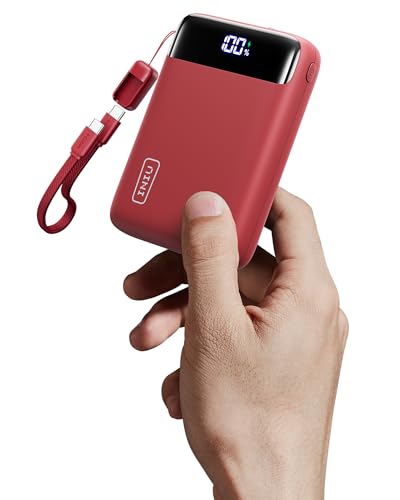
- Substantial 20,000mAh battery capacity in a compact 4.1-inch tall chassis
- Detachable USB-C nylon lanyard cord removes the need to pack a separate cable for USB-C devices
- Clear numeric LED battery display eliminates guesswork compared to basic four-dot status lights
- Built-in flashlight adds practical utility for travel, camping, and home emergency kits
Cons
- Maximum 22.5W output is intended for phones and small mobile gear rather than high-wattage USB-C laptops
- Weighs approximately 11 ounces with a 1.2-inch thickness, making it noticeably chunkier than lower-capacity 5,000mAh or 10,000mAh pocket banks
- Apple users with legacy Lightning devices must provide their own compatible cable to use available ports
This INIU 20000mAh portable charger is a high-density, compact battery pack designed for mobile device users who require serious multi-day power backup without hauling an oversized brick. Engineered specifically for everyday commuters, students, business travelers, and outdoor campers, this external battery pairs a substantial 20,000mAh nominal capacity with up to 22.5W of wired fast-charging output. It best suits smartphone owners and mobile device users who want reliable, cord-free convenience when working or traveling away from electrical outlets.
Charging performance centers on its 22.5W maximum output, engineered to shorten recharge times on modern smartphones. According to manufacturer specifications, the unit can recharge a Samsung Galaxy S25 up to 70% or an iPhone 16 up to 60% in approximately 25 minutes, with sufficient internal energy to deliver up to four full phone charges. As with all external batteries, nominal cell capacity differs from actual delivered energy due to standard voltage conversion losses, but the unit incorporates internal thermal sensors to manage heat buildup and maintain steady power delivery.
The physical design prioritizes density and travel-friendly utility, measuring 2.8 by 4.1 by 1.2 inches and weighing roughly 11 ounces (0.69 pounds). A key ergonomic feature is the detachable woven nylon USB-C cable that securely fastens to double as a carrying lanyard. This setup avoids tangled wires in bags and outlasts standard plastic cables. In addition, the casing includes a smart digital LED display that provides a precise, real-time readout of remaining battery percentage, along with an integrated LED flashlight suited for emergencies, blackouts, or finding items inside a deep bag.
Daily operation and transit handling are straightforward thanks to the all-in-one lanyard configuration and single-glance monitoring. The lanyard design lets users attach the pack securely to a backpack loop or slip it comfortably over a wrist while boarding public transit or moving through airport terminals. While the product description indicates that the battery capacity meets standard airport security parameters for carry-on baggage, passengers should always check specific airline and regulatory carry-on guidelines before embarking on a flight.
The most notable limitation of this power bank is its 22.5W power ceiling, which is optimized for smartphones, tablets, and personal accessories rather than charging demanding USB-C laptops at full speed. Furthermore, while the high-density construction keeps the footprint compact, an 11-ounce weight and 1.2-inch profile still create noticeable pocket heft compared to slim 5,000mAh or 10,000mAh packs. Users with older Apple products using Lightning connectors will also need to carry their own charging cables to connect to the secondary ports.
For smartphone users, frequent commuters, and travelers seeking multi-charge endurance combined with an integrated cable and numeric battery monitor, this INIU 20000mAh power bank offers outstanding everyday value. Shoppers who need 45W to 100W laptop charging capabilities or an ultra-thin pocket battery should look toward higher-wattage or lower-capacity alternatives. For dependable, multi-day backup power in a dense footprint with a 3-year warranty, this model is an exceptionally practical portable charger.
The integrated detachable USB-C cable serves a clever dual purpose, functioning both as a dedicated charging cord and as a durable carrying lanyard. Constructed from tightly woven nylon, the cable is built to resist wear and tear far better than conventional rubber-sheathed cords while keeping your charger ready to grab at a moment's notice.
Unlike standard power banks that rely on vague four-dot indicator lights, this model incorporates a digital LED percentage display. The numeric screen shows exact remaining capacity from 1% to 100%, helping you accurately gauge when the battery pack itself requires a recharge before heading out on a trip.
With an integrated LED flashlight and a high-density 20,000mAh battery reserve, this charger serves reliably as an emergency-kit companion or outdoor backup power supply. The flashlight offers quick illumination during roadside vehicle repairs, camping excursions, or unexpected household power interruptions.
The high capacity is geared to deliver multiple phone top-ups over several days of transit without searching for wall outlets. While its capacity is designed to align with common airline cabin restrictions, travelers should always confirm specific carrier policies regarding lithium battery carry-on limits prior to travel.

Pros
- Four built-in cables eliminate the need to carry separate cords for different device types
- Slimmer 19mm profile makes high-capacity 20,000mAh storage easier to carry than thicker conventional bricks
- Up to 22.5W fast-charging output delivers rapid power to supported smartphones
- Integrated cable doubles as a practical lanyard strap for quick handling and bag attachment
- Two additional open ports allow simultaneous charging across multiple personal electronics
Cons
- Weighs roughly 0.76 pounds, making it heavier than lower-capacity 5,000mAh or 10,000mAh pocket chargers
- Does not deliver the higher wattages required for USB-C laptop charging
- Built-in cables are permanently attached and cannot be replaced individually if worn out
The VRURC 20000mAh Portable Charger is an all-in-one mobile power solution built for users who want substantial battery backup without packing loose charging cords. Designed specifically for commuters, frequent travelers, students, and busy families, this unit eliminates cable clutter by integrating four essential connectors directly into the frame: USB-C, a Phone connector for Apple devices, Micro-USB, and USB-A. Alongside these tethered cords, the battery pack includes two auxiliary ports (one USB-A and one USB-C), creating a versatile charging hub capable of powering multiple devices simultaneously while away from wall outlets.
Charging capability centers around a 20,000mAh nominal capacity and manufacturer-rated 22.5W low-temperature fast charging. According to product specifications, this output level can charge supported smartphones up to 50 percent in approximately 30 minutes, providing an estimated 3 to 4 full phone charges over its cycle. The charger supports mainstream mobile hardware, including Apple iPhones, Samsung Galaxy and Google Pixel phones, iPads, e-readers, and wireless headphones. Buyers should keep in mind that nominal battery capacity represents total internal cell rating rather than guaranteed delivered energy, as voltage conversion and thermal factors naturally affect total output.
In terms of physical design, this upgraded model prioritizes a thinner profile compared to bulky traditional 20,000mAh bricks. Measuring 6.14 by 2.75 by 0.75 inches and weighing roughly 0.76 pounds, its 19mm thickness makes it noticeably sleeker to hold and slip into a travel bag. The casing features a Sky-Blue finish with molded channels that keep each built-in cable neatly tucked away when not in use. Additionally, the integrated Micro-USB cord is reinforced to double as a carrying strap, enabling users to carry the battery in hand or loop it directly onto a backpack clip.
Daily operation and recharging are simple and intuitive. Connecting a device requires only unseating the matching integrated cable and plugging it in, or inserting a personal cable into one of the open ports. To recharge the power bank itself, users can plug the built-in USB-A cable directly into a standard USB wall adapter, car charger, or powered computer port without hunting for a separate input lead. This self-contained setup proves especially helpful during airport layovers, road trips, and outdoor festivals where misplaced cords can disrupt your routine.
There are several realistic limitations to consider before purchasing. While the 22.5W output is fast enough for modern smartphones, wireless earbuds, and smaller tablets, it does not support the higher wattages needed for USB-C laptops. Furthermore, at over three-quarters of a pound, it has noticeable heft compared to lightweight 5,000mAh or 10,000mAh emergency pocket chargers. Users should also note that tethered cables cannot be individually replaced if damaged, meaning you would have to rely on the external open ports if an integrated cord experiences wear over time.
The VRURC 20000mAh Portable Charger is best suited for smartphone users, travelers, and multi-device owners who value all-in-one convenience and high-capacity backup above absolute minimal weight. It is an ideal fit for daily commutes, flights, and weekend camping trips where keeping cords organized is essential. Shoppers needing high-wattage laptop charging or ultra-compact pocket power should look toward dedicated high-output power banks or mini batteries, but for all-in-one mobile convenience, this model provides excellent functional value.
The VRURC portable charger features four integrated cables: USB-C, Phone, Micro-USB, and USB-A. This combination covers modern Android devices, Apple electronics, legacy accessories, and direct power bank recharging without requiring any external cords.
For extra flexibility, the chassis also provides two standalone ports, consisting of one USB-C port and one USB-A port. This configuration allows you to connect longer third-party cables or share battery power across several devices at the same time.
At 0.75 inches (19mm) thick and weighing approximately 0.76 pounds, this battery pack is engineered to be roughly 33 percent slimmer than older 20,000mAh power banks. Its built-in cable lanyard adds practical carrying convenience by hooking onto bags or staying secure in hand.
With a 20,000mAh capacity, this power bank is well suited for travel on planes, trains, and road trips. Travelers should always check current airline and regulatory carry-on policies regarding lithium battery ratings prior to departure.


Pros
- Integrated 100W AC outlet powers small electronics that require standard two-prong or three-prong plugs
- Bidirectional 65W USB-C PD port supports laptop charging and recharges the bank in 1.5 hours
- Listed 98Wh energy rating complies with standard 100Wh airline carry-on limits
- Four versatile output ports accommodate both modern USB-C gear and legacy USB-A accessories
Cons
- AC outlet output is capped at 100W, making it unsuitable for high-draw heating elements or large appliances
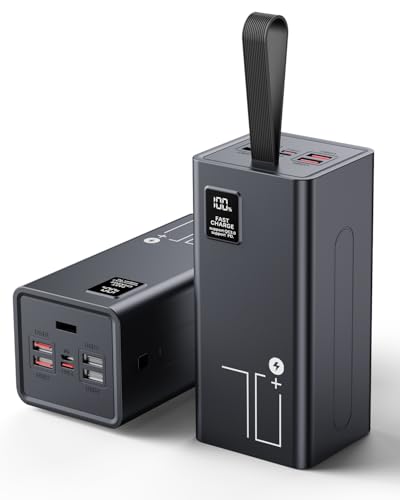
- The 6.7 x 2.6 x 2.6-inch tower design is bulkier than flat, pocket-sized smartphone power banks
- Achieving the 1.5-hour recharge time requires a separate 65W USB-C wall adapter not detailed as included
The Paopaoyu 100W AC Outlet Portable Power Bank is a versatile high-capacity backup charger engineered for remote workers, business travelers, campers, and emergency home backup kits. Combining an integrated AC socket with modern USB Power Delivery ports, this unit eliminates complete reliance on wall plugs when working away from a desk. It provides substantial off-grid energy in a standalone tower format, making it particularly useful for keeping essential mobile gear operational during flights, road trips, field assignments, or unexpected electrical outages.
Equipped with a listed nominal capacity of 27,000 mAh and an energy rating of 98Wh, this power bank delivers multi-device flexibility through four distinct output ports. The primary feature is a 100W AC outlet capable of handling portable electrical appliances that draw less than 100 watts. For modern mobile electronics, a bidirectional 65W USB-C Power Delivery port provides high-speed charging for compatible laptops, tablets, and smartphones. Additional connectivity includes an 18W USB-A port and a 12W USB-A port, allowing users to power cameras, handheld devices, and older mobile accessories without carrying separate adapter plugs.
In terms of build and layout, the Paopaoyu charger adopts a block-style tower aesthetic measuring 6.7 by 2.6 by 2.6 inches. This structured footprint keeps the AC outlet and USB array easily accessible on desktop workspaces, airline tray tables, or camp tables while minimizing horizontal surface clutter. Because the battery capacity is listed at 98Wh, the unit falls just beneath the general 100Wh limitation enforced by the FAA and TSA for passenger carry-on baggage. While the column shape is too substantial for pocket carry, it slips neatly into commuter backpacks, camera cases, and emergency prep bags.
Recharging the power bank is efficient thanks to the 65W input capability on the USB-C port, which the manufacturer states can replenish the 27,000 mAh battery in approximately 1.5 hours when connected to a compatible high-wattage power adapter. Operating connected devices is largely plug-and-play, allowing power delivery across USB-A, USB-C, and AC connections depending on total demand. Everyday operation remains straightforward whether positioned on an airport terminal bench, an office desk away from wall sockets, or an outdoor picnic table.
Prospective buyers must recognize the operational limits of a 100W AC inverter. Electrical appliances requiring sustained or surge power above 100 watts, such as household hair dryers, electric kettles, or high-draw tools, will trigger the built-in overload protection mode. Furthermore, achieving the advertised 1.5-hour recharge turnaround necessitates a separate 65W USB-C wall charger. While the 98Wh energy rating complies with general airline carry-on guidelines, individual carrier policies can vary, and actual delivered energy will reflect standard voltage conversion losses and AC inversion efficiency.
For mobile professionals, frequent flyers, outdoor enthusiasts, and emergency planners who need reliable AC and 65W USB-C power in a single transportable package, the Paopaoyu 100W AC Power Bank offers strong utility. Shoppers looking strictly for a slim, pocket-friendly phone battery may prefer smaller 5,000 mAh or 10,000 mAh power banks. However, if your gear kit demands an AC socket and laptop-grade USB-C output without exceeding airline capacity limits, this versatile multi-port unit represents a practical and capable choice.
The Paopaoyu power bank provides four dedicated outputs to accommodate both modern USB electronics and standard AC wall plugs. The 100W AC outlet handles laptops, camera battery chargers, and compact personal appliances drawing under 100W. The bidirectional USB-C port supports 65W Power Delivery for both charging compatible laptops and rapidly recharging the power bank itself. For legacy devices, an 18W fast-charge USB-A port and a standard 12W USB-A port provide dedicated connections for smartphones, earbuds, and accessories.
Safety architecture on this power bank includes FCC, CE, and RoHS certifications alongside built-in protection against overcharging, overvoltage, overcurrent, and short circuits. If an attached device exceeds the 100W threshold on the AC outlet, an automatic safety shutoff activates to protect the battery and internal inverter. With an explicit energy rating of 98Wh, the battery bank is designed to comply with standard TSA and FAA passenger carry-on thresholds under 100Wh, though travelers should always verify specific carrier guidelines before flying.
Frequently Asked Questions
What is the maximum watt-hour limit for a power bank on a flight?
A portable charger must not exceed 100 watt-hours (Wh) to travel without airline pre-approval. Aviation authorities like the FAA permit power banks rated at 100Wh or less in carry-on luggage. Batteries between 101Wh and 160Wh require airline approval, while anything above 160Wh is strictly prohibited.
Are 20000mAh portable chargers allowed on airplanes?
Yes, standard 20000mAh battery packs are generally permitted in carry-on baggage. Most 20000mAh power banks operate at 3.7 volts, equaling roughly 74 watt-hours, well under the 100Wh restriction. Models like the INIU 20000mAh and VRURC 20000mAh feature flight-approved capacities that pass security checks. Always ensure the capacity label remains legible on the casing.
Can an oversized battery pack like a 38800mAh charger be brought on a plane?
No, high-capacity chargers around 38800mAh are barred from passenger flights. At nominal voltage, a 38800mAh battery equals roughly 143Wh, exceeding the standard 100Wh carry-on limit. Products like the RGVOTA 38800mAh external battery explicitly state in their specifications that they cannot be carried on flights. Travelers must leave these heavy packs at home.
Are power banks allowed in checked luggage?
No, spare lithium-ion power banks are strictly prohibited in checked baggage. Aviation regulations mandate that all external battery packs remain in carry-on luggage within the passenger cabin. Cabin crews can respond quickly if a lithium cell malfunctions during transit. If you gate-check your carry-on bag, remove all power banks first.
Can you bring a laptop power bank with an AC outlet on a plane?
Yes, you can bring a laptop power bank with an AC outlet if its capacity is under 100Wh. The Paopaoyu 27000mAh unit features a 100W AC port and 65W USB-C output while maintaining a 98Wh rating to comply with TSA limits. You can also view the best Anker power bank with wall plug for direct terminal charging. Both options keep travel gear powered.
How do you calculate watt-hours if only mAh is printed on the charger?
Multiply the milliamp-hour rating by nominal voltage (usually 3.7V) and divide by 1,000. For instance, a 10000mAh charger equals 37Wh, while a 20000mAh model equals roughly 74Wh. This calculation confirms which power bank is allowed in flight before you pack. Security personnel use this metric to verify carry-on compliance.




Write Your Review
No reviews yet. Be the first to share your experience!