


Sitting at a crowded airport departure gate with a dead phone screen creates immediate stress for any traveler. Many flyers ask are portable power banks allowed on airplanes before packing their bags, and aviation regulations allow them exclusively in carry-on baggage when their capacity remains at or below 100 watt-hours (Wh). Battery capacity and watt-hour ratings represent the most critical purchase criteria for flying safely, forcing buyers to weigh maximum backup energy against strict airline limits. Massive batteries can keep devices powered for days off-grid, but packs exceeding airline limits face confiscation at security checkpoints.
Understanding specific hardware details helps you select a travel-friendly external charger that delivers fast charging without airport delays. Models like the UGREEN 20000mAh Qi2 15W Power Bank provide airline-compliant charging with integrated cables, whereas oversized units like 40,000mAh or 50,000mAh external bricks explicitly cannot fly. To evaluate your daily charging requirements versus travel rules, check our detailed comparison of power bank features. Comparing listed watt-hours, USB Power Delivery outputs, and carry-on dimensions ensures you stay powered from takeoff to landing.

Pros
- Features a standard 110V/130W three-prong AC outlet for running devices that require traditional wall power
- 99.9Wh energy rating complies with airline carry-on capacity limits for lithium-ion battery packs
- Digital LED display eliminates guesswork by showing exact remaining battery percentage
- Sturdy aluminum alloy casing provides superior protection compared to plastic battery packs
Cons
- USB-C port output is limited to 20W, meaning higher-wattage laptops must be charged using their original AC brick via the 110V outlet
- Recharging the power bank requires the dedicated 19V/2A DC input rather than standard USB-C charging
- Weighing 2.56 pounds, it is significantly heavier than single-purpose smartphone battery packs
The Volessence 27000mAh AC 130W Laptop Charger is a heavy-duty portable power bank and travel battery pack designed to power laptops, small household electronics, and mobile devices without access to a wall socket. Featuring an integrated 110V AC port capable of delivering up to 130W alongside traditional USB outputs, this unit best serves business travelers, outdoor campers, students, and CPAP users requiring off-grid emergency power. By incorporating a standard three-prong wall outlet directly into the battery pack, it solves the problem of powering equipment that lacks native USB-C charging capability.
In terms of output performance, the battery pack provides a nominal capacity of 27,000mAh with a 99.9Wh energy rating. For mobile electronics, it offers one 20W USB-C Power Delivery port and two 18W Quick Charge 3.0 USB-A ports, enabling simultaneous charging for up to four connected devices. According to manufacturer estimates, the battery provides roughly 5.2 charges for an iPhone 15, 1.5 charges for a 13-inch MacBook Air, or 3.8 charges for a Nintendo Switch. Actual delivered energy will naturally vary depending on device efficiency, active background tasks, and standard conversion losses inherent to the built-in AC inverter.
The physical construction centers on a premium aluminum alloy shell that aids in thermal management while protecting the internal lithium-ion polymer cells from impacts. Measuring 6.5 by 5.98 by 1.57 inches and weighing 2.56 pounds, it delivers substantial power in a manageable footprint that easily packs into a carry-on or work bag. A prominent numeric LED display replaces standard multi-dot indicators, providing real-time tracking of the exact remaining charge so you are never left guessing about available capacity.
Recharging the unit is managed through a DC 19V/2A input port, which the manufacturer states restores full capacity in approximately 3.5 hours. Because the battery energy is rated at 99.9Wh, it sits just below the 100Wh airline limit established by the FAA and TSA for carry-on electronics, making it suitable for domestic and international flights without mandatory airline declarations. For medical backup, the manufacturer estimates the pack can power a ResMed AirSense 11 for around 2.5 hours with the humidifier on, or over 10 hours on a compact travel unit like the AirMini without humidification.
Despite its extensive versatility, this power bank comes with practical limitations. The native USB-C port is capped at 20W, which is ideal for smartphones and basic tablets but insufficient for fast-charging modern laptops directly via USB-C; laptop users will need to plug their OEM AC adapter into the 110V socket. Additionally, at over 2.5 pounds, this is an equipment-grade battery intended for bag carry rather than an everyday pocket power bank, and recharging relies on a dedicated DC adapter rather than universal USB-C cables.
This AC portable charger is an excellent choice for travelers, CPAP patients, and mobile professionals who specifically need a reliable 110V plug away from home for devices rated under 130W. Shoppers looking solely to charge a USB-C laptop directly at 65W or 100W without carrying an AC wall brick, or those who want an ultra-light pocket charger, should opt for a dedicated high-wattage USB-C PD power bank instead.
The core highlight of this power bank is its built-in 110V AC outlet, which provides up to 130W of continuous power for appliances and electronics rated under that threshold. This makes it compatible with laptops, small projectors, desk lamps, mini printers, and compact travel appliances that require a standard wall plug.
For mobile charging, the device provides three dedicated DC outputs: one USB-C Power Delivery port rated for up to 20W, and two Quick Charge 3.0 USB-A ports rated for up to 18W each. The multi-port layout supports simultaneous charging across four devices, allowing users to keep a laptop running on AC while powering a phone, tablet, and wireless earbuds simultaneously.
With a rated capacity of 99.9Wh, this power bank complies with standard FAA and TSA carry-on regulations, which generally limit carry-on lithium-ion batteries to 100Wh or less without special airline pre-approval. This allows air travelers and digital nomads to transport significant backup power in their cabin baggage legally and safely.
For emergency readiness, the unit provides critical backup runtime for CPAP machines during power outages or camping trips. The manufacturer estimates runtimes of roughly 2.5 hours on a ResMed AirSense 11 with the humidifier enabled, and up to 10 or more hours on travel-sized CPAP machines like the AirMini, making it a valuable safety net when off-grid.

Pros
- Enormous 50,000 mAh battery capacity delivers days of off-grid power away from wall outlets
- Delivers up to 22.5W fast charging via USB-C and USB-A with PD and QC 4.0/3.0 support
- Charges up to three devices simultaneously to keep phones and accessories powered together
- Clear LED digital percentage readout eliminates guesswork about remaining battery level
- Backed by a 365-day replacement guarantee and includes a USB-C cable in the box
Cons
- Not permitted on commercial passenger airplanes due to airline lithium battery capacity restrictions
- Noticeably heavy at 1.43 pounds (21.6 ounces), making it too bulky for everyday pocket carry
- Recharging a 50,000 mAh battery via the 18W USB-C input requires a lengthy overnight charging session
The OHOVIV 50000mAh Portable Charger is an ultra-high-capacity external battery pack engineered primarily for extended off-grid use, road trips, outdoor camping, and emergency home readiness. Built for users who need multiple days of mobile power without access to an electrical outlet, this heavy-duty unit supplies reliable backup power for smartphones, tablets, smartwatches, and small electronic accessories. It is an ideal option for campers, outdoor enthusiasts, remote field workers, and households assembling severe-weather preparedness kits.
Charging capability centers on a maximum output of 22.5W, supporting both Power Delivery (PD) and Quick Charge 4.0/3.0 fast-charging protocols. According to the manufacturer, this level of output can charge an iPhone 14 from zero to 55 percent in approximately 30 minutes via the fast-charging USB-C port. The battery pack features three output ports in total - one bidirectional USB-C port (supporting 18W input and up to 22.5W output) and two USB-A ports rated up to 22.5W - allowing up to three devices to charge at the same time. Shoppers should note that 50,000 mAh represents the nominal internal battery capacity, and actual delivered energy to connected devices will vary depending on normal voltage conversion losses and device charging limits.
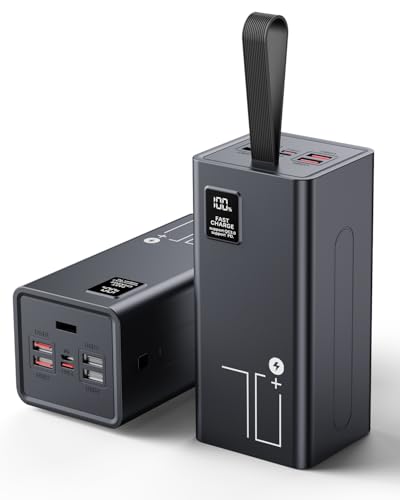
In terms of physical design, the power bank is encased in a sleek Space Black housing measuring 5.38 by 2.75 by 1.6 inches and weighing approximately 1.43 pounds (21.6 ounces). The primary hardware highlight is the front-facing smart LED digital display, which accurately indicates the remaining battery percentage instead of relying on ambiguous four-dot indicator lights. While the unit maintains a relatively compact footprint for a 50,000 mAh battery pack, its 1.6-inch thickness and substantial weight mean it is best stored in a backpack, vehicle glove compartment, or emergency bag rather than carried in a pocket.
Daily operation and device management are completely straightforward. Connecting a phone or accessory via USB-C or USB-A initiates charging automatically, while the digital screen gives immediate feedback on available power reserves. Recharging the power bank is handled through the 18W USB-C input port. Given the massive 50,000 mAh capacity, replenishing the pack from empty requires an extended charging session, making an overnight recharge with a dedicated fast wall charger the most practical routine. The package includes the power bank, a USB Type-C charging cable, a user manual, and a manufacturer 365-day replacement guarantee.
The most important limitation of the OHOVIV 50000mAh Portable Charger is that it is explicitly prohibited on commercial passenger aircraft. Federal and international airline regulations strictly limit lithium carry-on batteries (typically capping them at 100 watt-hours without special carrier approval), and a 50,000 mAh capacity exceeds these thresholds. Furthermore, with a maximum single-port output of 22.5W, this charger is designed for mobile phones and smaller gadgets rather than high-wattage USB-C laptops. Connecting three devices at once also shares the internal power distribution, which reduces individual port speeds.
This battery pack is strongly recommended for road travelers, campers, outdoor workers, and emergency preppers who prioritize maximum stored power over pocket portability and do not intend to fly with their battery. Commuters and airline passengers should look toward smaller 10,000 mAh to 20,000 mAh airline-compliant options instead. For ground-based situations where staying powered for days is essential, the OHOVIV 50000mAh power bank delivers exceptional capacity, versatile multi-port charging, and convenient digital monitoring.
A nominal capacity of 50,000 mAh provides an exceptionally large reservoir of stored energy, making this battery pack capable of keeping smartphones and small electronic devices powered through extended power outages or week-long camping trips. However, nominal cell capacity should never be confused with guaranteed delivered energy, as standard circuit conversion losses occur during the step-up and step-down of voltage across USB connections.
Travelers must be aware that the manufacturer explicitly notes this 50,000 mAh portable charger is not allowed on airplanes. Commercial airline and regulatory rules regarding lithium-ion batteries generally place carry-on limits at 100 watt-hours (Wh), and this pack comfortably exceeds that threshold. As a result, this product is intended strictly for ground-based travel, road trips, vehicle camping, and home emergency preparedness.
Pros
- Substantial 40,000 mAh listed capacity delivers long-lasting power for extended off-grid use and home emergencies.
- Bidirectional USB-C port supports 22.5W fast output and 20W recharge input for efficient power delivery.
- Charges up to three devices simultaneously via dual USB-A ports and one USB-C connection.
- Built-in emergency LED flashlight and five-stage status indicators provide convenient operational feedback.
Cons
- Exceeds standard airline battery capacity limits and is explicitly not allowed on commercial flights.
- Maximum 22.5W output is designed for phones and tablets, lacking sufficient wattage to power standard laptops.
- Secondary Micro-USB input recharges slower than the dedicated 20W USB-C input.
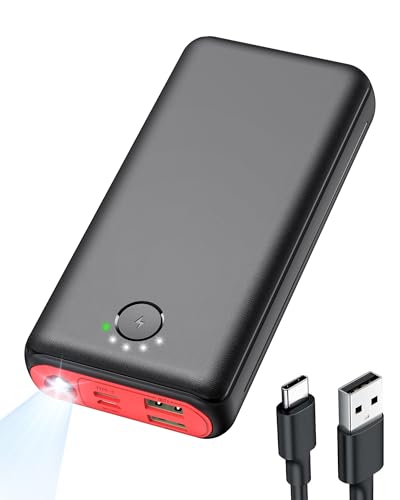
The RONEGN 40000mAh Portable Charger is a heavy-duty external battery pack engineered for users who require extended power reserves away from wall outlets, such as campers, road-trippers, and households preparing for emergency weather outages. Built for multi-day dependability, this power bank focuses on high stored battery volume rather than airline portability, making it a dedicated backup solution for outdoor adventures and home disaster readiness.
For charging performance, the power bank delivers up to 22.5W of power through its bidirectional USB-C port while supporting modern protocols including USB Power Delivery 4.0 and Quick Charge 4.0. According to the manufacturer, this 22.5W output allows a compatible iPhone 15 to charge from zero to 60 percent in roughly 30 minutes. Across its three total outputs, consisting of two USB-A ports and one USB-C port, the charger can power up to three devices simultaneously, accommodating smartphones, tablets, smartwatches, and Bluetooth headphones without the need for multiple wall adapters.
Measuring 5 by 3 by 1 inches, the unit houses its large battery pack within a black shell finished with a textured non-slip grain pattern that improves grip during transport. A practical feature for camping and emergency kits is the built-in high-brightness LED flashlight, which offers quick illumination during power outages. Operational monitoring is handled through five LED indicator lights: four lights communicate remaining energy in 25 percent increments, while the fifth light illuminates green to verify active fast-charging operation.
Recharging the internal battery is straightforward thanks to dual input ports, allowing users to replenish the unit via a modern 20W USB-C input or a secondary Micro-USB connection. A USB to USB-C cable is included in the package, making it easy to pair with an existing fast-charging USB wall adapter. Because of the substantial 40,000 mAh capacity rating, using a 20W USB-C PD power adapter is recommended to achieve the fastest recharge turnaround before heading out on multi-day excursions.
A critical limitation of this power bank is travel compliance: the manufacturer explicitly notes that 40,000 mAh battery packs are not permitted on commercial airplanes due to standard aviation safety regulations. Furthermore, while the 22.5W maximum output is optimized for smartphones and small tablets, it does not supply the higher wattage required to charge standard USB-C laptops. Connecting three devices simultaneously will also distribute output power across the ports, reducing per-device charging speeds compared to single-device charging.
Buyers looking for dependable, extended power backup for outdoor recreation, road trips, or storm survival kits will find strong value and utility in this RONEGN charger. Frequent air travelers should look for smaller 10,000 mAh to 20,000 mAh models that conform to airline carry-on requirements. For ground-based travel and emergency preparedness where battery capacity and multi-device convenience take priority, this charger provides a robust and economical power reserve.
The RONEGN power bank features a versatile port configuration designed to handle both modern and legacy charging setups. Output capabilities include two standard USB-A ports alongside a bidirectional USB-C port capable of up to 22.5W fast output, accommodating multiple devices like phones, earbuds, and handheld electronics simultaneously.
Recharging flexibility is supported through dual inputs, offering a 20W USB-C input for faster recovery alongside a Micro-USB input for users with existing legacy cables. The integrated five-light LED array provides instant feedback on charge status, including a dedicated green indicator that confirms when fast-charging protocols such as PD 4.0 or QC 4.0 are actively engaged.
Travelers should note that this 40,000 mAh power bank exceeds the 100 watt-hour threshold typically enforced by commercial airlines and regulatory agencies for passenger flights. The manufacturer explicitly highlights that this high-capacity unit is not allowed on airplanes, meaning it should be reserved for road trips, camping, and stationary emergency kits rather than air travel.
The power bank includes a built-in multi-protection safety system designed to safeguard connected devices against overcharging, overcurrent, and related electrical faults during extended charging sessions. As with all high-capacity lithium battery packs, it should be kept away from excessive heat and inspected regularly when stored in home emergency kits.

Frequently Asked Questions
What is the maximum watt-hour limit for power banks on airplanes?
The standard limit set by the FAA and TSA is 100 watt-hours (Wh) per battery without requiring special airline approval. Most commercial airlines allow power banks rated at 100Wh or less in carry-on bags across domestic and international routes. Batteries between 101Wh and 160Wh require explicit airline permission, while anything above 160Wh is completely prohibited on passenger aircraft. Travelers should always check the physical rating label on the battery casing before boarding.
Can you pack a portable charger in checked luggage?
No, lithium-ion power banks and spare battery packs are strictly prohibited in checked luggage by all major airlines. Aviation safety regulations require external batteries to remain in carry-on baggage inside the passenger cabin where flight crew can rapidly address any thermal incidents. Placing a power bank in a checked bag risks baggage inspection delays, confiscation, or removal from the flight.
Are 40,000mAh and 50,000mAh power banks allowed on airplanes?
No, power banks with capacities of 40,000mAh or 50,000mAh exceed airline carry-on limits and are not permitted on commercial flights. Large battery packs such as the OHOVIV Portable Charger Power Bank 50000mAh,PD and the Portable Charger Power Bank 40000mah Fast Charging explicitly note in their specifications that they are not allowed on airplanes. At typical 3.7V cell voltages, a 40,000mAh pack equates to roughly 148Wh and a 50,000mAh pack reaches 185Wh, placing them well over the standard 100Wh limit.
Can you take an AC outlet laptop power bank on a plane?
Yes, as long as the battery pack lists a capacity rating under 100 watt-hours. For instance, the Volessence 27000mAh AC 130W Laptop Charger provides a 110V AC outlet and lists a 99.9Wh capacity specifically engineered to comply with FAA carry-on limits without requiring special declarations. It allows travelers to run or charge compatible laptops and small medical devices up to 130W directly from an overhead seat.
What features should you look for in a flight-approved portable charger?
An ideal travel power bank balances maximum compliant capacity, versatile charging ports, and integrated convenience. The UGREEN 20000mAh Qi2 15W Power Bank exemplifies this balance by offering a 20,000mAh flight-friendly capacity, magnetic Qi2 wireless charging, and an integrated 30W USB-C cable that doubles as a lanyard. Travelers who prefer leaving extra charging adapters at home can also consider a power bank with built-in wall plug for streamlined hotel and airport terminal recharging.
How do you calculate watt-hours from mAh to verify airline compliance?
You calculate watt-hours by multiplying milliamp-hours (mAh) by the nominal battery voltage (typically 3.7V for lithium-ion cells) and dividing by 1,000. For example, a standard 20,000mAh external battery pack operates at 3.7 volts, resulting in roughly 74Wh, which easily clears the 100Wh airline threshold. If a power bank does not clearly display its Wh rating or voltage specifications on its exterior shell, airport security officers may reject it during screening.


Write Your Review
No reviews yet. Be the first to share your experience!