


Sudden power outages put refrigerated food and emergency medicines at immediate risk. Modern kitchen refrigerators and compact coolers demand consistent AC wattage alongside high surge capacity to handle compressor startup spikes. Selecting a practical solar power bank for refrigerator setups requires balancing high battery capacity, pure sine wave AC output, and rapid solar input rather than just raw battery storage. Whether you need a whole home coverage solar power bank cell phone setup or an expandable home unit, matching continuous wattage ratings to your appliance power draw makes all the difference during extended outages.
Evaluating these solar power stations involves analyzing battery chemistry like LiFePO4 cells, continuous running watts, surge peak tolerance, and seamless transfer capabilities. Heavy appliances require heavy-duty output, which is why small pocket banks only support handheld accessories while dedicated power stations keep compressors running. Based on listed manufacturer specifications and realistic off-grid power demands, our review highlights capable units ranging from portable 280Wh units to expandable 3584Wh backup systems. You can also explore accessories like a solar power bank holder for organizing auxiliary gear alongside your main setup.

Pros
- Massive 3072Wh capacity paired with durable 4,000-cycle LiFePO4 battery chemistry for long-term reliability
- Dual 100W USB-C PD outputs allow simultaneous fast charging of power-hungry laptops and mobile devices
- Fast 2.2-hour wall recharging minimizes downtime before storms or road trips
- Dedicated TT-30 RV receptacle offers direct compatibility for camper and travel trailer electrical systems
Cons
- Weighs 59.52 pounds, requiring two hands or dedicated equipment to transport comfortably
- Exceeds standard passenger airline carry-on capacity limits, restricting travel to ground transportation
- Substantial physical dimensions require dedicated floor or storage space in smaller living areas
The Jackery HomePower 3000 is a high-output portable power station designed primarily for residential emergency backup, RV road trips, and off-grid remote work setups. Featuring an expansive 3072Wh LiFePO4 battery pack and a 3600W continuous AC pure sine wave inverter (with 7200W surge capability), this unit bridges the gap between portable mobile chargers and whole-home stationary generators. It is tailored specifically for homeowners preparing for storm outages, camper van owners, and professionals needing uninterrupted power for essential communication gear, appliances, and mobile hardware.
Charging performance across personal mobile electronics is driven by two dedicated 100W USB-C Power Delivery ports alongside standard USB-A ports, DC outlets, and heavy-duty AC plugs. The 100W USB-C ports supply enough wattage to charge compatible USB-C laptops, tablets, drones, and modern smartphones at their maximum supported speeds without requiring bulky AC wall bricks. Beyond personal electronics, the massive 3600W continuous output easily supports heavy household appliances. According to manufacturer estimates, the unit can keep a standard refrigerator powered for one to two days or sustain a full collection of home essentials for up to 15 hours.
The build quality incorporates Cell-to-Body (CTB) battery integration, which packages the battery cells directly into the structure to save interior volume. The chassis measures 16.4 by 12.8 by 12 inches and features a honeycomb-style bottom shell designed for enhanced structural rigidity. For home office setups, desktop workstations, and medical appliances, the internal UL-certified uninterruptible power supply (UPS) automatically transfers power within 20 milliseconds or less during sudden grid failures, preventing unexpected shutdowns or interrupted video conferences.
Recharging the 3072Wh internal battery can be completed through several convenient power sources, including standard AC wall receptacles, solar panels, 12V car ports, and gas generators. Plugged into a standard AC wall outlet, the system fully recharges in approximately 2.2 hours, or as fast as 1.7 hours when utilizing combined hybrid AC and DC charging. Users setting up off-grid solar arrays can pair the station with two Jackery SolarSaga 200W panels to reach an 80 percent charge in roughly 9 hours under optimal daylight conditions. Internal ChargeShield 2.0 AI battery management monitors operating parameters to safeguard the long-lasting LiFePO4 cells across their rated 4,000-cycle lifespan.
The most prominent limitation of this system is its sheer physical heft compared to handheld portable chargers. Weighing 59.52 pounds, the unit requires substantial lifting effort and is clearly intended for stationary placement or vehicular transport rather than casual everyday carry. Furthermore, with an energy capacity of 3072Wh, this unit far exceeds commercial airline passenger battery limits, making it strictly prohibited on commercial flights. Shoppers looking purely for a lightweight commuter battery to slip inside a backpack will find this heavy-duty unit far larger than necessary.
The Jackery HomePower 3000 is best suited for homeowners wanting dependable storm resilience, RV campers seeking a built-in TT-30 connection, and outdoor crews operating heavy equipment away from the electrical grid. Those who only require occasional battery top-ups for a smartphone or tablet should choose a compact pocket-sized power bank instead. For buyers needing serious energy storage, rapid device recharging via dual 100W USB-C ports, and reliable appliance support, this portable generator represents a highly capable power investment.
The Jackery HomePower 3000 offers comprehensive output options to support everything from delicate mobile gadgets to heavy-duty appliances. For mobile device users, dual 100W USB-C Power Delivery ports deliver high-wattage charging for compatible laptops, tablets, and smartphones directly from the battery pack without extra adapters. Standard USB-A ports are also included to handle legacy electronics, wireless earbuds, and accessories.
For heavy electrical equipment, the station provides multiple pure sine wave AC outlets alongside a built-in TT-30 RV port, allowing direct plug-in convenience for camper electrical systems. A 12V DC car output is also integrated for running portable coolers, tire inflators, and specialized travel accessories. The UL-certified UPS mode ensures seamless power switching within 20 milliseconds or less, protecting connected hardware from unexpected grid blackouts.
At the core of the Jackery HomePower 3000 is a 3072Wh LiFePO4 battery pack engineered for extended operational lifespans. Unlike conventional lithium-ion cells, the LiFePO4 chemistry is rated for 4,000 complete charge cycles while maintaining at least 70 percent of its initial capacity, supported by ChargeShield 2.0 AI management algorithms to balance charging rates and thermal conditions.
The unit supports rapid recharging through multiple energy pathways. Using a standard AC wall input, the entire 3kWh system replenishes in approximately 2.2 hours, decreasing to 1.7 hours when combining AC and DC charging methods. Off-grid replenishment is supported through 12V vehicle charging, gas generators, or solar setups, with two optional SolarSaga 200W panels replenishing the battery up to 80 percent in approximately 9 hours of strong sunlight.
Pros
- Substantial 48,000 mAh battery capacity delivers extensive reserve energy for multiple recharges away from wall outlets
- Four foldable solar panels provide viable supplemental off-grid replenishment during sunny outdoor excursions
- Built-in array of four charging cables and a wireless surface means users do not need to bring separate wires
- Simultaneous multi-device support allows powering up to seven compatible phones, accessories, or tablets at once
- Bidirectional USB-C port handles both charging the power bank and outputting up to 5V/3A to external devices
Cons
- Substantial 1.57-inch thickness and heavy form factor make it impractical for everyday pocket carry
- Exceeds typical 100-watt-hour commercial airline carry-on thresholds, making it unsuitable for passenger flight travel
- Maximum USB-C output is rated at 5V/3A (15W), which lacks the higher-wattage USB Power Delivery protocols needed for laptops
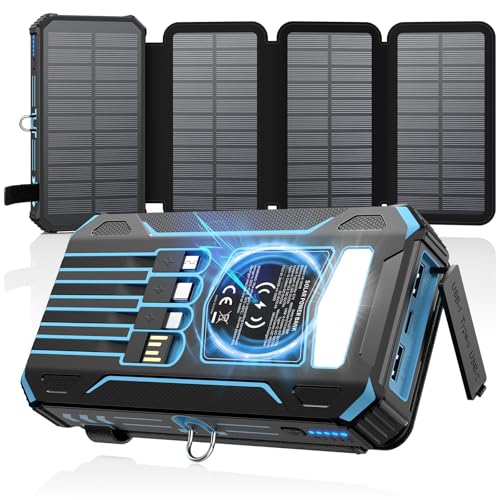
This is a heavy-duty, high-capacity portable solar power bank engineered specifically for outdoor adventures, multi-day camping trips, road travel, and household emergency backup. The SOARAISE 48000mAh model combines a large lithium-polymer battery reserve with a four-panel folding solar array, integrated output cables, standard USB ports, and a wireless charging deck. It best suits outdoor enthusiasts, families on camping trips, and emergency preppers who prioritize maximum stored runtime and standalone charging convenience over lightweight pocket portability.
The central functional advantage of this battery pack is its expansive multi-device power delivery. The manufacturer lists a nominal battery capacity of 48,000 mAh, which provides ample reserve power for repeatedly topping up smartphones, headlamps, tablets, and portable GPS units. Charging output is anchored by a 5V/3A USB-C port, which the manufacturer states can boost an iPhone from 15% to 60% in roughly 30 minutes. In addition to the USB-C port, the pack includes two USB-A output ports, four attached cables (USB-C, Phone connector, USB-A, and Micro-USB), and a top-mounted wireless charging pad. This versatile configuration supports charging up to seven devices simultaneously, making it an effective shared power station for group outings.
In terms of physical build and design, the unit measures approximately 6.38 inches long, 3.43 inches wide, and 1.57 inches thick. The four foldable solar panels unfold outward to maximize sun exposure during basecamp use and fold securely against the thick blue housing when packed. The four integrated cables snap flush into dedicated grooves on the chassis, minimizing clutter and preventing snagging in a backpack. While the thick housing adds noticeable mass, the integrated structure protects the internal cells and keeps all necessary charging connectors attached to the unit at all times.
Daily operation and recharging require an understanding of how large-capacity battery packs function. For routine preparation before a trip, replenishing the battery bank via the bidirectional 5V/3A USB-C input from a standard wall adapter is the fastest and most dependable method. The four high-efficiency solar panels serve as a supplemental off-grid charging solution, capturing ambient sunlight while resting at a campsite or strapped to gear. Given the immense 48,000 mAh capacity, direct solar exposure is intended to extend operating time and provide emergency top-ups rather than rapidly recharging the depleted battery pack from zero to full.
Buyers must consider a few distinct trade-offs before choosing this model. The most significant restriction involves air travel: a nominal 48,000 mAh battery capacity far exceeds standard FAA and airline carry-on limits, which typically cap unapproved lithium-ion consumer batteries at 100 watt-hours (roughly 27,000 mAh). Consequently, this battery pack is strictly an overland, road-trip, camping, and home-emergency device rather than a flight companion. Additionally, while the 5V/3A (15W) output is sufficient for rapid phone charging, it does not support higher-wattage USB Power Delivery (PD) protocols required to power modern USB-C laptops.
The SOARAISE 48000mAh Solar Power Bank is highly recommended for car campers, overlanders, cabin owners, and emergency-kit planners who want an all-in-one charging station that requires no loose cords. Users who need an ultra-lightweight commuter battery, a fast laptop charger, or an airline-approved travel companion should choose a smaller, dedicated USB PD power bank instead. For off-grid preparedness and multi-device wilderness utility, its combination of folding solar panels, integrated cables, and massive battery capacity provides solid practical value.
The SOARAISE power bank stands out from conventional single-panel solar chargers by incorporating four foldable high-efficiency solar panels. According to manufacturer specifications, this multi-panel array gathers solar energy up to five times faster than standard single-panel alternatives, providing meaningful trickle charging when completely disconnected from grid power during long outdoor stays.
Versatility is further enhanced by its ability to power up to seven compatible devices at once. With four integrated cords (USB-C, Phone, USB-A, and Micro-USB), two USB-A output ports, a bidirectional USB-C port, and a wireless charging pad, the unit can simultaneously supply power across modern and legacy electronics without requiring you to carry a separate pouch of charging cables.
When planning trips, travelers must note that the 48,000 mAh capacity places this battery pack well above the standard 100-watt-hour threshold enforced by most commercial airlines for carry-on luggage. Because lithium-polymer power banks of this size are prohibited on commercial flights, this charger is intended strictly for ground-based travel, including road trips, RV outings, and backpacking expeditions.
Measuring approximately 1.57 inches thick, this model prioritizes rugged reserve capacity over pocket-friendly dimensions. It is best carried inside a backpack side sleeve, gear tote, or glove compartment where its integrated cables and durable casing can serve as a dependable, self-contained basecamp charging hub.

Pros
- Enormous 3584Wh capacity and 3600W output comfortably power demanding 120V and 240V residential appliances
- Long-lasting LFP battery chemistry rated for 6,000 cycles and up to a 10-year service life
- Extremely fast 2-hour hybrid recharge capability minimizes downtime between outages
- Built-in wheels and collapsible pull handle make moving the 77-pound unit much easier across flat ground
- Plug-and-play manual transfer switch compatibility enables straightforward home circuit integration
Cons
- Substantial 77.16-pound weight requires two people for safe lifting into vehicle trunks or up staircases
- Massive 3584Wh energy capacity far exceeds FAA passenger flight limits, making it strictly ground-travel only
- Demands significant dedicated storage space with dimensions measuring 15.2 x 12.2 x 19.3 inches
The Jackery HomePower 3600 Plus is a high-capacity portable power station engineered primarily for residential emergency backup, extended power outages, off-grid cabins, and mobile workstations. Designed to bridge the gap between portable battery packs and permanent standby generators, this unit combines a massive 3584Wh lithium iron phosphate (LFP) energy capacity with a robust 3600W AC inverter. It directly addresses the needs of suburban homeowners, rural property managers, overland travelers, and remote professionals who must keep vital equipment running without the noise, fumes, or maintenance demands of traditional gas-powered alternatives.
In terms of electrical output and capacity, the power station provides enough sustained energy to manage heavy-draw household essentials. The 3600W inverter supports demanding appliances such as well pumps, space heaters, full-sized refrigerators, and power tools, with the capability to reach 7200W output and dual 120V/240V delivery when paired with a second unit. The integrated 3584Wh capacity can also be scaled modularly up to 21kWh per unit or up to 43kWh in multi-unit setups, allowing users to configure custom reserve power based on family size and outage duration.
Durability and safety are centered on automotive-grade cell-to-body engineering and high-temperature-resistant ceramic membrane LFP cells. The manufacturer rates these battery cells for 6,000 operational cycles with an estimated 10-year lifespan, retaining thermal stability tested up to 302 degrees Fahrenheit to mitigate thermal runaway risks. Furthermore, the internal power architecture is rated to function in severe conditions down to -4 degrees Fahrenheit, ensuring that severe winter storms and sub-freezing emergencies do not disable access to stored electricity.
Setting up and recharging the unit is straightforward thanks to four distinct input methods. Using hybrid AC plus DC charging, the internal battery can replenish from 0 to 100 percent in approximately 2 hours, while standard AC wall outlets and gas generators each achieve a full recharge in roughly 2.5 hours. For off-grid power generation, compatible solar inputs can replenish the battery pack in as little as 4 hours under optimal sunlight, providing a clean daily energy cycle during prolonged grid failures.
Physical portability is balanced against the unit's substantial energy density. Measuring 15.2 x 12.2 x 19.3 inches and weighing 77.16 pounds, this is not a handheld battery pack for casual commutes or backpacks. To mitigate the bulk, Jackery incorporates a luggage-style suitcase layout featuring durable transport wheels and an ergonomic telescopic pull handle, allowing smooth rolling from garages to living spaces. However, lifting the power station into a truck bed or carrying it up steps requires considerable effort, and the 3584Wh capacity strictly prohibits it from commercial airline transport under federal battery regulations.
For homeowners and extended travelers who require substantial, fume-free emergency power without complicated electrical retrofits, the Jackery HomePower 3600 Plus represents a reliable, high-output power reserve. Shoppers needing an ultra-light everyday carry battery for laptops or smartphones should opt for compact USB-C power banks, but those focused on whole-home appliance readiness, job site independence, and rapid replenishment will find this unit exceptionally capable.
The core strength of the Jackery HomePower 3600 Plus lies in its flexible replenishment speeds and substantial energy storage. The base 3584Wh LFP battery pack ensures extended runtimes for critical medical equipment, food preservation, communications hubs, and household lighting during severe blackout events.
Recharging options are versatile, offering four distinct input configurations to fit varying emergency scenarios. When connected via hybrid AC and DC inputs, the power station achieves a full recharge in 2 hours, minimizing preparation time when a major storm approaches. Conventional AC wall charging takes 2.5 hours, a clean solar array recharge requires approximately 4 hours, and standard gas generators can replenish the station in 2.5 hours to save fuel.
For users seeking whole-home resilience, the system supports expansion capabilities reaching up to 21kWh on a single station or 43kWh across multiple linked units. Paired with a compatible manual transfer switch, it enables a quick plug-and-play transition to battery power, providing smooth operational continuity across domestic circuits without complex permanent wiring.

Pros
- Dual 110V AC wall-style outlets provide standard plug-in capability for laptops and electronics under 300 watts.
- Weighs only 5.08 pounds with a built-in top handle, making it exceptionally portable for road trips, campsite use, or car travel.
- Comes bundled with both a household AC wall adapter and a 12V car charging cable right in the box.
- Multiple output options allow powering up to seven devices simultaneously across AC, DC, and USB connections.
Cons
- Lacks modern USB-C Power Delivery ports, requiring users to rely on AC charging adapters or standard USB-A cables for newer devices.
- Inverter is limited to appliances under 300W, making it unsuitable for high-draw heating devices like coffee makers, hair dryers, or space heaters.
- Requires regular top-up recharging every 2 to 3 weeks during storage to prevent the internal battery pack from entering self-protection mode.
The ZeroKor 300W Portable Power Station is a compact, entry-level battery generator engineered for outdoor camping, road trips, and temporary home power disruptions. Built with a 280Wh energy capacity and a 300W rated AC inverter, this unit bridges the gap between handheld pocket power banks and heavy home backup batteries. It suits campers, road trippers, photographers operating drones in the field, and remote workers who need to run standard laptops and mobile gear far from an electrical outlet.
Power distribution is centered around two 110V AC outlets that handle a combined continuous load of up to 300 watts, controlled by a manual power switch. For small electronics, the unit includes four USB ports: one Quick Charge port delivering 5V/3A or 9V/2A profiles, alongside three standard USB ports delivering up to 5V/3A shared. A dedicated DC port provides 9V to 12.6V output at up to 10A for compatible 12V vehicle accessories. These connections easily handle smartphones, tablets, cameras, drones, and laptops drawing under 300 watts. However, high-draw appliances such as coffee makers, toasters, hair dryers, and electric heaters exceed the unit's capacity and cannot be powered.
Weighing 5.08 pounds and measuring 8.5 by 6.7 by 4.1 inches, the power station features a rugged orange housing with an integrated carry handle for quick mobility. The front control face organizes the output ports, the master switch, and battery status indicators for clear visibility in the field. An integrated multi-mode LED light on the housing serves as a camp reading lamp or an SOS flashing beacon during vehicle breakdowns and storm emergencies. An internal intelligent cooling fan automatically activates when operating temperatures rise, keeping noise down during lighter loads.
Recharging the station is adaptable to different travel scenarios through three distinct pathways. The package includes a standard AC wall adapter for home charging and a 12V car charging cable for vehicle recharging during transit. For off-grid recharging, the unit features an internal MPPT controller accepting DC5521 solar inputs between 13V and 23V, though solar panels must be purchased separately. Operating the unit is straightforward: simply activate the main power switch and toggle the manual AC button whenever standard plug power is needed.
Several clear operational limitations should be kept in mind prior to purchase. The power station does not feature native USB-C or USB Power Delivery ports, meaning users with newer USB-C laptops or modern tablets must connect their device's original AC wall charger into the inverter. Additionally, the manufacturer notes that the battery pack requires routine maintenance cycling; leaving it depleted or stored unattended for months may cause it to enter a self-protection state. To maintain battery health, the unit should be recharged at least once every two to three weeks and stored at roughly 60% to 80% capacity.
For outdoor campers, road trippers, and everyday electronics users seeking a lightweight, budget-friendly power hub for phones, cameras, and modest laptops, the ZeroKor 300W Power Station offers strong utility. It delivers real AC plug versatility in a manageable 5-pound package that stows easily in a vehicle trunk. Users requiring direct high-speed USB-C PD charging, support for high-draw heating appliances, or a hands-off emergency battery designed for unattended multi-year storage will be better served by larger power systems.
The ZeroKor power station provides seven output ports to handle a variety of everyday personal electronics. The primary power delivery comes from dual 110V AC outlets delivering up to 300W maximum continuous output. These outlets require manual activation using the front-panel toggle switch to conserve battery reserves when not in use.
Mobile charging is handled by four USB outputs, consisting of one Quick Charge port supporting 5V/3A and 9V/2A alongside three standard 5V/3A USB ports. A 12V DC barrel port capable of 9V to 12.6V at up to 10A provides power for compatible 12V automotive and camping accessories. Because native USB-C ports are omitted, devices requiring USB-C cables should be connected using appropriate USB-A adapters or their standard AC wall charging bricks plugged directly into the AC outlets.
The power station supports three recharging methods to accommodate both home preparation and off-grid travel. Users can recharge via a standard household wall outlet using the included AC wall adapter, or plug into vehicle auxiliary power on the road with the included 12V car charging cable.
For outdoor and camping applications, the power station incorporates an internal MPPT (Maximum Power Point Tracking) charge controller. It connects to compatible solar panels delivering DC5521 output between 13V and 23V. Third-party solar panels must be purchased separately, as one is not included in the standard retail package.
The ZeroKor power station features a built-in Battery Management System (BMS) designed to monitor electrical performance and prevent operational damage. The safety system provides protection against short circuits, overcurrent, overvoltage, and overload situations, while an internal cooling fan regulates internal temperatures during heavy use.
Proper battery care requires avoiding complete battery exhaustion before recharging. To prevent the unit from entering a deep self-protection sleep state, the manufacturer advises topping up the battery every 15 to 20 days when not in regular use and maintaining stored reserves between 60% and 80% capacity rather than storing it empty.
Pros
- Rapid 45-minute recharge to 80 percent minimizes downtime before outdoor excursions or severe weather.
- Durable LiFePO4 battery cells deliver long-term longevity rated for over a decade of regular use.
- Fast sub-10ms transfer switch protects sensitive computers and workstations against data loss during power cuts.
- Robust 1800W AC output with 2600W X-Boost headroom powers both sensitive electronics and heavy appliances.
Cons
- At 26.7 pounds, it requires vehicle transport or two-handed lifting rather than convenient personal carry.
- Not compatible with DELTA 2 Smart Extra Batteries or Delta 3 Series Smart Extra Batteries for capacity expansion.
- Solar panels for off-grid recharging are not included and must be purchased separately.
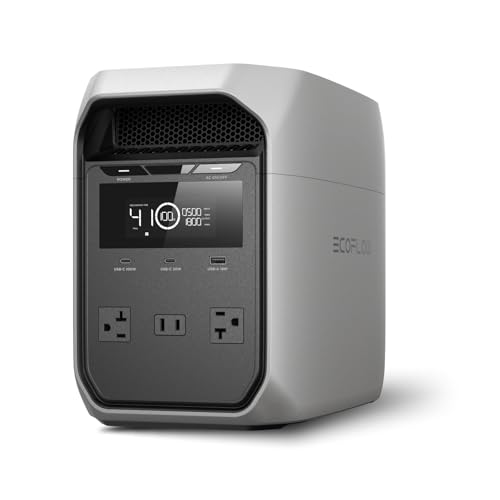
The EcoFlow DELTA 3 Classic is a high-output portable power station engineered to deliver heavy-duty backup electricity for home emergency preparedness, vehicle camping, remote job sites, and off-grid road trips. Built around a 1024Wh battery capacity, this unit bridges the gap between handheld power banks and bulky fuel-powered generators. It is primarily built for users who need to run demanding electronic equipment away from grid power, providing a dependable solution for keeping laptops, communications gear, medical equipment, and appliances operating during power outages or mobile work sessions.
In terms of output performance, the DELTA 3 Classic provides 1800W of continuous AC output with a 3600W surge threshold, allowing it to start and operate power-demanding devices. The onboard X-Boost technology extends operational support up to 2600W for resistive loads, enabling users to run appliances such as microwaves, refrigerators, and portable cooking gear alongside standard workstations. In addition, the system integrates an emergency power switchover rating of under 10ms. This rapid switchover functions as an uninterruptible power supply (UPS) for desktop PCs, personal servers, and sensitive medical devices, ensuring continuous operation without system rebooting or lost data during blackouts.
The build quality relies on lithium iron phosphate (LiFePO4) battery cells housed in an EV-grade cell-to-chassis (CTC) layout. The manufacturer rates these battery cells for more than 10 years of daily usage, protected by an intelligent Battery Management System that continuously tracks voltage, current, and temperature parameters. With physical dimensions of 7.9 x 11.1 x 15.7 inches and an overall weight of 26.7 pounds, the chassis offers a compact footprint relative to its 1024Wh capacity. The solid casing can be comfortably positioned in an RV cabinet, car trunk, or home closet without consuming excessive room.
Recharging the power station is remarkably fast thanks to EcoFlow X-Stream AC charging technology, which can take the internal battery from 0 to 80 percent in roughly 45 minutes using standard wall power. When traveling off the grid, the station accepts up to 500W of solar input, replenishing the battery in as little as 2.5 hours under optimal sunlight when paired with a compatible solar panel. Users can monitor real-time power metrics and control features wirelessly through the EcoFlow mobile app, which allows charging speed adjustments, scheduling, and specialized standby settings such as Storm Alert mode directly from a smartphone.
There are important operational tradeoffs and hardware limits to consider. Weighing 26.7 pounds, this unit is designed for vehicle transport or stationary setup rather than backpack carry or everyday mobility. Furthermore, the manufacturer explicitly indicates that the DELTA 3 Classic model is not compatible with DELTA 2 Smart Extra Battery or Delta 3 Series Smart Extra Battery units, so the 1024Wh capacity cannot be expanded with add-on battery packs. Solar charging panels are also an optional accessory sold separately, which adds to the overall investment for users seeking renewable solar power.
For remote professionals, road trippers, campers, and homeowners seeking a self-contained emergency power system, the EcoFlow DELTA 3 Classic offers an exceptional combination of fast AC charging, durable LiFePO4 cell longevity, and high continuous output. Its ability to power everything from laptops to refrigerators makes it a dependable backup option for unexpected outages. Those looking for an ultralight pocket-sized charger for daily commuting or users requiring an expandable modular battery system should consider smaller portable chargers or expandable power station models instead.
The EcoFlow DELTA 3 Classic stands out for its high-speed wall recharging capabilities. Using standard AC wall power, proprietary X-Stream technology recharges the 1024Wh battery from 0 to 80 percent in approximately 45 minutes, allowing travelers and emergency planners to prepare the station quickly before a road trip or approaching storm.
For outdoor adventurers and sustainable off-grid applications, the unit features a solar charging input supporting up to 500W. When paired with an optional 500W solar panel under optimal direct sunlight, the power station can reach a full recharge in roughly 2.5 hours, providing renewable power independence at campsites or remote cabins.
Designed for home backup integration, the DELTA 3 Classic features a sub-10ms automatic transfer switch. When connected between a household wall outlet and critical equipment, the station seamlessly takes over battery power within 10 milliseconds if the main electrical supply fails, protecting desktop computers, servers, and sensitive gear from sudden shutdown.
Through the EcoFlow companion smartphone app, users can customize power management preferences, view live input and output wattages, set charging time schedules, and activate Storm Alert mode to ensure the station is fully charged and ready whenever local severe weather threatens the electrical grid.

Pros
- High 50,000mAh listed capacity provides extended off-grid energy for multi-day trips and family emergencies
- Convenient built-in USB-C and Lightning cables eliminate the need to pack extra cords
- Supports charging up to 6 devices simultaneously via wired ports, built-in cables, and wireless output
- Rugged outdoor enclosure includes an emergency flashlight, compass, thermometer, and solar backup panel
Cons
- Solar recharging serves strictly as a slow emergency backup rather than a practical primary recharge method
- High capacity and 1-pound weight make it bulkier than standard pocket-sized daily commuting battery packs
- The 50,000mAh rating may raise regulatory hurdles with strict airline carry-on watt-hour limitations
The SOARAISE 50000mAh Solar Power Bank is an outdoor-oriented high-capacity portable charger engineered for multi-device power off the grid. Featuring rugged exterior construction, built-in cables, and a secondary solar collection panel, this unit is aimed primarily at campers, hikers, road trippers, and homeowners building storm emergency kits who require prolonged battery reserve without frequent access to a wall outlet.
On paper, the manufacturer equips this power bank with a 50,000mAh nominal capacity and 22.5W USB-C Power Delivery output. The USB-C port provides bidirectional operation, serving as both an output for fast charging modern smartphones and a rapid input for recharging the internal cells. Alongside the USB-C port, the unit integrates two built-in cords (one USB-C and one Lightning), three additional output ports, and a 15W wireless charging surface. This layout enables simultaneous charging for up to six devices. Users should understand that nominal milliamp-hour ratings reflect internal battery capacity rather than net delivered energy, as voltage conversion and thermal dissipation inherently reduce usable output.
Measuring 6 by 3 by 1 inches and weighing 1 pound, the charger balances heavy-duty capacity with manageable packability. The orange-accented chassis is listed by the manufacturer as waterproof, dustproof, and shockproof to withstand trail drops and foul weather. Beyond charging, SOARAISE integrates a versatile outdoor survival kit directly into the housing, including a 3-mode emergency flashlight, a physical compass, and an ambient thermometer. The surface-mounted solar panel provides passive sunlight capture, making it a functional emergency signal and power station.
In day-to-day operation, the built-in cables streamline use by removing the hassle of carrying loose cords for iPhones or Android devices. Recharging the battery pack is best accomplished via the fast USB-C input using a compatible wall adapter before heading outdoors. While the built-in solar panel provides passive energy harvesting under direct sunlight, solar input is slow due to the compact surface area of a single panel. The manufacturer explicitly identifies solar charging as an emergency backup rather than a primary replenishment method.
Despite its versatility, buyers should weigh specific design tradeoffs. Connecting multiple devices at once divides the internal power circuitry, which reduces individual port speeds compared to single-device 22.5W output. Wireless charging efficiency depends on proper coil alignment and phone case thickness, functioning best through cases under 3 millimeters without metal components. Additionally, although the product marketing notes air travel suitability, travelers should exercise caution regarding commercial airline guidelines. Most major airlines and aviation authorities cap carry-on lithium batteries at 100 watt-hours without special carrier permission, and a 50,000mAh nominal pack typically exceeds that threshold depending on internal cell voltage.
The SOARAISE 50000mAh Solar Power Bank is best suited for outdoor enthusiasts, remote campers, and emergency preppers who want an all-in-one charging station with integrated cables and utility tools. Minimalist commuters seeking an ultra-light pocket charger or business flyers needing guaranteed airline carry-on compliance should consider smaller 10,000mAh or 20,000mAh alternatives. For rugged multi-day outdoor trips where powering several devices from a single rugged brick is the priority, this multi-port charger represents a capable option.
The SOARAISE power bank is built specifically for off-grid conditions with integrated survival utilities. Its built-in flashlight features three illumination modes for navigating dark campsites or signaling in emergencies. Paired with a functional compass and analog thermometer, the pack serves as a multi-purpose tool that consolidates several pieces of outdoor gear into a single shock-resistant, dustproof, and waterproof frame.
The integrated solar panel acts as a passive charging safeguard when electrical outlets are completely unavailable. Because a small single panel generates modest current, solar harvesting is intended strictly for emergency top-offs and prolonged wilderness survival situations. To maintain peak performance, the battery pack should always be fully charged via its 22.5W USB-C input before leaving home.
Device compatibility spans modern smartphones and small electronics across both Apple and Android ecosystems. Wired charging supports fast-charging profiles up to 22.5W via USB-C PD, delivering rapid power to compatible devices including recent iPhone, Samsung Galaxy, and Google Pixel handsets. The built-in Lightning cable directly powers older and standard Apple hardware, while the built-in USB-C cable handles modern USB-C mobile phones and tablets.
Wireless power delivery provides up to 15W of cable-free charging for Qi-enabled devices. Supported phones include iPhone 8 through iPhone 17 series, Samsung Galaxy S and Note lines, Google Pixel models, and compatible wireless charging earbuds. Optimal wireless charging requires center alignment on the pad and phone cases thinner than 3 millimeters without metal plates or kickstands.
Frequently Asked Questions
Can a solar power bank run a full-size kitchen refrigerator?
Yes, but only high-capacity portable power stations with sufficient AC output and surge wattage can run a standard refrigerator. Full-size residential fridges typically require a power station with at least 1000Wh of capacity and 1800W continuous AC output to handle compressor start-up loads. Models like the Jackery HomePower 3000 or EcoFlow DELTA 3 Classic provide the necessary wattage, whereas pocket-sized power banks cannot power household appliances.
What is the difference between running watts and surge watts for refrigerator backup?
Running watts represent the continuous energy needed while the compressor runs, while surge watts account for the momentary spike when the cooling cycle kicks on. A typical refrigerator may pull 150W to 300W during standard cooling but spike up to 1200W or higher at startup. Power stations designed for emergency backup offer surge ratings reaching 3600W to 7200W to prevent shutdown trips during compressor cycling.
How long will a 1000Wh solar power station keep a refrigerator running?
A 1000Wh battery station typically powers an efficient full-size refrigerator for roughly 8 to 14 hours depending on compressor duty cycles. Because refrigerators cycle on and off rather than drawing continuous power, total runtime depends on ambient temperature and door openings. For multi-day emergency backup without grid power, pairing your system with compatible solar panels allows continuous daytime replenishment.
Can small handheld solar power banks power a mini fridge?
No, compact solar chargers cannot run 110V or 12V mini fridges because they lack AC inverters and sufficient voltage. Handheld 48000mAh or 50000mAh solar power banks are designed strictly for DC mobile devices, phones, and tablets via USB-A or USB-C. For personal electronics or tablet charging during outages, consider a reliable solar power bank for iPad and phones while reserving dedicated power stations for refrigeration.
Does an uninterruptible power supply (UPS) mode matter for a refrigerator?
Yes, an integrated UPS mode ensures your refrigerator transitions to battery backup instantly during unexpected grid blackouts. Units with switchover times under 20ms keep the compressor running without interrupting internal cooling cycles or resetting digital temperature controls. This rapid response prevents food spoilage and protects sensitive electronic control boards inside smart refrigerators.
How do solar input limits affect off-grid refrigerator runtime in 2026?
Higher solar input ratings determine how rapidly your battery recharges while actively powering your refrigerator under daylight. If a refrigerator consumes 600Wh per day and your solar panels generate 800Wh in optimal sun, your battery maintains a net surplus. Matching solar input wattage to your daily consumption is essential for sustained off-grid operation throughout 2026.




Write Your Review
No reviews yet. Be the first to share your experience!