


Sitting at a crowded airport terminal with a dying phone battery creates instant travel anxiety, especially when wall outlets are occupied. Yes, travelers can legally bring a portable charger on an airplane, but lithium battery packs must always stay in carry-on baggage and typically cannot exceed a 100 watt-hour rating without explicit carrier approval. If you are questioning whether can you fly with a phone power bank, checking the listed watt-hour rating and physical capacity is the single most critical step before packing. Airlines strictly forbid loose spare batteries in checked luggage due to safety risks, so understanding your charger’s technical profile ensures smooth security screening. Evaluating a battery pack requires balancing maximum energy capacity against everyday carry weight, ensuring your devices stay charged without exceeding federal limits.
Selecting the right battery for travel depends on your hardware requirements and port preferences. Frequent flyers often balance charging speed against compact packability, requiring reliable protocols like USB Power Delivery to rapidly replenish modern smartphones or even tablets. For travelers needing deeper insights into hardware capabilities, reviewing a specs comparison of power bank features helps distinguish between pure capacity and practical fast charging. High-capacity options like the 20,100mAh Anker Prime deliver serious multi-port output, whereas slim options like the 10,000mAh INIU slip effortlessly into personal items. Always verify that your travel pack displays clear manufacturer labeling showing the milliamp-hour or watt-hour capacity directly on the casing.

Pros
- Exceptional 140W single-port output capable of charging high-power USB-C laptops at full speed.
- Massive 220W combined output accommodates three devices simultaneously without stalling power delivery.
- Rapid 100W USB-C recharge capability significantly cuts down turnaround time between trips.
- Includes a premium 3.3-foot 240W USB-C to USB-C cable and travel pouch in the package.
- The 72.36Wh energy rating complies with standard airline travel rules for carry-on electronics.
Cons
- Weighs approximately 1.12 pounds, making it noticeably bulkier than standard pocket phone chargers.
- Does not include a 100W wall adapter, which is required separately to achieve advertised recharging speeds.
- The thick pillar-style shape is better suited for a backpack or laptop bag than a jacket pocket.
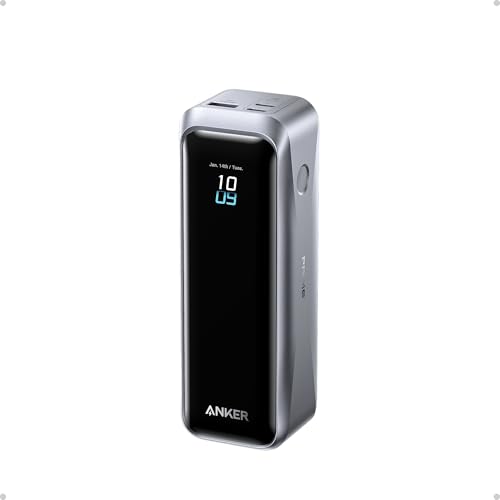
The Anker Prime Power Bank (20,100mAh, 220W) is a high-performance portable charger engineered for users who need to power demanding electronics on the move. Built with a nominal battery capacity of 20,100mAh (72.36Wh), this external battery pack bridges the gap between everyday pocket chargers and oversized power stations. It is designed primarily for professionals, remote workers, students, and frequent flyers who rely on power-hungry devices such as USB-C laptops, tablets, and modern flagship smartphones.
Charging capability is the primary strength of this battery pack, offering up to 140W of high-speed power from a single USB-C port when using a compatible 5A cable. According to manufacturer lab testing, this 140W output can charge a 16-inch MacBook Pro (M4 Pro) to 50% in roughly 28 minutes. When all three ports are occupied-consisting of two USB-C ports and one USB-A port-the power bank can push up to 220W of combined total output. For mobile phone users, the manufacturer states the 20,100mAh capacity provides enough reserve power for up to 4.2 days of video streaming on an iPhone 17 Pro Max. While actual charging power always depends on device acceptance limits and operational thermals, the available headroom easily accommodates demanding multi-device workflows.
In terms of physical design, the unit sports a sleek Phantom Gray casing with an elongated, pillar-style profile. Measuring 5.78 by 1.75 by 1.96 inches and weighing approximately 1.12 pounds, the charger trades slim pocketability for serious electrical throughput and capacity. The vertical footprint works well on crowded coffee shop tables or compact airplane tray tables, resting cleanly beside a notebook without taking up unnecessary surface area. The port layout places all connections within easy reach on the top panel, making it straightforward to swap cables in low-light environments or tight quarters.
Recharging the power bank itself is equally rapid thanks to its 100W maximum USB-C input support. Based on manufacturer specifications, the internal battery can reach a 50% charge in just 25 minutes when connected to a 100W or higher USB-C wall charger. In the box, Anker includes a 3.3-foot USB-C to USB-C charging cable rated for up to 240W, ensuring you have the necessary cable hardware to unlock both maximum charging and recharging speeds. With an energy rating of 72.36Wh, the battery pack falls well under the typical 100Wh limit enforced by airlines and the TSA for carry-on luggage, though travelers should always verify specific carrier rules before flying.
Prospective buyers should take note of a few practical tradeoffs. At roughly 1.12 pounds, this is not an ultralight battery pack, and carrying it in a pants pocket or small sling bag is impractical compared to a standard 5,000mAh or 10,000mAh phone bank. Additionally, because a high-output wall charger is not included in the box, users must supply their own 100W-capable USB-C wall adapter to achieve the fastest recharge times. Multi-port power distribution will also share the total 220W pool across connected devices, meaning individual port wattages will adjust dynamically based on the number and type of connected gadgets.
For mobile professionals, college students with heavy laptop workloads, and travelers who need reliable, high-wattage power away from AC outlets, the Anker Prime 20,100mAh Power Bank is an outstanding choice. Buyers who strictly need a compact charger for quick smartphone top-ups during a daily commute may prefer a lighter, more pocket-friendly alternative. However, if your primary goal is maintaining full-speed laptop charging alongside phone and accessory backup in a flight-compliant package, this model delivers exceptional speed and build quality.
The Anker Prime Power Bank is specifically optimized to meet the high wattage requirements of modern USB-C laptops. With up to 140W output available from a single port, the charger provides sufficient power to handle resource-intensive laptops, including a 16-inch MacBook Pro, under active processing loads. Supplying this level of power requires a 5A-rated cable, which Anker provides in the box with an included 240W-rated USB-C to USB-C cable.
For multi-device setups, the three available ports allow users to power a laptop, a smartphone, and smaller accessories simultaneously. The 220W total output pool gives the charger sufficient overhead to maintain fast speeds across multiple ports at the same time, preventing significant charging slowdowns when an extra device is plugged in. This versatility makes the unit a practical mobile docking hub for remote work at airports, libraries, and off-grid workspaces.
Airline travel compliance is a major advantage of the Anker Prime 20,100mAh battery pack. Its nominal capacity of 72.36Wh sits comfortably below the standard 100Wh maximum limit established by the FAA, TSA, and international aviation authorities for carry-on lithium-ion batteries. While spare lithium-ion batteries must always remain in carry-on luggage rather than checked bags, this rating ensures broad compatibility with major airline travel policies.
Turnaround time between flights is minimized by the 100W maximum USB-C input capability. According to manufacturer laboratory data, the battery can replenish from empty to 50% in approximately 25 minutes when connected to a 100W power source. The included travel pouch protects the Phantom Gray finish from scratches inside a backpack, making the entire kit convenient to pack and transport on road trips, daily commutes, or cross-country flights.

Pros
- Clear digital LED percentage display eliminates guesswork compared to standard four-dot LED lights.
- Compact, slim profile sits comfortably against your phone without obstructing the rear camera module.
- Supports simultaneous dual-device charging via the wireless surface and 20W USB-C wired port.
- Strong magnetic alignment holds tightly to MagSafe-compatible iPhones and magnetic Android cases.
Cons
- Requires a magnetic case or magnetic adapter ring to magnetically snap onto Android smartphones like Samsung Galaxy models.
- Charging two devices at once splits power output and may reduce individual charging speeds.
- Wired charging delivers faster and more energy-efficient power transfer than the wireless pad.
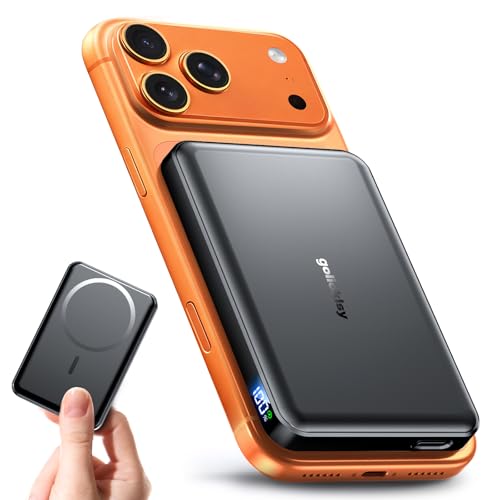
The golioklsy 10000mAh Magnetic Power Bank is a compact portable battery pack engineered primarily for everyday commuters, frequent travelers, and smartphone users who want snap-on wireless convenience without blocking their phone camera. Combining magnetic wireless charging with a 20W USB-C wired port, this battery pack is tailored for owners of MagSafe-compatible iPhone models and Android devices equipped with magnetic cases who need pocket-friendly backup power on busy days.
In terms of power output, the charger features a versatile dual-charging design that allows users to power two devices simultaneously using both wireless and wired connections. The manufacturer lists up to 20W USB-C wired charging alongside wireless output up to 15W or 20W depending on configuration, providing flexible top-up options for supported smartphones. While the 10000mAh nominal capacity provides substantial reserve energy - with manufacturer estimates suggesting roughly 1.5 to 2.2 full recharges for modern standard and larger phone models - actual delivered energy will naturally be lower due to normal conversion losses, thermal dissipation, and wireless transfer inefficiencies.
The physical layout of the battery pack emphasizes ergonomic handling and clear visual feedback through an integrated digital LED battery percentage display. Measuring roughly 3.7 by 2.6 by 0.55 inches with a lightweight design around 0.26 pounds (with package specifications noting up to 4.12 by 2.7 by 0.66 inches), the power bank is deliberately contoured so it does not obstruct rear camera lenses on supported phones during use. The built-in magnetic array and nano-adsorption surface provide firm attachment to compatible phones or magnetic cases, preventing slipping or accidental dislodging during active movement.
Using the charger on a daily commute or flight is straightforward thanks to real-time status monitoring and simple plug-and-charge operation. Users can monitor exact remaining power on the digital readout rather than guessing between vague indicator dots, making it easier to plan recharges before heading out. With its compact footprint, the pack easily slips into a jacket pocket, commuter backpack, or carry-on bag, serving as reliable backup power during flights, road trips, or campus study sessions.
Despite its convenient form factor, the battery pack has specific practical limitations that buyers should weigh. Magnetic wireless attachment requires direct compatibility with MagSafe hardware on iPhone series 12 through modern iterations, while Android devices such as Samsung Galaxy models require an external magnetic phone case to achieve alignment. Furthermore, charging two devices at once divides power output, and wireless charging inherently generates more ambient warmth and transfers power less efficiently than a dedicated direct-wired USB-C connection.
This magnetic power bank is a compelling choice for iPhone and magnetic-case Android users who prioritize a lightweight, camera-friendly form factor with an informative LED percentage screen for daily carry. Shoppers seeking multi-day off-grid power, heavy-duty laptop charging, or certified Qi2 speeds may need a larger-capacity or dedicated high-wattage charging brick instead. For everyday urban commutes, school days, and weekend travel, its balance of 10000mAh nominal capacity and 20W wired backup delivers dependable convenience.
The golioklsy portable charger is engineered to work directly with MagSafe-compatible iPhone models from the iPhone 12 series onward, snapping onto the device without requiring extra hardware. The compact profile ensures that even on smaller devices like the iPhone mini or standard models, the charger does not intrude into the camera field of view.
For Android smartphones such as Samsung Galaxy or Google Pixel devices, wireless power transfer is supported, but magnetic adhesion requires a magnetic phone case or magnetic ring adapter. The built-in 20W USB-C port offers universal wired compatibility, allowing users to plug in standard USB-C cables to charge tablets, wireless earbuds, or secondary phones reliably.

Frequently Asked Questions
Can you fly with a phone power bank in checked luggage?
No, airline regulations and FAA guidelines strictly prohibit packing any phone power bank in checked luggage. Lithium-ion battery packs present a fire hazard that flight crews cannot easily monitor inside the cargo hold. All spare external batteries must be placed exclusively inside carry-on bags or personal items. If gate agents force you to gate-check your carry-on bag, you must remove all power banks before handing the bag over.
What is the maximum battery capacity allowed on a flight?
The standard limit for lithium-ion battery packs on domestic and international commercial flights is 100 watt-hours (Wh). Most cell phone chargers comfortably meet this standard, as a typical 20,000mAh external battery operates at roughly 72 to 74 watt-hours. Units between 101Wh and 160Wh require special airline approval, while anything exceeding 160Wh is completely prohibited on passenger aircraft. Always inspect the back of your portable battery to ensure its watt-hour rating or voltage and milliamp-hour ratings are legibly printed.
How do you calculate watt-hours for a portable charger?
You calculate watt-hours by multiplying the battery capacity in milliamp-hours (mAh) by the nominal cell voltage (usually 3.7V) and dividing by 1,000. For instance, a 10,000mAh battery multiplied by 3.7 volts equals 37,000, which divides to 37 watt-hours. Many modern models list the watt-hour rating explicitly on their casing to prevent confusion at security checkpoints. If your charger lacks clear factory markings, security screeners may confiscate the device during inspection.
Can you fly with a phone power bank that supports wireless or magnetic charging?
Yes, magnetic and wireless charging power banks are fully permitted in carry-on baggage as long as their capacity remains under 100Wh. Magnetic packs designed for newer smartphones provide cable-free convenience during flights, fitting easily into seatback pockets. However, wireless charging typically generates slightly more heat than direct wired connections and charges at lower efficiency. For users who prefer simple, budget-friendly options, examining a universal Anker power bank under 25 dollars offers a reliable wired alternative for travel.
Can you charge your phone using a power bank during a flight?
Yes, passengers are generally allowed to recharge their phones using a power bank while in flight. Airlines permit using portable chargers at your seat during cruising altitudes, though some flight crews request that passengers refrain from charging during takeoff and landing. Never leave a charging device unattended in an overhead bin or buried deep under your seat where heat cannot dissipate. If a charger or phone feels abnormally hot while charging, disconnect the cable immediately.
Can you fly with a phone power bank that features solar panels?
Yes, solar-equipped power banks can be brought on flights, provided they follow standard lithium battery carry-on rules and stay under the 100Wh threshold. The built-in photovoltaic panels on compact outdoor battery packs do not violate aviation safety rules, but the lithium battery inside still requires cabin stowage. While rugged solar packs provide auxiliary lights and multi-cable ports, their solar recharge rate is slow and intended primarily for off-grid emergencies rather than rapid in-transit charging. For travelers evaluating specialized outdoor gear, examining options like a solar power bank Rivanta reveals how backup solar features compare to dedicated wall-charged units.





Write Your Review
No reviews yet. Be the first to share your experience!