


Running out of laptop battery during a long commute or off-grid trip leaves you stranded without power, especially when your device demands a standard three-prong wall plug rather than a basic USB port. Standard portable chargers cannot run small electronics or specialized laptop charging bricks, which makes the best ac outlet power bank an indispensable tool for mobile workstations. These compact battery units integrate functional 110V or 120V AC sockets alongside modern USB-C Power Delivery ports, enabling you to run camera chargers, laptops, and outdoor gear right from your bag. Evaluating critical specs like continuous wattage, battery capacity, and safety circuits ensures smooth power flow without unexpected resets. For a deeper breakdown of how capacity numbers translate to usable runtimes, reviewing this specs comparison of power bank features helps clarify real-world battery behavior.
Balancing heavy capacity against travel portability remains a primary consideration for business commuters and weekend campers alike. While large battery packs offer reassurance during unexpected storm outages, watt-hour ratings dictate whether your gear is legally allowed on commercial flights. Units that stay strictly below the 100Wh threshold provide substantial emergency backup while meeting standard airline carry-on guidelines. Selecting an effective mobile power station means matching continuous AC output to your equipment’s specific wattage requirements so you can recharge smoothly wherever work takes you.


Pros
- Durable LiFePO4 battery pack rated for over 3,500 charge cycles, far outlasting standard lithium cells
- Dual AC wall outlets and a 45W USB-C PD port accommodate laptops and everyday electronics
- Ultra-quiet fanless construction operates without disruptive background noise
- Rapid recharging technology replenishes the battery up to 80 percent in 1.5 hours
Cons
- 100W AC output limit is unsuitable for high-draw heating appliances, coffee makers, or hair dryers
- Solar charging panel and solar connection cable must be purchased separately
- At 2.54 pounds, it is heavier and bulkier than standard pocket smartphone power banks
The Daran 89.6Wh Portable Power Station is a compact, multi-output mobile power bank engineered for users who need more versatility than a standard pocket charger can deliver. Built with durable LiFePO4 battery cells and dual AC sockets, this 2.54-pound generator alternative bridges the gap between pocket battery packs and bulky home backup stations. It serves remote workers running laptops away from wall sockets, campers wanting quiet off-grid charging, photographers managing camera gear, and families building portable emergency kits.
Charging capability centers around an 89.6Wh capacity pack paired with seven distinct output connections. Users get two standard AC wall sockets capable of delivering 100W continuous output with a 200W surge peak, suitable for running compatible laptops, small electronics, or compact equipment. For mobile electronics, the unit includes two USB-C ports offering up to 45W and 15W respectively, alongside two USB-A ports delivering up to 18W and 15W for smartphones, tablets, or earbuds. A dedicated 60W DC5521 port adds auxiliary 12V connectivity, while the manufacturer notes compatibility with devices such as drones, cameras, and mini-coolers within the 100W threshold.
Measuring 6.5 by 3.3 by 4 inches, the enclosure adopts a dark gray finish designed with a practical soft carry handle for convenient transit in backpacks or vehicle trunks. A clear LED status display indicates real-time operational status and remaining battery level, guarded by a protective peel-away shipping film. Operation is completely silent thanks to a fanless thermal structure, making it unobtrusive when placed beside a sleeping bag or on a quiet desk. For blackout preparedness and outdoor nights, an integrated four-level LED flashlight offers both continuous illumination and SOS signaling modes, secured by a long-press accidental-touch activation mechanism.
Replenishing the internal battery is straightforward, with the manufacturer providing four distinct recharge pathways. Owners can charge via a standard AC wall socket, bidirectional USB-C PD, a 12V vehicle port, or an external solar panel. Fast-charging technology allows the battery to reach an 80 percent charge in approximately 1.5 hours, and the system even supports simultaneous AC and DC input charging to maximize turnaround speed. An internal battery management system (BMS) incorporates 12 safety safeguards that monitor voltage, current, and internal temperatures during both discharge and recharge cycles.
Realistic operational limits revolve primarily around power output and physical footprint. The AC sockets are strictly capped at 100W total output, meaning this unit cannot run high-draw household appliances such as coffee makers, blenders, hair dryers, or space heaters. In addition, while 2.54 pounds is relatively lightweight for an AC-equipped power station, it remains significantly heavier and bulkier than standard 10,000mAh smartphone chargers. Buyers planning to recharge with solar energy should also note that the solar panel and connection cables must be purchased separately.
The Daran 89.6Wh Power Station is a sensible choice for road trippers, students, and mobile professionals seeking an all-in-one power hub with genuine AC utility and USB-C fast charging. The standout reason to choose this model over conventional lithium-ion battery packs is its LiFePO4 battery chemistry, which delivers a rated lifespan exceeding 3,500 cycles for sustained reliability. Those requiring sustained output above 100W for demanding appliances will need a larger power station, but users needing dependable power for laptops, phones, and travel essentials will find great utility in this compact design.
The Daran power station features seven total output ports to support multiple devices at once. The two standard three-prong AC outlets share up to 100W of continuous output (200W peak), making them suitable for compatible laptops, small drones, and low-draw desktop gear.
Mobile charging is anchored by two USB-C ports and two USB-A ports. The primary USB-C connection delivers up to 45W Power Delivery for rapidly charging modern USB-C laptops, tablets, and flagship smartphones, while the secondary USB-C port provides 15W. The USB-A ports output up to 18W and 15W respectively, allowing legacy charging cables to operate alongside modern Type-C connections.
A 60W DC5521 round barrel port provides direct 12V output for compatible auxiliary equipment. Because the unit offers such varied port options, users can charge an array of gear including cameras, smartphones, and low-power travel devices without carrying separate wall adapters.
At the core of this power bank is an 89.6Wh lithium iron phosphate (LiFePO4) battery pack. Unlike conventional NCM lithium-ion cells that typically degrade after 500 to 1,000 charge cycles, this LiFePO4 chemistry is rated for over 3,500 life cycles, offering substantial long-term durability across years of routine use.
Safety is managed through an advanced integrated Battery Management System (BMS) that actively tracks 12 protective metrics. This system oversees cell voltage, current output, and thermal conditions to safeguard against common electrical issues such as overcharging, overcurrent, and short circuits.
For optimal battery calibration and gauge accuracy, the manufacturer recommends fully discharging and recharging the battery pack twice upon initial unboxing. The listed 89.6Wh capacity also provides a helpful baseline for comparing the unit against airline carry-on regulations, though travelers should always verify specific carrier battery policies before flying.

Pros
- Built-in 110V/65W AC plug provides versatility that standard USB-only battery packs cannot offer
- Listed 88.8Wh rating falls below the 100Wh threshold common in airline passenger carry-on battery guidelines
- LED digital percentage display eliminates guesswork compared to generic multi-dot battery lights
- Supplied with complete charging gear, including a 30W home adapter and vehicle charging accessories
Cons
- The 65W AC output ceiling cannot power high-wattage appliances, hair dryers, or heavy gaming notebooks
- Recharging relies on a proprietary barrel-style DC input rather than bidirectional USB-C charging
- At 1.4 pounds and 1.8 inches thick, it is significantly bulkier than standard pocket-sized smartphone battery packs
The SinKeu 24000mAh Portable Power Bank is a compact mini power station designed for users who need access to a standard three-prong wall outlet while away from traditional grid power. Unlike conventional mobile chargers that offer only USB ports, this unit integrates a 110V/65W AC outlet alongside DC and USB connections. It best suits road trippers, tent campers, college students, field photographers, and remote professionals who carry hardware like compact laptops, camera battery chargers, and specialized field gear that requires a standard AC plug.
Power distribution is versatile, centered around the 110V AC port rated for up to 65 watts. For mobile devices, the power bank includes a USB-A port with Quick Charge 3.0 support and a USB-C port, both capable of 5V/3A and 9V/2A outputs. A high-current DC barrel output operates between 9V and 12.6V at up to 10A, which pairs with the included female cigarette lighter socket to operate 12V automotive accessories. While the 24,000 mAh nominal capacity represents internal battery cell volume rather than net delivered output after conversion losses, the listed 88.8Wh energy reserve delivers dependable multi-charge capability across phones, tablets, and low-draw notebooks.
Physically, the power bank balances capacity and portability with measurements of 6.8 x 3.8 x 1.8 inches and a weight of 1.4 pounds. The light blue housing features heat dissipation vents necessary for running an internal AC inverter safely. On the top panel, an LED digital display provides a direct numerical reading of the remaining battery percentage so users always know their power status. An integrated LED flashlight is also built into the chassis, adding practical utility during roadside emergencies or night use around a campsite.
Recharging the power bank is straightforward using the included DC 15V/2A (30W) wall adapter, which plugs into the dedicated DC input port. SinKeu also bundles a 12V car charging cable, allowing drivers to recharge the unit from a vehicle power socket while traveling between destinations. Connecting devices is simple, though operating the AC inverter requires pressing a dedicated switch to activate output. Internal safety is supported by UL safety certification for the battery pack along with CE, FCC, and RoHS compliance to guard against overcurrent, overheating, and short circuits.
The most important limitation to consider is the 65W threshold on the AC inverter. This rating is sufficient for small electronics, drones, and ultraportable notebooks, but it will immediately trip overload protections if connected to heating elements, power tools, blenders, or gaming laptops requiring 100W or more. Additionally, the unit does not recharge via USB-C, meaning users must pack the dedicated barrel charger or car adapter rather than relying on standard phone cables to replenish the power bank.
The SinKeu 24000mAh AC power bank is an excellent option for travelers, mobile workers, and campers seeking an affordable, all-in-one bridge between pocket power banks and heavy solar generators. Buyers who only need to top off a smartphone should stick to a slimmer, pocketable USB-C charger, while those needing to run household appliances will need a full-sized power station. For powering low-wattage electronics and standard laptops in a carry-on-friendly footprint, this model provides tremendous utility.
Port selection on the SinKeu 24000mAh battery pack is designed for comprehensive multi-device utility across both consumer electronics and automotive accessories. The primary feature is the 110V/65W AC outlet, which accommodates standard two-prong and three-prong plugs for devices that lack native USB-C charging options. For mobile handhelds, it provides a USB-C output and a USB-A port, both supporting 5V/3A and 9V/2A configurations with Quick Charge 3.0 capability on supported devices.
Beyond standard consumer ports, the unit features a high-output DC barrel port operating from 9V to 12.6V with up to a 10A ceiling. With the included cigarette lighter adapter cable, this DC port can power portable tire inflators, car vacuum cleaners, and 12V camping accessories directly from the battery pack. The ability to charge devices across AC, DC, and USB channels simultaneously gives this portable unit the versatility of a miniature power station.
The battery system inside the SinKeu power bank features a nominal capacity of 24,000 mAh and a stated energy rating of 88.8Wh. In portable electronics, energy capacity expressed in watt-hours offers the most reliable indicator of reserve power because it accounts for voltage differences across internal cells and external outputs. The 88.8Wh rating also sits below the typical 100Wh threshold enforced by many commercial airline carry-on regulations, though passengers should always confirm individual carrier policies prior to departure.
To replenish the unit, SinKeu provides a dedicated 30W DC power supply (15V/2A) that connects directly to the barrel input port. The manufacturer also supplies a 12V vehicle adapter so users can replenish the pack during road trips. While the lack of USB-C input charging means you must bring the dedicated wall or car adapter along, the supplied 30W DC wall adapter ensures steady, predictable recharge rates for the high-capacity battery pack.

Pros
- Integrated folding AC wall plug simplifies recharging without needing separate wall adapters
- Built-in USB-C and iOS cables provide immediate cord-free convenience for Apple and Android devices
- 22.5W PD and QC fast-charging support across the USB-C port, USB-A port, and integrated USB-C cable
- Pass-through charging allows simultaneous power-bank recharging and device charging
Cons
- Maximum 22.5W output provides trickle charging for laptops like the MacBook Air rather than high-speed charging
- Claimed 50,000 mAh capacity exceeds standard 100Wh airline carry-on thresholds, restricting commercial flight use
- Charging multiple devices simultaneously will split available power output and reduce per-device charging speeds
The Sucrosey 50000mAh Portable Charger is an all-in-one power bank engineered to deliver extended backup power for mobile users who want to ditch external cords and charging bricks. Designed with a built-in foldable AC wall plug alongside integrated USB-C and iOS charging cables, this battery pack eliminates the clutter of travel accessories. It is aimed primarily at campers, road trippers, outdoor workers, college students, and emergency-prep planners who need dependable multi-day charging away from wall outlets.
Charging capabilities center on 22.5W fast charging supported through USB Power Delivery and Quick Charge protocols. According to manufacturer specifications, the external USB-C port, the integrated USB-C cable, and the USB-A port each support up to 22.5W output, allowing an iPhone 15 to reach roughly 50 percent battery in about 30 minutes. While the manufacturer claims compatibility with higher-draw devices such as an iPad Pro and MacBook Air, users should recognize that 22.5W delivers basic or maintenance charging for laptops rather than the full-speed charging offered by 65W USB-C PD supplies.
The physical layout prioritizes self-contained utility by housing both the charging prongs and device cables directly inside the shell. Measuring approximately 4.6 by 2.8 by 1.2 inches and weighing under a pound, the black rectangular chassis remains manageable inside backpacks, center consoles, or tool bags. The foldable two-prong AC plug retracts flush when not in use, protecting adjacent items in your bag from scratches, while the attached cables tuck securely into dedicated channels on the unit.
Recharging the power bank is straightforward thanks to dual-method flexibility, allowing direct connection to any standard 100-240V wall socket or an external power source. The manufacturer notes that plugging directly into a wall outlet can replenish the internal cells in approximately 6 hours. Furthermore, pass-through charging is supported, meaning you can plug the power bank into a hotel or bedside outlet at night to simultaneously replenish the internal battery and charge a connected smartphone.
A primary consideration is the relationship between the nominal 50,000 mAh rating and travel regulations. While a high nominal capacity sounds ideal for long road trips, a battery of this scale technically equates to roughly 185Wh, which exceeds standard commercial airline carry-on limits of 100Wh without special airline carrier approval. Additionally, simultaneous multi-device charging will split available power output, and nominal battery capacity differs from actual delivered energy due to natural voltage conversion losses during operation.
The Sucrosey 50000mAh Portable Charger is best suited for budget-conscious drivers, campers, students, and emergency-kit builders who value built-in cables and direct wall-plug recharging above all else. Users seeking certified carry-on power banks for commercial flights or dedicated high-wattage 65W to 100W laptop chargers should look at airline-compliant alternatives. For grounded multi-device convenience and off-grid mobile endurance, this integrated package delivers significant practical utility.
The Sucrosey power bank utilizes 22.5W fast-charging technology across multiple connection points, supporting both USB Power Delivery (PD) and Quick Charge (QC) standards. The manufacturer specifies that the built-in USB-C cable, external USB-C port, and USB-A port each reach up to 22.5W maximum output when used individually. This wattage allows compatible smartphones like the iPhone 15 series or modern Android phones to recharge noticeably faster than with standard 5W or 10W baseline adapters.
When powering larger electronics such as an iPad Pro or MacBook Air, the 22.5W threshold will provide steady auxiliary power or slow charging during light usage. However, high-performance laptop workflows will draw power faster than 22.5W can replace it. Connecting multiple devices at the same time will distribute the internal power supply, reducing single-port output to protect connected electronics from overcurrent conditions.
Portability is defined by the unit's all-in-one form factor, which measures 4.6 by 2.8 by 1.2 inches. By integrating a foldable AC wall plug, a USB-C cable, and an iOS cable directly into the body, the charger eliminates the bulk of carrying secondary wall bricks and tangled wires during road trips, daily commutes, or college campus sessions.
For air travel, passengers should exercise caution before packing this charger. Standard airline and FAA regulations typically restrict lithium-ion batteries over 100 watt-hours (Wh) in carry-on baggage without prior airline approval, and prohibit them entirely in checked luggage. Because a 50,000 mAh capacity at 3.7V equates to approximately 185Wh, this battery pack is better suited for ground transportation, road travel, and camping rather than commercial flights.

Pros
- Integrated 100W AC outlet powers small electronics that require standard two-prong or three-prong plugs
- Bidirectional 65W USB-C PD port supports laptop charging and recharges the bank in 1.5 hours
- Listed 98Wh energy rating complies with standard 100Wh airline carry-on limits
- Four versatile output ports accommodate both modern USB-C gear and legacy USB-A accessories
Cons
- AC outlet output is capped at 100W, making it unsuitable for high-draw heating elements or large appliances
- The 6.7 x 2.6 x 2.6-inch tower design is bulkier than flat, pocket-sized smartphone power banks
- Achieving the 1.5-hour recharge time requires a separate 65W USB-C wall adapter not detailed as included
The Paopaoyu 100W AC Outlet Portable Power Bank is a versatile high-capacity backup charger engineered for remote workers, business travelers, campers, and emergency home backup kits. Combining an integrated AC socket with modern USB Power Delivery ports, this unit eliminates complete reliance on wall plugs when working away from a desk. It provides substantial off-grid energy in a standalone tower format, making it particularly useful for keeping essential mobile gear operational during flights, road trips, field assignments, or unexpected electrical outages.
Equipped with a listed nominal capacity of 27,000 mAh and an energy rating of 98Wh, this power bank delivers multi-device flexibility through four distinct output ports. The primary feature is a 100W AC outlet capable of handling portable electrical appliances that draw less than 100 watts. For modern mobile electronics, a bidirectional 65W USB-C Power Delivery port provides high-speed charging for compatible laptops, tablets, and smartphones. Additional connectivity includes an 18W USB-A port and a 12W USB-A port, allowing users to power cameras, handheld devices, and older mobile accessories without carrying separate adapter plugs.
In terms of build and layout, the Paopaoyu charger adopts a block-style tower aesthetic measuring 6.7 by 2.6 by 2.6 inches. This structured footprint keeps the AC outlet and USB array easily accessible on desktop workspaces, airline tray tables, or camp tables while minimizing horizontal surface clutter. Because the battery capacity is listed at 98Wh, the unit falls just beneath the general 100Wh limitation enforced by the FAA and TSA for passenger carry-on baggage. While the column shape is too substantial for pocket carry, it slips neatly into commuter backpacks, camera cases, and emergency prep bags.
Recharging the power bank is efficient thanks to the 65W input capability on the USB-C port, which the manufacturer states can replenish the 27,000 mAh battery in approximately 1.5 hours when connected to a compatible high-wattage power adapter. Operating connected devices is largely plug-and-play, allowing power delivery across USB-A, USB-C, and AC connections depending on total demand. Everyday operation remains straightforward whether positioned on an airport terminal bench, an office desk away from wall sockets, or an outdoor picnic table.
Prospective buyers must recognize the operational limits of a 100W AC inverter. Electrical appliances requiring sustained or surge power above 100 watts, such as household hair dryers, electric kettles, or high-draw tools, will trigger the built-in overload protection mode. Furthermore, achieving the advertised 1.5-hour recharge turnaround necessitates a separate 65W USB-C wall charger. While the 98Wh energy rating complies with general airline carry-on guidelines, individual carrier policies can vary, and actual delivered energy will reflect standard voltage conversion losses and AC inversion efficiency.
For mobile professionals, frequent flyers, outdoor enthusiasts, and emergency planners who need reliable AC and 65W USB-C power in a single transportable package, the Paopaoyu 100W AC Power Bank offers strong utility. Shoppers looking strictly for a slim, pocket-friendly phone battery may prefer smaller 5,000 mAh or 10,000 mAh power banks. However, if your gear kit demands an AC socket and laptop-grade USB-C output without exceeding airline capacity limits, this versatile multi-port unit represents a practical and capable choice.
The Paopaoyu power bank provides four dedicated outputs to accommodate both modern USB electronics and standard AC wall plugs. The 100W AC outlet handles laptops, camera battery chargers, and compact personal appliances drawing under 100W. The bidirectional USB-C port supports 65W Power Delivery for both charging compatible laptops and rapidly recharging the power bank itself. For legacy devices, an 18W fast-charge USB-A port and a standard 12W USB-A port provide dedicated connections for smartphones, earbuds, and accessories.
Safety architecture on this power bank includes FCC, CE, and RoHS certifications alongside built-in protection against overcharging, overvoltage, overcurrent, and short circuits. If an attached device exceeds the 100W threshold on the AC outlet, an automatic safety shutoff activates to protect the battery and internal inverter. With an explicit energy rating of 98Wh, the battery bank is designed to comply with standard TSA and FAA passenger carry-on thresholds under 100Wh, though travelers should always verify specific carrier guidelines before flying.
Pros
- Built-in AC outlet allows charging devices that require standard two-prong or three-prong wall adapters
- High-speed 65W USB-C PD output delivers rapid power to supported laptops, tablets, and smartphones
- 98Wh energy capacity complies with the standard 100Wh airline carry-on threshold for flights
- Durable aerospace-grade aluminum shell aids passive cooling and stands up to travel wear
- Versatile 4-port layout supports multi-device charging across AC, USB-C, and USB-A connections
Cons
- Weighs 2.2 pounds, making it noticeably heavier than standard pocket-sized phone power banks
- A 65W wall adapter is not included, requiring a separate purchase to achieve the 2.5-hour recharge time
- AC outlet is restricted to 98W continuous output, which will not support high-draw appliances like hair dryers or heaters
The Flyvair Portable Laptop Charger is a high-capacity hybrid battery pack and mini power station built specifically to keep laptops, mobile gear, and small appliances running off the grid. Featuring a nominal 27,000 mAh capacity rated at 98Wh, this power bank targets business travelers, field workers, campers, and college students who frequently operate away from standard wall receptacles. Unlike traditional battery banks that only offer low-voltage USB ports, this unit integrates a full 110V AC wall-style socket alongside high-speed USB Power Delivery, bridging the gap between an everyday mobile charger and a bulkier portable power station.
Charging performance centers around four versatile output options, highlighted by a bidirectional 65W USB-C port and a 110V AC outlet delivering up to 98W continuous output. The 65W USB Power Delivery connection provides ample output for supported USB-C laptops like the MacBook Pro 13-inch, Dell, and HP models, while also delivering rapid charging for smartphones such as the iPhone 15, iPhone 14, Samsung Galaxy S24, and tablets like the iPad. For non-USB devices, the AC port powers equipment typically restricted to household plugs, including drone battery docks, dedicated camera chargers, and compact fans. In addition, the battery pack includes an 18W Quick Charge 3.0 USB-A port and a standard USB-A output, allowing users to charge up to four devices simultaneously across different power requirements.
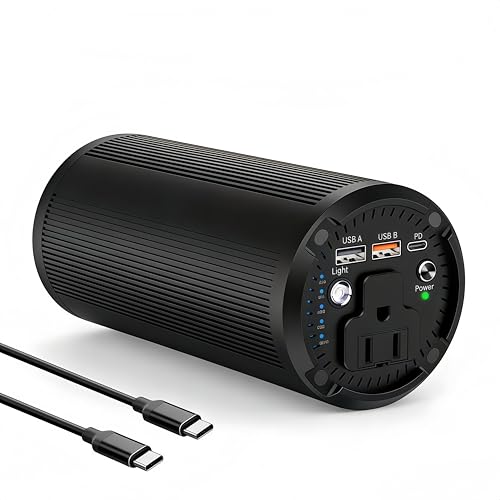
In terms of construction, the charger features a cylindrical aerospace-grade aluminum alloy housing that enhances physical durability and heat dissipation relative to standard plastic battery shells. Measuring 6.89 by 2.8 by 2.8 inches, the chassis is shaped similarly to a compact water bottle, making it practical to slide into a backpack side sleeve, travel bag, or vehicle cup holder. The ports and AC socket are placed for straightforward access, and the unit integrates a built-in LED flashlight. That illumination feature offers handy utility for outdoor camping, roadside situations, or reading during unexpected residential power outages.
Recharging the Flyvair power bank utilizes the bidirectional 65W USB-C port, which the manufacturer states can replenish the full 27,000 mAh capacity in roughly 2.5 hours when paired with a compatible 65W wall adapter. From a travel perspective, the 98Wh energy rating is intentionally kept beneath the common 100Wh threshold established for commercial airline carry-on luggage under TSA guidelines. While passengers should always double-check specific airline policies prior to flying, this rating makes it an attractive option for cross-country flights and business commutes. Daily operation is straightforward: plug in the appropriate USB cables or insert a standard AC plug directly into the socket without requiring specialized converters.
The primary tradeoff with this versatile power pack stems from its physical mass and specific wattage limitations. Weighing in at 2.2 pounds, this is noticeably heavier and bulkier than pocketable 10,000 mAh or 20,000 mAh phone chargers, making it better suited for backpack transport rather than everyday coat pockets. Additionally, the AC outlet is capped at a maximum of 98W, meaning it cannot run high-wattage heating appliances, hair dryers, blenders, or power-hungry workstation laptops that demand over 100 watts. Buyers should also note that a 65W wall adapter is not included in the box, so reaching the advertised 2.5-hour recharge speed requires providing your own fast-charging power brick.
For remote professionals, content creators, and travelers who need to power standard AC accessories and high-draw laptops from a single airline-compliant pack, the Flyvair 27000mAh charger offers exceptional versatility. Shoppers who strictly need a slim pocket charger for topping up a phone during an evening commute would be better served by a smaller, lighter USB-C battery. However, for users whose workflow relies on a mix of laptop USB-C fast charging and direct AC plug connectivity, the combination of 98Wh capacity, 65W PD speed, and rugged aluminum construction makes this unit a solid portable workstation companion.
The Flyvair power bank offers four distinct outputs to accommodate varied tech setups on the go. Its primary connection is a bidirectional 65W USB-C port supporting Power Delivery (PD) protocols, suitable for compatible laptops, modern tablets, and flagship smartphones. Alongside the USB-C port, the unit features an 18W Quick Charge 3.0 USB-A port for fast-charging legacy devices and an additional standard USB-A port for smaller peripherals like headphones.
For gear requiring standard household current, the built-in 110V AC outlet supplies up to 98W of power. This allows users to charge proprietary battery cradles for cameras, drone hubs, or compact fans directly in the field without needing dedicated DC travel adapters. Up to four devices can be plugged in simultaneously, giving mobile creators and multi-device owners broad charging flexibility from a single battery bank.
Designed with frequent fliers in mind, the Flyvair battery pack has an energy capacity of 98Wh, positioning it just below the standard 100Wh restriction for carry-on lithium-ion batteries under TSA guidelines. While airline regulations and carrier enforcement can vary, keeping the rating under 100Wh generally enables travelers to bring high-capacity backup power aboard passenger aircraft without requiring special airline pre-approval.
The unit measures 6.89 by 2.8 by 2.8 inches and weighs 2.2 pounds, matching the approximate profile of a standard insulated water bottle. While too heavy for pants pockets, the cylindrical shape fits easily into backpack water bottle sleeves, laptop bags, or vehicle cup holders, making it convenient to transport during business travel, outdoor excursions, or road trips.
Frequently Asked Questions
Can the Best Ac Outlet Power Bank charge a high-powered gaming laptop?
No, most compact AC battery packs support continuous loads between 65W and 100W, which cannot sustain demanding gaming laptops requiring 150W to 300W. If your computer draws more power than the inverter’s maximum rated output, the safety circuit will automatically trip to prevent overheating. Always check your laptop’s power adapter brick to ensure its rated input wattage stays strictly below the power bank’s AC output rating.
Are portable chargers with AC outlets permitted on commercial airplanes in 2026?
Yes, power banks rated at 100 watt-hours (Wh) or less are generally permitted in carry-on baggage under standard FAA and TSA rules. Models like the Flyvair and Paopaoyu carry 98Wh ratings specifically engineered to comply with airline limits. Spare lithium battery packs are strictly prohibited in checked luggage, so always keep your AC power bank in your carry-on bag.
How does an AC outlet power bank differ from a charger with a built-in wall plug?
An AC outlet power bank features an integrated socket that outputs 110V or 120V alternating current to power external devices, whereas a battery with a built-in plug uses folding prongs solely to recharge itself from a wall receptacle. If you want a self-contained battery pack that plugs into the wall to recharge without loose cords, a best Anker power bank with wall plug offers that convenience for phones and tablets.
Can you recharge an AC portable power station with solar panels?
Yes, several portable AC power banks include dedicated DC input ports compatible with portable solar panels. Units like the Daran 89.6Wh station and Powkey battery accept DC input for off-grid recharging during outdoor trips. Pairing these versatile stations with a solar power bank rivanta creates a reliable emergency charging setup when grid power is unavailable.
Why does using the AC outlet drain the battery faster than the USB-C port?
Direct current battery power must pass through an internal inverter to convert into 110V alternating current, creating natural energy loss as heat. USB-C Power Delivery delivers DC power directly to your device without conversion loss, resulting in superior energy efficiency. Whenever your phone or laptop supports native USB-C charging, using the Type-C port will yield more total charges than plugging a wall adapter into the AC socket.
What happens when you connect an appliance that exceeds the AC wattage limit?
The unit’s internal battery management system detects an overload and shuts down output immediately to protect both the battery cells and connected electronics. Models from brands like SinKeu and Powkey use integrated multi-protect systems that cut power when continuous load limits are breached. To restore normal operation, simply unplug the incompatible appliance and turn the power switch back on.



Write Your Review
No reviews yet. Be the first to share your experience!