


Powering Up Off-Grid with Reliable Solar Charging
Off-grid adventures often hit an immediate snag the moment camera batteries, GPS units, or smartphones run dry miles away from an electrical outlet. Carrying a reliable river solar power bank bridges the gap between rugged backcountry travel and continuous power access. Gear in this category spans from pocketable handheld battery banks with emergency solar cells up to heavy-duty power stations like the EF ECOFLOW River lineup engineered for high AC wattage. Before planning an extended overland trek, reviewing solar power bank pros and cons helps set realistic expectations regarding panel surface area and actual charging rates under direct sunlight.
Evaluating battery chemistry and sustained output ratings ensures your gear stays operational without unexpected thermal shutdowns. Pocket chargers offer convenient cable-free convenience through integrated cords and wireless charging pads, while larger LiFePO4-based stations deliver true AC wave output alongside fast USB-C Power Delivery. According to user feedback and listed specifications across leading brands, dedicated pass-through circuitry and flexible port configurations eliminate charging bottlenecks at camp. If your itinerary involves open water or damp shorelines, checking how an onboard marine solar power bank resists moisture can protect your electronic essentials from sudden weather shifts.

Pros
- Fast under-10ms UPS switchover with PC and NAS communication cable for automated data safety
- Long-lasting LiFePO4 chemistry backed by a 5-year manufacturer service coverage
- Extra battery includes an independent 140W bidirectional USB-C port for heavy-duty device charging
- Extremely quiet 30 dB operating noise level at 1.6 feet when running lower-wattage devices
- Fast 1-hour AC wall recharging minimizes downtime during emergency prep
Cons
- Total combined bundle weight of approximately 18.5 pounds limits walk-around portability
- Continuous AC output is capped at 600W, which may require X-Boost mode for higher-draw heating appliances
The EF ECOFLOW River 3 Max Plus is an expandable portable power station and uninterruptible power supply (UPS) built to support mobile tech users, home workstations, campers, and emergency kits. This bundle pairs the 286Wh River 3 Plus base station with the EB600 572Wh extra battery, yielding a combined 858Wh of stored energy. It serves users who need reliable desktop backup power during grid failures, as well as outdoor enthusiasts who want substantial off-grid energy without carrying an oversized generator.
Charging versatility is one of this system's strongest assets. The main unit delivers 600W of continuous pure sine wave AC output, surging up to 1200W with EcoFlow X-Boost technology to manage sudden startup demands. The port array includes three UPS-protected AC outlets, two USB-A ports, a high-speed USB-C port, and a standard 12V car cigarette lighter port. In addition, attaching the EB600 module via wireless Pogo Pins unlocks a bidirectional 140W USB-C port, providing ample power to charge demanding modern laptops, tablets, and smartphones at their full supported rates.
Hardware resilience and home office utility are front and center with this model. An under-10-millisecond UPS transfer speed ensures that sensitive desktop PCs, monitors, and network-attached storage (NAS) devices remain running without rebooting during sudden blackouts. The station includes an EcoFlow USB-B to USB-A communication cable that works with PC software to safely initiate automated data saving before battery exhaustion. Internally, the unit relies on LiFePO4 cells engineered for 3,000 charge cycles before dropping to 80 percent health, housed within a fire-retardant shell rated for 3-foot drop resistance and IP54 battery splash protection.
Daily operation and replenishing the system are straightforward. Thanks to X-Stream AC charging technology, the River 3 Plus can achieve a zero-to-full charge in roughly one hour from a standard wall outlet. For off-grid power, the station accepts up to 220W of solar input, which can recharge the battery in approximately 1.5 hours in ideal sunlight. When operating appliances drawing under 100W, EcoFlow X-GaNPower efficiency keeps sound levels down to an ultra-quiet 30 dB at 1.6 feet, while Bluetooth and Wi-Fi allow complete monitoring and custom charge-rate adjustments through the mobile companion app.
While this power station is relatively compact for its capacity, buyers should keep a few practical tradeoffs in mind. The combined setup weighs around 18.5 pounds (with the base station alone weighing 10.4 pounds), making it well-suited for road trips, RV outings, and desk placement rather than lightweight backpacking. Additionally, while the 600W inverter easily powers laptops, CPAP machines, small blenders, and entertainment setups, high-draw appliances like large space heaters or hair dryers exceed its primary continuous wattage threshold.
The EF ECOFLOW River 3 Max Plus is an excellent choice for remote professionals, content creators, and emergency planners who want the security of a rapid UPS alongside an expandable, high-output outdoor power source. Shoppers seeking a tiny pocket charger will prefer a handheld power bank, but anyone needing multi-device AC and 140W USB-C backup with long-life LiFePO4 chemistry will find tremendous utility in this versatile system.
The River 3 Plus distinguishes itself from ordinary portable chargers by functioning as a high-speed uninterruptible power supply (UPS). With a transfer latency under 10 milliseconds, the inverter kicks in quickly enough to keep sensitive computer systems, gaming PCs, and home network routers running without rebooting during sudden brownouts or grid failures.
To safeguard important files and prevent data corruption, the system features a dedicated PC and NAS communication interface. Using the included USB-B to USB-A communication cable alongside EcoFlow software, connected computers can receive low-battery signals and initiate automated, safe shutdowns before the power station runs completely out of energy.
Built around durable lithium iron phosphate (LiFePO4) chemistry, the River 3 Max Plus provides 3,000 charging cycles to 80 percent capacity, representing up to a decade of daily usage. The station combines a 286Wh base unit with a 572Wh EB600 expansion module for 858Wh of total capacity, connecting seamlessly without external wires via durable Pogo Pin contacts.
Recharging options are quick and versatile. The station accepts fast AC wall power to reach a 100 percent charge in 1 hour via X-Stream technology. Users traveling off-grid can plug in up to 220W of solar panels to replenish the battery pack in roughly 1.5 hours in clear conditions, making it an adaptable power solution for cabins, RVs, and emergency outages.

Pros
- Up to 20W fast charging output via USB-C for modern smartphones and handheld electronics
- Rugged IPX5 water resistance, shockproofing, and dust sealing withstand outdoor exposure
- Charges up to three devices at the same time using combined wired and wireless outputs
- Dual super-bright flashlights and compass carabiner add practical emergency preparedness value
- Lightweight 0.58-pound profile clips easily to hiking bags or packs into travel luggage
Cons
- Compact solar panel is intended primarily for emergency top-offs rather than rapid daily recharging
- Connecting multiple devices simultaneously distributes power and lowers individual charging speeds
- Maximum 20W output is engineered for phones and small mobile electronics rather than USB-C laptops
The BLAVOR Solar Power Bank 10,000mAh is a rugged portable charger engineered for outdoor enthusiasts, campers, travelers, and emergency-prep users who need durable off-grid backup power. Built around a 10,000mAh Lithium-cobalt battery pack, this unit combines traditional wired power with a wireless charging surface and an emergency solar panel. It best suits American smartphone users, hikers, and commuters seeking a resilient secondary power source that can withstand unpredictable weather while keeping essential mobile gear operational.
In terms of charging performance, the unit features an upgraded USB-C output supporting up to 20W fast charging alongside wireless charging functionality. According to manufacturer claims, the 20W wired connection can power an iPhone 15 up to 65% in approximately 30 minutes, with broad compatibility spanning iPhone, iPad, Samsung Galaxy, and other USB-powered mobile devices. The manufacturer also estimates that a fully charged 10,000mAh battery can recharge an iPhone 8 up to 3.6 times, an iPhone 14 Pro up to 2.2 times, or an iPad Air once. Users can charge up to three devices simultaneously using the available wired and wireless outputs, though connecting multiple devices will divide overall output power.
The physical design emphasizes field durability, featuring flame-retardant ABS and PC construction wrapped in a rubberized protective coating with waterproof silicone port sealing. Measuring 5.9 x 3.1 x 0.8 inches and weighing roughly 0.58 pounds, the battery pack remains comfortably portable for backpacks, daypacks, or glove compartments. It carries an IPX5 water-resistance rating along with dustproof and shockproof qualities to endure outdoor exposure. Dual integrated super-bright flashlights provide nighttime visibility around camp, while the included compass carabiner lets hikers secure the charger directly to exterior pack webbing.
Routine operation is straightforward, with dedicated ports for wired connections and a dedicated surface for wireless charging. Recharging the internal battery pack is primarily completed through its wired input for speed and consistency before heading out on trips. While the integrated solar panel provides an auxiliary method to harvest sunlight, solar inputs on compact hand-held chargers are inherently gradual and best reserved for emergency top-offs rather than daily replenishments. The lightweight profile and included attachment clip make it simple to monitor battery status while trekking or commuting.
Important practical limitations should be weighed before relying solely on this charger in remote locations. First, the 20W peak output is optimized for smartphones, earbuds, and small tablets, meaning it is not designed to power USB-C laptops that require higher wattage profiles. Second, simultaneous multi-device charging will naturally distribute the power budget, reducing individual port speeds across connected gear. Finally, the nominal 10,000mAh capacity will experience standard conversion and circuit losses during wired and wireless transfers, so delivered energy will be lower than the raw battery cell rating.
For hikers, road trippers, and emergency-kit planners wanting an affordable, weather-resistant charger with fast wired and wireless options, the BLAVOR 10,000mAh Solar Power Bank is a practical and versatile choice. Everyday commuters who only need pocketable power for office use may prefer a slimmer, non-rugged power bank without exterior outdoor tools. However, for outdoor recreation and reliable emergency backup, its combination of 20W USB-C output, IPX5 protection, integrated dual flashlights, and durable Lithium-cobalt construction offers solid utility.
The BLAVOR portable charger delivers power through a 20W USB-C fast-charging output as well as an integrated wireless charging pad. This dual-format design accommodates modern smartphones such as iPhone and Samsung Galaxy devices, along with portable accessories like wireless earbuds. The charger supports powering up to three devices simultaneously, providing flexible backup options during outdoor outings or power outages.
Because total power is shared when multiple devices are connected, the fastest charging rates are achieved when plugging a single device directly into the 20W USB-C port. Actual charging speeds will always depend on device reception limits, cable capability, and operating temperatures.
Engineered for outdoor survival and demanding environments, the charger features an IPX5 water-resistant, dustproof, and shock-resistant chassis. The housing combines flame-retardant ABS and PC materials with internal silicone seals and a tactile rubber skin-feel exterior to resist drops and adverse weather.
BLAVOR utilizes a Lithium-cobalt battery composition, which the manufacturer states provides 50% more cycle life compared to standard lithium-polymer cells. Integrated dual super-bright flashlights and an included compass carabiner deliver functional utility for nighttime navigation and gear attachment.

Pros
- Fastest-in-class 60-minute full AC wall recharge using the included standard cable
- Long-lasting LiFePO4 battery cells deliver 3,000+ charge cycles for extended operational life
- Compact 7.7-pound form factor with a rigid molded carry handle for easy portability
- Multiple output options including standard 300W AC wall outlets and USB-C connectivity
- Clean 110W solar charging input enables renewable off-grid energy replenishment
Cons
- A 300W continuous AC output rating cannot run high-draw heating appliances like microwaves, space heaters, or hair dryers
- The 256Wh battery capacity exceeds typical commercial airline carry-on limits (generally capped at 100Wh to 160Wh)
- Solar panels required for renewable outdoor recharging must be purchased separately
The EcoFlow RIVER 2 is a compact, entry-level portable power station engineered to bridge the gap between handheld power banks and bulky emergency generators. Built for mobile device users, outdoor enthusiasts, remote field workers, and suburban emergency kits, this unit provides off-grid electrical independence in a package that fits easily into a vehicle or closet shelf. It allows users to run standard AC wall-plug devices alongside modern USB electronics without needing noisy, gas-powered machinery.
Charging capability is centered around a 256Wh lithium iron phosphate (LiFePO4/LFP) battery pack and an internal inverter providing 300W of continuous AC output, with EcoFlow rating the unit to handle up to 600W for certain essential appliances. The station supports up to six devices simultaneously through a balanced port array that includes standard 300W AC outlets, USB-C, and USB-A connections. This configuration makes it well-suited for keeping smartphones, tablets, USB-C laptops, cameras, CPAP machines, and small camping coolers energized during outdoor trips or unexpected municipal power interruptions.
In terms of physical design and durability, the RIVER 2 weighs approximately 7.7 pounds and measures 9.6 x 8.4 x 5.5 inches, presenting a solid and space-efficient rectangular profile. A sturdy rear-facing integrated carry handle enables quick one-handed transport between a vehicle trunk and a campsite picnic table. Under the hood, EcoFlow integrates an advanced Battery Management System (BMS) that constantly monitors voltage, current, and operating temperatures. The underlying LFP chemistry provides over 3,000 full recharge cycles before degrading to 80 percent of original capacity, representing nearly 10 years of routine use.
Recharging speed is one of the most practical everyday advantages of this power station. Utilizing EcoFlow's X-Stream fast-charging technology, the RIVER 2 can achieve a full zero-to-100-percent recharge from an AC wall outlet in only 60 minutes with the included charging cable. For outdoor off-grid scenarios, the unit also accepts up to 110W of solar input, capable of replenishing the battery in as little as 2.3 hours under optimal sun conditions, giving campers and field crews a sustainable way to maintain power away from civilization.
Users should be mindful of the physical and electrical boundaries inherent to this compact form factor. While 300W of continuous power easily handles consumer electronics, field displays, and small personal gear, it cannot power heavy thermal appliances such as electric skillets, hair dryers, or space heaters. Furthermore, because its 256Wh energy rating surpasses standard FAA and commercial airline carry-on allowances (typically restricted to 100Wh, or 160Wh with airline approval), this battery station is strictly suited for ground travel, road trips, camping excursions, and home preparedness rather than air travel.
The EcoFlow RIVER 2 stands out as an exceptional investment for campers, van travelers, remote digital creators, and homeowners who need a reliable, fast-recharging power station for essential devices and small appliances. Buyers looking to power heavy power tools or entire kitchen setups will need to step up to higher-wattage power stations, but those seeking long-life battery chemistry, rapid AC turnaround, and genuine 7.7-pound portability will find the RIVER 2 to be an outstanding everyday solution.
The EcoFlow RIVER 2 utilizes advanced LFP (lithium iron phosphate) battery cells, providing a substantial lifespan upgrade over traditional lithium-ion alternatives. While conventional battery packs often begin degrading after 500 charge cycles, the LFP cells in the RIVER 2 are rated for more than 3,000 complete charge and discharge cycles before capacity drops to 80 percent. This equates to nearly a decade of regular use, offering long-term reliability for frequent campers and long-term emergency preparation.
With an energy storage capacity of 256Wh and an inverter delivering 300W of continuous AC output, the station offers ample energy reserves for portable electronics. EcoFlow also incorporates power management technology that handles loads up to 600W, preventing unwanted overload shutdowns on supported devices. Integrated thermal and electrical protections continuously track current and voltage fluctuations to ensure safe power delivery across all connected mobile devices and gear.
Recharging convenience is a primary strength of the EcoFlow RIVER 2 platform. Through its integrated X-Stream technology, the unit accepts standard AC wall input via the included wall cable, accomplishing a complete 100 percent recharge in roughly 60 minutes without requiring a bulky external power brick. This allows users to top off their battery completely during a brief stop at home or an RV hookup before heading outdoors.
For remote off-grid operation, the RIVER 2 features a dedicated solar charging port that accommodates up to 110W of clean solar input. When paired with compatible portable solar panels under strong, direct sunlight, the internal MPPT controller can replenish the entire 256Wh battery pack in as little as 2.3 hours. This dual-charging flexibility ensures reliable power availability whether preparing at home or operating off the grid.
Pros
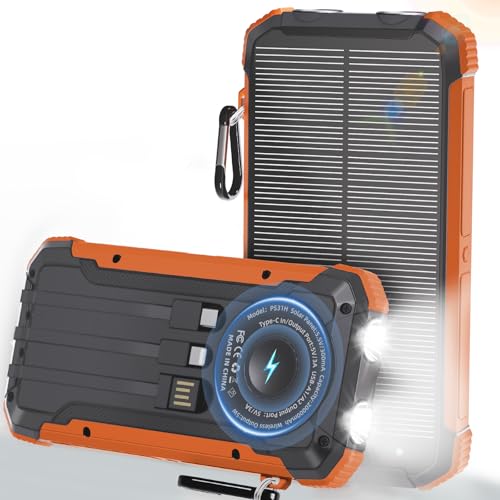
- Integrated Lightning, USB-C, and USB-A cables eliminate the hassle of carrying separate cords
- Supports wireless and wired charging for up to six devices at the same time
- Emergency solar panel and dual LED flashlights provide valuable backup utility for camping and outages
- Includes a mountaineering buckle carabiner and a 12-month warranty with lifetime customer support
Cons
- Compact single-panel solar recharging is slow and intended strictly as an emergency backup rather than primary power input
- Charging multiple devices simultaneously divides available output current among connected electronics
- Specific per-port wattage ratings and Power Delivery laptop capabilities are not supported
The Luvknit Solar Charger Power Bank 20000mAh is an outdoor-focused portable battery pack designed for campers, hikers, road-trippers, and emergency-preparedness kits. Built with integrated charging cables, a Qi wireless charging surface, an onboard solar panel, and dual LED flashlights, this unit targets users who want an all-in-one power reserve without packing separate loose cords. Its 20,000 mAh nominal capacity provides substantial backup power for modern smartphones, tablets, and small personal electronics away from standard electrical wall outlets.
In terms of charging performance, this battery pack supports simultaneous power delivery for up to six devices through a combination of wired and wireless connections. Physical connectivity includes three integrated cables (USB-C, Lightning, and USB-A) alongside two standard USB-A output ports and a USB-C port. The integrated Qi charging pad offers cable-free power for compatible iPhone, Samsung Galaxy, and other Qi-enabled mobile devices. While the manufacturer advertises fast-charging capability across multiple connected devices, specific per-port wattages and protocol negotiations are not published, meaning power allocation divides among connected electronics during simultaneous multi-device use.
The physical layout of the battery pack emphasizes utility for travel and outdoor recreation, measuring 6.29 by 3.34 by 0.77 inches. Its ruggedized orange casing encloses dual forward-facing LED flashlights for nighttime campsite illumination or emergency signaling. The top surface hosts the integrated solar panel, while the built-in charging cables fold neatly into dedicated channels on the casing to minimize clutter in a backpack or emergency duffel. An included mountaineering buckle lets users clip the battery pack directly to outdoor gear for hands-free transport.
Recharging the power bank can be accomplished via the USB-C input port using standard wall adapters or through the built-in solar panel under direct sunlight. Although the integrated solar panel provides an emergency charging option during extended off-grid outings, small solar surfaces naturally collect energy at modest rates. For routine everyday preparation before trips or flights, recharging the 20,000 mAh battery through a wired wall connection ensures full capacity in practical timeframes. Built-in smart protection circuitry monitors operation to guard against overcharging, overheating, and short-circuit conditions during both charging and discharging cycles.
The primary operational limitation of this power bank centers on expectations surrounding solar input and power distribution. Single-panel solar chargers of this physical size are engineered strictly as secondary emergency top-up solutions, not as primary day-to-day charging methods. Additionally, without published individual wattage ratings or Power Delivery specifications, buyers should not expect laptop charging capabilities or verified high-wattage device replenishment. Charging six devices at once will inevitably divide the available battery current, leading to slower overall charging times across all connected gadgets.
This Luvknit 20,000 mAh portable charger is best suited for outdoor enthusiasts, road-trippers, campers, and household emergency planners seeking an affordable backup battery with maximum connectivity convenience. The combination of built-in Lightning, USB-C, and USB-A cables eliminates the frustration of misplaced cords, while the dual flashlights and carabiner attachment add practical field functionality. Shoppers needing high-wattage laptop charging or ultra-compact pocket carry should look toward dedicated Power Delivery power banks, but for multi-device smartphone backup outdoors, this model offers outstanding practical utility.
Connectivity is the primary design focus of this Luvknit power bank, featuring three built-in cables alongside external ports to eliminate cable clutter. The integrated cords include a USB-C cable for modern Android devices and newer accessories, a Lightning cable for Apple iPhone and iPad devices using Lightning ports, and a USB-A cable for older electronics and power input.
In addition to the integrated cables, the housing accommodates two standard USB-A output ports and a dedicated USB-C port, allowing users to attach their own cords when needed. Combined with the surface-mounted Qi wireless charging pad, this configuration allows up to six devices to draw power at the same time, making it exceptionally functional for families, group camping, and multi-device travelers.
Designed with off-grid utility in mind, this battery pack incorporates a compact solar panel to absorb sunlight when standard wall electricity is unavailable. While solar charging on portable handheld batteries is intended for emergency trickle replenishment rather than primary routine recharging, it serves as a valuable peace-of-mind backup during unexpected outages or outdoor survival situations.
The integrated dual LED flashlights provide steady, high-visibility illumination for camping tents, night hiking, vehicle repairs, and household power failures. Combined with internal safety protections that safeguard against excessive heat, overcharging, and short-circuit risks, the unit serves as a dependable addition to home emergency kits and vehicle glove compartments.

Pros
- Four built-in cables provide immediate plug-and-play charging for iPhone, Android, and legacy Micro-USB devices.
- Substantial 49,800 mAh nominal capacity offers extended power reserve for long camping weekends and power outages.
- Versatile charging options combine 22.5W wired fast charging with a 15W wireless pad.
- Rugged IP65-rated body and multi-mode emergency flashlight provide practical utility for outdoor use.
Cons
- Bulky 1.28-inch thick housing and heavy overall footprint make it awkward for standard pocket carry.
- The large 49,800 mAh capacity is likely to exceed typical airline carry-on battery limits without prior approval.
- Solar charging speed is naturally limited by the small surface area and is suitable primarily for emergency replenishment.
The BLASOUL Solar Power Bank is a high-capacity external battery pack engineered specifically for outdoor recreation, emergency backup preparedness, and multi-device mobile users. Outfitted with a nominal 49,800 mAh lithium-polymer battery, built-in cables, and an integrated solar cell, this unit serves as a self-contained mobile power station. It best suits campers, hikers, road trippers, and homeowners preparing for severe weather outages who require dependable backup power without packing a tangled assortment of separate charging accessories.
Charging performance is anchored by versatile wired and wireless options, delivering up to 22.5W through supported Power Delivery 3.0 and Quick Charge 3.0 standards. The dedicated built-in USB-C cable provides up to 20W when used alone, which the manufacturer states can take an iPhone 14 up to 60 percent in approximately 30 minutes. In addition to tethered charging, the unit features an elevated 15W wireless charging pad compatible with wireless-capable devices such as recent Apple iPhone and Samsung Galaxy handsets. Buyers should note that nominal battery capacity represents internal cell storage rather than net delivered energy, as routine voltage conversion and environmental factors naturally influence usable output.
The physical casing measures 7 by 3.66 by 1.28 inches and is built to withstand demanding conditions, featuring an IP65 rating for water, dust, and shock resistance. Cable management is neatly integrated into the frame, stowing three output connectors (Lightning, USB-C, and Micro-USB) along with a USB-A input cable directly within molded channels. An ultra-bright LED flashlight is integrated into the housing, offering steady beam, SOS emergency beacon, and strobe signaling modes for nighttime campsite navigation and roadside breakdowns.
Replenishing the power bank itself can be accomplished either via an external wall adapter using the built-in USB-A lead or through compatible USB-C inputs. While the integrated solar panel provides auxiliary top-off capability when exposed to direct sunlight, solar replenishment is fundamentally slow due to the compact surface area and should be treated as an off-grid safety net rather than a daily charging method. Because of the substantial 1.28-inch profile and heavy battery mass, the charger is much better suited for storage in backpacks, dry bags, or emergency bins than everyday jacket pockets. Furthermore, because a 49,800 mAh lithium battery rating significantly exceeds standard 100Wh airline carry-on limits, air travelers should consult airline policies and avoid counting on this unit for standard commercial flight travel.
The primary limitations of this power bank stem directly from its heavy-duty capacity and ruggedized build. Everyday commuters looking for an ultralight, pocket-friendly charger will find the substantial dimensions cumbersome for quick urban transit. In addition, integrated cables cannot be individually swapped or upgraded if a single connector experiences wear over time, meaning users must handle the tethered leads carefully. Full AC wall replenishment also requires dedicated planning before heading outdoors, as relying on the solar panel alone to fill an empty battery pack of this size is impractical.
The BLASOUL 49800mAh Solar Power Bank is an excellent match for outdoor enthusiasts, remote field workers, and families assembling storm-ready emergency kits. Minimalist commuters and airline passengers will be better served by a slim, lower-capacity power bank that complies smoothly with standard flight regulations. However, for anyone needing multi-day battery reserves, broad cross-device compatibility, and all-in-one cable convenience away from electrical grids, this rugged charger offers outstanding practical value.
Wired charging speeds on the BLASOUL battery pack reach up to 22.5W via compatible PD 3.0 and QC 3.0 fast-charging protocols. The integrated USB-C cable delivers up to 20W output when used independently, offering rapid power delivery to modern smartphones, action cameras, and portable camping gadgets.
Wireless charging functionality supports up to 15W maximum output for Qi-enabled devices. Users can simply place an iPhone, Samsung Galaxy, or compatible wireless earbud case on the designated charging zone, eliminating the need to untangle cords during downtime at camp or at a work desk.
Outdoor resilience is reinforced by an IP65 weather-resistant casing designed to repel dust, splashes, rain, and minor trail impacts. The rugged exterior makes it a dependable companion for kayaking, fishing, backpacking, and unpredictable outdoor environments.
Emergency functionality is bolstered by the top-mounted LED illumination system and solar charging strip. The flashlight toggles between continuous steady light, an emergency SOS distress pulse, and a rapid strobe signal, while the built-in solar panel provides passive trickle replenishment during extended grid failures.

Pros
- Substantial 48,000 mAh nominal battery capacity provides extensive power reserves away from wall outlets
- Four built-in cables offer complete all-in-one charging convenience without packing extra cords
- Fold-out four-panel solar array significantly improves outdoor solar energy capture compared to single-panel alternatives
- Supports wired, port-based, and wireless charging simultaneously for up to seven devices
Cons
- Substantial 1.57-inch thickness and heavy build make it impractical for standard pocket carry
- High 48,000 mAh nominal capacity exceeds the standard 100 Wh airline carry-on threshold for commercial flights
- Maximum 5V/3A (15W) output does not support high-wattage USB Power Delivery for charging laptops
The SOARAISE 48000mAh Solar Power Bank is an outdoor-focused, high-capacity portable charger engineered for campers, road trippers, emergency-preparedness shoppers, and multi-device users who spend extended time away from AC outlets. Equipped with a massive 48,000 mAh lithium-polymer battery and four foldable solar panels, this unit serves primarily as a self-contained power hub. It is best suited for outdoor recreation, base camps, and severe weather backup where carrying separate cables and finding wall power are difficult.
Charging capability focuses on device versatility and simultaneous power sharing. The charger features a 5V/3A (15W) USB-C port that the manufacturer states can boost an iPhone from 15% to 60% in approximately 30 minutes, alongside two standard USB-A outputs and an integrated wireless charging pad. The system supports charging up to seven devices at the same time across its cables, ports, and wireless surface. Compatible phones include the iPhone 12 through iPhone 17 series as well as Samsung Galaxy S21 through S24 models. Buyers should understand that nominal battery capacity does not equal delivered energy to devices due to normal voltage conversion, thermal overhead, and cable resistance.
The build design emphasizes all-in-one convenience with an outdoor aesthetic. Measuring 6.38 by 3.43 by 1.57 inches, the unit combines a rugged black shell with high-visibility orange accents for quick locating in a backpack or survival tote. Rather than relying on a single small solar cell, it incorporates four fold-out solar panels that unfold to capture sunlight and snap securely against the casing for transport. Four built-in charging cables-USB-C, Phone, Micro-USB, and USB-A-tuck cleanly into molded grooves on the chassis, preventing cable tangles and ensuring support for both modern and legacy devices.
Daily operation and recharging depend on your power source and environment. While the quad-panel solar system is rated by the manufacturer to harvest energy up to five times faster than standard single-panel banks, portable solar charging remains an emergency and supplementary option rather than a quick replacement for grid electricity. For routine use, users should fully replenish the 48,000 mAh pack via wall adapter prior to leaving home, utilizing the solar panels to top off energy during sunny outdoor activities.
There are several realistic limitations buyers must consider before purchasing this model. At over 1.5 inches thick, this battery pack is noticeably bulky and unsuitable for everyday pocket carry or slim purse storage. In addition, its 48,000 mAh rating at typical 3.7V lithium-polymer voltage translates to roughly 177 Wh, which exceeds the standard 100 Wh limit set by the FAA and major international airlines for passenger carry-on bags. Furthermore, the 5V/3A charging ceiling provides standard smartphone fast charging but lacks the higher-wattage USB Power Delivery or PPS protocols required to power full-size laptops.
This solar portable charger is an outstanding choice for outdoor enthusiasts, tailgaters, road trippers, and families preparing home emergency storm kits who need high-capacity backup and total cable independence. Commuters seeking a lightweight pocket companion or air travelers needing a TSA-friendly flight charger should look toward smaller 10,000 mAh or 20,000 mAh battery packs. For off-grid resilience and multi-device camping convenience, the SOARAISE 48000mAh model offers exceptional utility in a durable package.
The SOARAISE 48000mAh Solar Power Bank delivers wide-ranging device connectivity designed to streamline mobile charging without requiring loose cords. The integrated cable array features dedicated USB-C, Phone, Micro-USB, and USB-A plugs, ensuring immediate compatibility with modern smartphones, older electronics, and rechargeable camping accessories.
Beyond the built-in cables, the power bank includes three dedicated ports: two USB-A output ports and a bidirectional USB-C input/output port rated up to 5V/3A. Together with the top-mounted wireless pad, the unit can distribute power to as many as seven connected devices simultaneously, functioning as a practical charging station for group outings and family trips.
Featuring four foldable high-efficiency solar panels, this portable charger captures sunlight up to five times faster than traditional single-panel solar banks according to manufacturer claims. The folding panel design unfolds quickly to maximize surface area under direct sun and folds flat against the body for easy packing.
While the solar panels provide valuable off-grid maintenance and emergency power during extended wilderness trips or power outages, natural solar charging speeds depend heavily on sunlight intensity and outdoor conditions. For best results, users should fully charge the battery via a wall charger before trips, using solar input to supplement power while off the grid.

Pros
- Fast 1-hour AC wall recharging via proprietary X-Stream technology
- Durable LiFePO4 battery cells rated for 3,000 cycles to 80 percent capacity
- Under 10ms UPS transfer switch prevents desktop PCs and routers from rebooting during outages
- Expandable modular design allows capacity growth up to 858Wh via optional extra batteries
- Compact footprint with 7 output ports including high-speed USB-C and 3 standard AC wall outlets
Cons
- Base capacity of 286Wh depletes rapidly when running high-draw heating or cooking appliances
- Carrying weight between 7.7 and 10.4 pounds is significantly heavier than pocket-sized phone battery packs
- Expansion batteries and solar panels must be purchased separately
The EcoFlow River 3 Plus is a compact portable power station engineered to bridge the gap between heavy outdoor generators and pocket-sized USB battery packs. Designed primarily for mobile professionals, campers, road trippers, and emergency home office preparedness, this unit provides traditional wall-style AC electricity alongside dedicated DC mobile outputs. Its integrated 286Wh capacity and 600W continuous output (surging to 1200W with X-Boost) provide a balanced off-grid power solution for running laptops, cameras, network routers, and low-draw electronics away from fixed wall outlets.
Charging capabilities center around seven dedicated output ports designed to power multiple consumer electronics simultaneously. The front panel features three AC outlets supported by a sub-10 millisecond UPS transfer switch, ensuring sensitive equipment like desktop computers and network storage devices remain running during unexpected outages. Mobile devices can recharge through a dedicated high-speed USB-C port, two standard USB-A ports, or a 12V car auxiliary socket. Devices drawing under 100W benefit from internal X-GaNPower efficiency, which EcoFlow notes provides up to twice the operational runtime compared to earlier architectures.
Physical construction balances desktop convenience with outdoor durability across a compact 9.2 by 9.1 by 5.8 inch chassis. The station incorporates an IP54-rated battery compartment to minimize water spray risks, encased in a fire-retardant exterior shell engineered to withstand a 3-foot (1.5-meter) drop. Acoustic performance is kept to a quiet 30 decibels at 1.6 feet during operation, making it unobtrusive in bedrooms, tents, or quiet office environments. An integrated front light bar adds immediate illumination for night travel, campsite staging, or unexpected blackout conditions.
Recharging the River 3 Plus is notably efficient, utilizing EcoFlow's X-Stream AC charging to achieve a zero-to-full recharge in approximately 60 minutes from a standard household outlet. Users operating off-grid can connect up to 220W of solar input to restore full capacity in as little as 1.5 hours under optimal sunlight. Day-to-day operation is streamlined through built-in Wi-Fi and Bluetooth connectivity, allowing users to monitor remaining wattage, adjust charging speeds, schedule power delivery, and receive low-battery warnings via the EcoFlow companion mobile application.
Despite its versatility, the River 3 Plus has distinct operational boundaries that prospective buyers must evaluate. With an internal capacity of 286Wh, running high-draw cooking appliances, power tools, or portable air conditioners will deplete the battery within minutes despite the 1200W X-Boost surge ceiling. Additionally, while compact for an AC power station, its listed weight of approximately 7.7 to 10.4 pounds makes it considerably bulkier than pocketable phone chargers, restricting its practical transport to car trunks, camper vans, or desk setups rather than daily airline carry-ons.
The EcoFlow River 3 Plus represents an outstanding investment for remote workers, tech enthusiasts, and weekend campers seeking dependable power protection and multi-port charging flexibility in a manageable form factor. Its long-lasting LiFePO4 battery chemistry offers 3,000 cycles to 80 percent health, while the sub-10ms UPS switchover makes it exceptionally useful as an uninterruptible power source for home workstations. Buyers who strictly need pocketable phone chargers should opt for smaller mobile battery packs, but those wanting genuine AC wall outlets and solar-ready independence will find the River 3 Plus exceptionally well rounded.
Built with long-lasting Lithium Iron Phosphate (LiFePO4) cell chemistry, the EcoFlow River 3 Plus is rated for 3,000 charge cycles before its capacity degrades to 80 percent, translating to roughly a decade of regular practical use.
For users who outgrow the base 286Wh capacity, the system supports modular battery expansion using EcoFlow Pogo Pin technology. Users can dock an optional EB300 (286Wh) or EB600 (572Wh) battery pack beneath the main unit to expand stored capacity up to 858Wh, while gaining an additional 140W USB-C input and output port without wrestling with external patch cords.
With an automated switchover speed of less than 10 milliseconds, the River 3 Plus operates as an uninterruptible power supply (UPS) for home workstations, desktop PCs, modems, and network-attached storage (NAS) drives.
The unit includes a specialized USB-B to USB-A communication cable that links directly to PCs and NAS hardware. Paired with EcoFlow desktop software, the power station can trigger automatic data saving and safe hardware shutdowns when the battery level drops during an extended power outage.
Frequently Asked Questions
Can a portable power station like the EF ECOFLOW River series charge a laptop via USB-C?
Yes, the EF ECOFLOW River power stations support high-wattage laptop charging through dedicated high-speed USB-C ports and standard AC outlets. The River 3 models deliver steady continuous AC wattage alongside high-speed DC output, providing ample power for demanding laptop adapters. Compact handheld battery banks offer lower USB-C output wattages that are better matched to phones or small tablets. Always check your laptop’s minimum charging wattage against the port specifications before connecting.
How does a pocket solar charger compare to a larger river solar power bank station for recharging speed?
Recharging speed depends directly on total solar input capacity and panel surface area rather than battery size alone. A pocket-sized river solar power bank featuring a single small integrated solar cell is designed strictly for emergency backup, whereas stations like the River 3 Plus accept up to 220W solar input to recharge in as little as 1.5 hours in bright sun. Foldable multi-panel chargers, such as the quad-panel array on the SOARAISE 48000mAh unit, gather energy significantly faster than single-panel options. Exploring alternative setups like a keutek portable solar power bank provides helpful perspective on how different physical form factors balance panel area against trail weight.
What is the difference between LiFePO4 batteries and standard lithium-polymer battery packs?
LiFePO4 battery chemistry offers significantly longer cycle life and enhanced thermal stability compared to conventional lithium-polymer cells. Power stations like the EF ECOFLOW River 2 and River 3 Max feature LiFePO4 cells rated for roughly 3000 charging cycles before dropping to 80% capacity. Standard lithium-polymer packs provide fewer lifetime cycles but deliver lighter weight and smaller footprints for everyday pocket carry. Selecting between them depends on whether you value long-term cycle durability or lightweight packability.
Can you bring a high-capacity river solar power bank on a commercial airline flight?
Commercial airline regulations permit power banks rated at 100 watt-hours (Wh) or less in carry-on luggage without airline operator approval. Units like the 256Wh River 2 or 858Wh River 3 Max Plus exceed standard FAA carry-on limits and cannot be brought aboard passenger flights. Compact handheld chargers like the 10,000mAh BLAVOR unit fall safely below the 100Wh limit and are allowed in cabin baggage. Never pack any loose lithium battery pack into checked baggage under any circumstances.
Does wireless charging on an outdoor battery bank work through a protective phone case?
Wireless charging works reliably through standard slim plastic or silicone cases up to a few millimeters thick. The Qi wireless pads on models like the Luvknit 20000mAh transfer energy across non-metallic phone cases smoothly. Heavy-duty phone cases containing metal kickstands, magnetic plates, or thick card holders prevent electromagnetic induction and interrupt power delivery. Keeping your gear secure during wilderness trips is essential, and reading about recovering a lost solar power bank can help protect your investment on rugged trails.
What happens to charging speeds when multiple devices are plugged in at once?
Available output splits across all active connections whenever multiple devices charge simultaneously. Compact power banks with shared internal circuitry often reduce individual fast-charging rates down to standard 5V power when multiple ports are engaged. Larger power stations incorporate separate DC regulators and inverters to sustain maximum charging power across both AC plugs and USB ports. Reviewing total combined output specifications ensures you select a power source capable of handling multi-device demands.





Write Your Review
No reviews yet. Be the first to share your experience!