


Plugging a phone into an external pack only to watch the battery crawl upward can disrupt a busy travel day. Determining how to check power bank charging speed requires examining port wattages, supported protocols, and digital displays rather than relying on milliamp-hours alone. A pocket-sized charger works well for daily commutes, while high-output battery packs deliver the wattage needed for tablets or laptops. Reliable phone power banks ensure your mobile gear charges at its intended fast-charging rate.
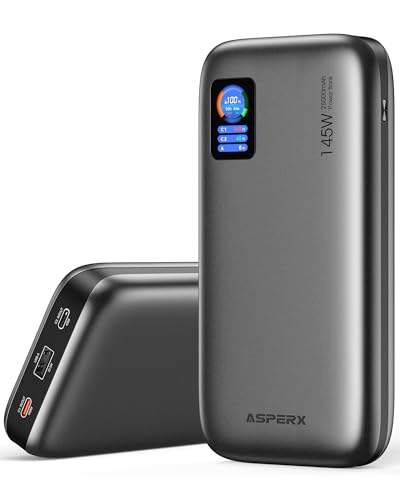
Portable chargers vary from basic emergency packs to high-wattage hubs. While simple LED dots only indicate remaining battery capacity, digital displays on models like the AsperX Laptop Power Bank or Belkin Portable Charger 25K show active output in real time. If you travel frequently by air, carrying certified power banks under 100Wh keeps your setup TSA-compliant while providing dependable power on the move.
Pros
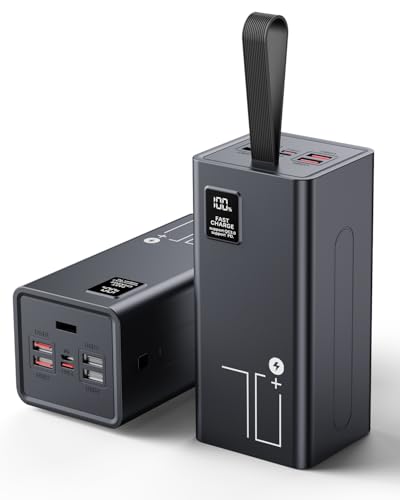
- Massive 70,000mAh capacity provides sustained power for extended outdoor trips or severe weather outages.
- Five output ports allow charging multiple phones and small accessories at the same time.
- Supports up to 30W fast charging via USB-A and 20W via USB-C for compatible mobile devices.
- Clear digital LCD screen displays exact remaining battery percentage rather than vague indicator dots.
- Integrated lanyard provides convenient hanging and carrying options around camp or in vehicles.
Cons
- Not permitted on commercial airplanes due to its massive 70,000mAh capacity exceeding passenger flight limits.
- Explicitly not compatible with laptops or high-wattage computing devices.
- Relatively heavy at approximately 1.85 pounds, making it better suited for packs and basecamps than pocket carry.
The Liahomco 70,000mAh Power Bank is an ultra-high-capacity portable battery pack engineered primarily for extended off-grid use, multi-day camping trips, road travel, and household emergency backup. Designed for users who need prolonged electrical independence away from wall outlets, this heavy-duty external charger acts as a centralized mobile power hub for smartphones, tablets, and personal electronics. While typical pocket chargers prioritize minimal weight for daily commutes, this unit prioritizes maximum stored energy, making it an excellent match for campers, outdoor festival attendees, families on road trips, and emergency-kit planners.
In terms of charging performance, the battery pack delivers up to 30W fast charging and supports both Power Delivery (PD) and Quick Charge 3.0 protocols. Connectivity includes five total outputs: two 30W USB-A ports, two 15W USB-A ports, and a bidirectional USB-C port offering up to 20W output. The manufacturer notes that compatible smartphones can reach up to a 60 percent charge in roughly 30 minutes under optimal fast-charging conditions. Compatibility extends to a broad range of 5V USB mobile gear, including iPhones, Android devices, tablets, handheld gaming consoles, camping fans, and Bluetooth audio accessories. However, the manufacturer explicitly notes that this power bank is not compatible with laptops, so shoppers seeking notebook power delivery must look elsewhere.
The physical design balances its substantial battery volume with practical handling features, measuring 2.56 x 2.56 x 5.91 inches and weighing approximately 1.85 pounds (30 ounces). The exterior housing features a built-in digital LCD screen that provides real-time tracking of remaining battery percentage, eliminating the ambiguity of standard four-dot LED lights. A firm, integrated lanyard is built directly into the chassis, allowing users to secure the unit to backpack straps, hang it from tent hooks at a campsite, or loop it securely around a wrist to prevent accidental drops. Internal safety circuitry includes built-in protection against overcharging, over-discharging, overheating, overcurrent, and short-circuit events.
Recharging a 70,000mAh battery pack requires patience and an appropriate power source, utilizing either the 18W USB-C input or the secondary Micro-USB input. Connecting devices is straightforward, with the system intelligently adapting output to match the power requirements of connected electronics across its five ports. Because the unit offers dual high-speed 30W ports alongside standard 15W ports, users can prioritize fast charging for depleted phones while simultaneously trickling power into lower-draw accessories like wireless earbuds or fitness trackers. The compact vertical brick profile sits stably on camping tables or nightstands, keeping multi-cable setups organized in shared spaces.
The most significant limitation of this power bank centers on travel regulations: due to its massive 70,000mAh capacity, it is strictly not allowed on commercial passenger aircraft under standard airline battery restrictions. Furthermore, at nearly two pounds, the unit is noticeably heavy and bulky compared to standard 10,000mAh or 20,000mAh everyday-carry chargers, making it impractical for pocket storage. Buyers must also consider that total available charging wattage is distributed across ports during multi-device use, and the lack of laptop support means it cannot serve as an all-in-one workstation charger.
For campers, road trippers, and homeowners preparing for storm-induced power outages, the Liahomco 70,000mAh Power Bank offers an exceptionally cost-effective way to keep essential mobile electronics running for days on end. However, frequent airline passengers and remote workers requiring laptop charging will need to choose a smaller, flight-compliant, high-wattage alternative. If your primary goal is maximizing stored backup energy for off-grid recreation or domestic emergency preparedness, this five-port powerhouse represents a very capable and practical investment.
The Liahomco power bank is equipped with a versatile array of seven total ports, dividing into five output ports and two input ports for flexible device management. The output configuration includes two 30W USB-A ports for Quick Charge 3.0 compatible devices, two standard 15W USB-A ports for secondary electronics, and one 20W USB-C port supporting Power Delivery. For replenishing the power bank itself, users can utilize the 18W fast-charging USB-C input or the secondary Micro-USB port, providing backup convenience if a specific charging cable is unavailable.
While the Liahomco 70,000mAh power bank is a standout companion for outdoor camping and overland vehicle travel, it is fundamentally unsuitable for air travel. Airline regulations prohibit lithium battery packs of this capacity on passenger planes, meaning this unit must remain strictly on the ground. For ground-based adventures, however, the integrated lanyard allows easy suspension inside tents or on pack exteriors, and the massive capacity ensures family devices, rechargeable lanterns, and emergency radios stay powered during extended stays away from electrical infrastructure.

Pros
- Integrated four-cable design eliminates the need to pack separate cords for Apple, Micro-USB, and USB-C devices
- Digital LED percentage display provides an immediate, exact reading of remaining battery life
- Supports charging up to five devices at the same time across ports and built-in cables
- Substantial 50,000 mAh listed capacity delivers days of off-grid mobile device recharges
Cons
- Maximum 22.5W output is designed for phones and tablets, making it unsuitable for high-power USB-C laptops
- A listed 50,000 mAh capacity exceeds standard 100Wh commercial airline carry-on limits without prior carrier approval
- Recharging such a large internal capacity takes several hours depending on the input power source
The YBYP 50000mAh portable charger is an ultra-high-capacity external battery pack engineered for road trippers, outdoor enthusiasts, campers, and household emergency kits. Designed to eliminate the headache of carrying multiple loose charging cords, this power bank integrates four separate cables directly into its compact frame. Weighing 0.75 pounds with physical dimensions of 4.8 by 3.1 by 1.1 inches, it packs a massive nominal battery reservoir into an accessible handheld form factor suitable for backpacks, gear totes, and glove compartments.
In terms of charging performance, the unit is rated for up to 22.5W fast charging through its supported outputs. According to the manufacturer, this output speed can recharge compatible smartphones like the Samsung Galaxy S25 up to 60 percent or an iPhone 17 up to 55 percent in approximately 30 minutes, though real-world charging speeds always depend on device battery limits and operating conditions. With the ability to charge up to five devices simultaneously using its combination of built-in cables and external ports, it easily accommodates phones, tablets, wireless earbuds, and smartwatches, though users should keep in mind that overall wattage is shared among connected electronics.
Hardware connectivity is the primary strength of this battery pack. It features four built-in cables: a Micro-B output, a USB-A input cable for recharging the power bank, a USB-C output, and a Lightning output. In addition to the hardwired cords, the chassis includes a Micro-B input port, a bidirectional USB-C input/output port, and a USB-A output port. A clear front-facing digital LED display indicates precise remaining battery percentage, offering a major upgrade over the vague four-dot status lights found on many competing high-capacity portable chargers.
Managing power on the go is straightforward due to the dual-input recharging setup, which allows users to recharge the power bank using either the integrated USB-A cable, the dedicated Micro-B port, or the bidirectional USB-C port. However, replenishing a 50,000 mAh cell requires patience and a reliable power source. Travel utility is also an important consideration: while this battery is well-suited for road trips, camping, and power outages, travelers should verify airline carry-on regulations before flying, as a 50,000 mAh rating typically exceeds standard 100Wh commercial flight thresholds without explicit airline permission.
Everyday limitations center around power allocation and charging capacity. The 22.5W maximum output is not intended to supply power-hungry USB-C laptops that demand 45W to 100W Power Delivery profiles. Additionally, while the integrated cables provide superb convenience, they are permanently fixed to the body, meaning users must rely on the open ports if an integrated cord sustains physical wear over extended use. The manufacturer integrates an 8-layer safety system covering overcurrent, overvoltage, short circuits, and thermal limits, though operating high-capacity lithium batteries under heavy simultaneous loads will naturally produce mild operational warmth.
This power bank is an excellent investment for families, campers, and emergency-preparedness shoppers who prioritize sustained multi-day smartphone battery life and clutter-free cable storage. Users who require laptop-grade Power Delivery or frequent flyers needing a strictly compliant sub-100Wh carry-on battery should look elsewhere, but for dependable, multi-device off-grid power, this unit offers exceptional versatility.
The YBYP 50000mAh portable charger provides an all-in-one charging setup designed to eliminate the need for third-party cords. The housing integrates four dedicated cables: a Micro-B output for legacy electronics, a USB-A input cable designed to recharge the power bank from any powered USB-A wall socket, a USB-C output cable for modern Android phones and tablets, and a Lightning output cable for compatible Apple devices.
In addition to the built-in cables, the unit features three independent connection ports along its housing. These include a Micro-B input port, a USB-A output port, and a bidirectional USB-C port that functions for both charging the internal battery and powering external electronics. This configuration allows simultaneous connection for up to five devices, making it simple to keep smartphones, tablets, and wearable accessories charged from a single hub.

Pros
- High 220W maximum power bank output easily handles multiple power-hungry devices at once
- Included 150W three-port charging base doubles as a stationary desktop power station
- Rapid 100W recharging capability reaches 50 percent capacity in just 27 minutes
- Smart app connectivity provides clear, real-time power tracking and display controls
- Includes a high-capacity 240W USB-C cable and a 24-month warranty
Cons
- Weighing approximately 1.12 pounds with a 5.78 x 1.75 x 1.96-inch frame, it is bulkier than basic phone power banks
- Powering the full six devices simultaneously requires the AC charging base to be plugged into an electrical outlet
- Presents an advanced, multi-piece charging system that may exceed the needs of casual single-device users
The Anker Prime Power Bank with Charging Base is a premium high-output portable power system engineered for hybrid professionals, power users, and multi-device travelers. Rather than serving solely as a standalone battery pack, this unit functions as a modular charging ecosystem that bridges desk-bound productivity and on-the-go backup power. With a listed nominal battery capacity of 20,100mAh, it provides substantial reserve energy for smartphones, tablets, and compatible work-from-anywhere gear without needing to hunt for wall outlets.
Charging capability is where this hardware distinctly stands out, offering up to 220W of maximum total output exclusively from the portable battery pack. The power bank features two USB-C ports and one USB-A port, while the included 150W charging base adds another three ports, allowing users to charge up to six devices simultaneously when docked. This flexible setup allows remote workers and frequent flyers to run multiple high-draw devices together at their desk or detach the main pack for rapid mobile power on the road.
The build quality reflects a modern, utilitarian aesthetic finished in Phantom Gray, measuring 5.78 x 1.75 x 1.96 inches and weighing approximately 1.12 pounds. The front of the battery pack houses a detailed digital display that provides real-time operational feedback. Beyond on-pack physical controls, users can connect through the companion mobile app to manage power flow, check live charging metrics, and customize display behavior directly from a smartphone.
Recharging the 20,100mAh battery pack is remarkably fast thanks to support for up to 100W input power. The manufacturer specifies that the battery can recharge to 50 percent in just 27 minutes when using the 100W maximum input from either the charging base or a direct USB-C source. The package includes a 3.3-foot USB-C to USB-C cable rated for up to 240W, a dedicated power cord for the charging base, and a travel pouch to keep cables organized during business commutes.
Despite its extensive power capabilities, there are a few practical considerations to keep in mind. At over one pound, the battery pack has a noticeable footprint that is better suited for laptop bags, backpacks, or briefcases than shallow pants pockets. Furthermore, utilizing all six ports requires the AC base station to be connected to wall power, meaning ultra-portable field use is limited to the three ports on the battery itself.
For business travelers, creative professionals, and tech enthusiasts who juggle multiple devices throughout the day, the Anker Prime bundle offers an exceptionally versatile dual-role charging solution. It streamlines desktop charging at home or the office while providing massive, fast-recharging mobile power whenever travel calls. Everyday commuters who only need to top up a single smartphone may prefer a smaller, pocket-sized alternative, but those with demanding productivity hardware will find strong everyday value here.
The included Anker Prime Charging Base acts as both a desktop power hub and a rapid drop-in dock for the portable battery pack. Delivering up to 150W of power across three dedicated charging ports, the base allows users to power everyday workstation accessories without depleting the portable battery. When combined with the two USB-C ports and single USB-A port on the power bank itself, the full setup can accommodate up to six devices at the same time.
This two-in-one configuration eliminates the clutter of multiple wall adapters on a desk while keeping the portable battery charged and ready to grab at a moment notice. Docking the battery pack onto the base engages high-speed contact recharging, creating a seamless transition between stationary workstation power and mobile productivity.
Recharging downtime is minimized through 100W maximum input support, enabling the 20,100mAh pack to reach a 50 percent charge in just 27 minutes. This high-speed input functions whether the battery is docked directly on the included charging base or connected through a capable high-wattage USB-C cable and wall source.
Smart monitoring is handled via integrated app connectivity, which communicates directly with the power bank. Users can inspect live power statistics, track energy distribution per port, and customize the unit digital display settings right from their phone. This added visibility gives travelers and power-conscious users precise oversight of their remaining battery capacity and real-time charging rates.

Pros
- Four built-in cables cover the most common connector types, reducing cable clutter and making it easy to charge phones, tablets, earbuds, and other devices without extra accessories
- Two additional ports (USB-A and USB-C) provide flexibility for devices that need a dedicated cable or for sharing power with others
- The 19mm-thick design is notably slimmer than many competing 20,000mAh power banks, improving pocket and bag portability
- Listed 22.5W fast charging may meaningfully speed up charging for compatible smartphones compared to standard 5W or 10W output
- The integrated Micro USB cable doubles as a carrying strap, adding a practical hands-free transport option
Cons
- The product description does not specify whether the USB-C port supports USB Power Delivery or other standardized fast-charging protocols, so laptop or higher-power device compatibility remains unclear
- Built-in cables are not replaceable - if one cable wears out or is damaged, the entire unit's convenience advantage is reduced
- No wall charger is mentioned as included, so buyers may need to supply their own USB-C or USB-A charger to recharge the power bank itself
The VRURC 20000mAh Portable Charger is a high-capacity power bank built around the convenience of four integrated charging cables and two additional output ports. This design targets multi-device users - particularly commuters, travelers, students, and families - who want a single charging solution that can handle iPhones, Android phones, tablets, earbuds, and e-readers without carrying a tangle of separate cables. VRURC positions this model as an all-in-one portable charging hub, and the built-in connector variety (Type-C, phone connector, Micro USB, and USB Type-A cable) supports that positioning well for everyday U.S. smartphone and tablet users.
The manufacturer lists a 20,000mAh battery capacity and a maximum 22.5W fast charging output, with a claim that compatible devices can reach up to 50% charge in roughly 30 minutes. It is important to understand that the 20,000mAh figure represents nominal battery capacity, not the exact amount of energy delivered to a connected device - voltage conversion, cable resistance, and device charging circuitry all reduce usable output. The manufacturer describes the unit as using dual premium cells to deliver the full listed capacity and states it provides approximately 3 to 4 full phone charges, though actual recharge counts will vary by phone model and battery size. The product description does not explicitly confirm USB Power Delivery, PPS, or Quick Charge protocol support on any port, so buyers who need a specific fast-charging standard for their devices should verify compatibility before purchasing.
Build quality centers on a slim 19mm profile measuring 6.14 x 2.75 x 0.75 inches and weighing under 0.77 pounds. The manufacturer highlights that this is 33 percent thinner than its previous version and slimmer than the typical 28-30mm thickness common among 20,000mAh power banks. The integrated Micro USB cable doubles as a carrying strap, which is a practical touch for hooking the unit onto a backpack or holding it during use. Six total charging connections - four built-in cables plus one USB-A port and one USB-C port - give the VRURC power bank genuine multi-device flexibility. However, the product data does not specify how output power is allocated when multiple devices charge simultaneously, so users should expect some reduction in per-device charging speed during multi-device use.
Setting up the VRURC power bank requires no special configuration - simply connect a device using one of the built-in cables or plug into the USB-A or USB-C port with your own cable. Recharging the power bank itself appears to be supported through the USB-C port, though the product listing does not specify a maximum input wattage or estimated recharge time, and no wall charger is mentioned as included. For daily carry, the slim form factor fits comfortably in most backpacks, laptop bags, and larger purses, and the strap feature adds a hands-free option that many competing power banks lack. The built-in cables eliminate the common frustration of forgetting or losing a cable, which is especially valuable for travelers, festival-goers, and students who move between locations frequently.
The biggest limitation of the VRURC 20000mAh power bank is the lack of explicit information about supported charging protocols. Without confirmed USB Power Delivery or PPS support, buyers who need guaranteed fast charging for newer iPhones, Samsung Galaxy devices, or Google Pixel phones at their maximum supported input speeds cannot be certain this unit will deliver protocol-negotiated fast charging. The built-in cables, while convenient, are not replaceable - wear or damage to any integrated cable reduces the unit's core value proposition. Additionally, the product description does not mention laptop charging compatibility, so users seeking a power bank to charge a MacBook, Chromebook, or Windows USB-C laptop should look for models with confirmed high-wattage USB-C PD output.
The VRURC 20000mAh portable charger is best suited for U.S. smartphone users, Android and iPhone owners, tablet users, and multi-device households who value the convenience of built-in cables and want a single power bank that covers most common connector types. It is a practical choice for commuters, airline travelers, road trippers, students, and anyone who frequently runs low on battery and wants a grab-and-go solution without managing separate cables. Users who prioritize confirmed USB Power Delivery support, laptop charging, or protocol-specific fast charging may want to consider a power bank with explicitly listed PD or PPS specifications. For everyday phone and tablet charging with maximum cable convenience, the VRURC's combination of 20,000mAh listed capacity, six charging connections, 22.5W listed output, and slim portable design makes it a compelling option in the multi-cable power bank category.
The VRURC 20000mAh power bank includes four built-in cables with Type-C, phone connector, Micro USB, and USB Type-A tips. This integrated cable design means most common smartphones, tablets, earbuds, e-readers, and small electronics can be charged without carrying any separate cables. The Micro USB cable doubles as a carrying strap, allowing the power bank to be held comfortably, hooked onto a backpack loop, or swung while walking.
In addition to the four built-in cables, the unit provides two extra ports - one USB-A and one USB-C - for devices that require a dedicated cable or for sharing power with someone else's cable. This brings the total number of charging connections to six, which is notably higher than most competing power banks in this capacity range. One important consideration is that built-in cables cannot be replaced if they wear out or become damaged, so careful handling of the cable tips and strain-relief points will help preserve long-term usability.
The VRURC power bank measures 6.14 x 2.75 x 0.75 inches and weighs approximately 0.76 pounds. At 19mm thick, the manufacturer states it is 33 percent thinner than its previous version and slimmer than the 28-30mm thickness typical of many 20,000mAh power banks. This makes it more practical for backpacks, purses, laptop bags, and even larger jacket pockets compared to bulkier high-capacity alternatives.
For travelers, the 20,000mAh listed capacity falls within the range that many airlines permit in carry-on luggage, though travelers should always verify current airline and regulatory battery rules before flying, as policies vary by carrier and jurisdiction. The slim profile and integrated strap add genuine everyday-carry convenience, making this power bank practical for commutes, campus use, office backup power, and outdoor activities like camping or festivals where outlet access is limited.
The manufacturer lists compatibility with iPhones, Samsung Galaxy phones, Google Pixel phones, iPads, AirPods, Kindles, and most tablets. The four built-in cable types - Type-C, phone connector, Micro USB, and USB Type-A - cover the connector requirements for the vast majority of current U.S. smartphones, tablets, wireless earbuds, portable speakers, and e-readers. The additional USB-A and USB-C ports extend compatibility to devices that use proprietary or less common cables.
The product description does not mention laptop charging compatibility, and without confirmed USB Power Delivery output specifications, this power bank should not be assumed to support charging MacBooks, Chromebooks, Windows laptops, or other higher-power USB-C devices. Users whose primary need is laptop charging should look for power banks with explicitly listed USB-C PD output at 30W or higher. For smartphone and tablet users, however, the VRURC's connector variety and listed 22.5W output should handle everyday charging needs for most popular devices on the U.S. market.

Pros
- Generous 5-foot length offers significantly more reach than standard short power bank recharge cords
- Broad compatibility with popular USB-C input battery brands including iWalk, Anker, and INIU
- Features FCC and CE safety certifications along with integrated overcharge and overheating protection
- Tangle-resistant, flame-retardant PVC jacket holds up well for everyday carry and travel storage
Cons
- Maximum charging current is capped at 2A, which is not designed for high-wattage USB Power Delivery fast charging
- Product specifications do not list data transfer capabilities, making it primarily a dedicated power cable
- Requires a separate USB power source or wall adapter, as only the charging cord is included
The JMDDS 5-Foot USB Fast Charging Cable is an aftermarket replacement and backup charging cord designed specifically for portable power banks equipped with a USB-C input port. While many mini power banks and portable chargers ship with impractically short 6-inch cables, this 5-foot cord targets everyday smartphone users, commuters, and travelers who need convenient reach to recharge their battery packs from wall sockets, desktop hubs, or bedside outlets. It directly serves owners of popular compact chargers from brands like iWalk, INIU, Anker, and Miady who want a dedicated recharge cord ready in their bag or on their desk.
Regarding electrical performance, the manufacturer rates this cable for a maximum current of 2A, supporting devices that accept between 500mA and 2000mA. This power range makes it suitable for replenishing small to medium-capacity power banks, such as iWalk 3350mAh, 9000mAh, and 10000mAh mini chargers, as well as standard portable batteries from BONAI, T-CORE, and Samsung that rely on 5V/2A input profiles. It does not advertise high-wattage USB Power Delivery (PD) protocols or laptop charging speeds, meaning it is tailored specifically for standard power-bank input speeds rather than fast-charging power-hungry workstations.
From a physical design standpoint, the cable uses a durable flame-retardant PVC jacket engineered to avoid stiff creasing and annoying knots during everyday carry. At 5 feet in length, it strikes a practical balance between extended reach and manageable bulk, easily coiling into a backpack pocket, purse, or travel organizer. Internally, the manufacturer highlights an integrated smart IC chip combined with FCC and CE certifications, designed to monitor charging status and help protect against overcurrent, overheating, and overcharging by shutting off power once the connected battery reaches full capacity.
Daily handling is straightforward, requiring users to connect the standard USB-A connector into a compatible wall block or USB port and the USB-C connector into the power bank input terminal. For frequent fliers, students, and office workers, the extra length makes hotel rooms, airport charging kiosks, and classroom desks much easier to navigate without leaving an expensive power bank dangling in midair. Cable management remains simple due to the flexible PVC construction, which resists curling up awkwardly on hard surfaces.
Realistic limitations center primarily on charging throughput and multi-function versatility. With a 2A maximum current ceiling, this cable will charge high-capacity power banks at a steady, moderate pace rather than modern high-wattage Power Delivery rates, and it cannot power USB-C laptops or tablets requiring 30W or greater. Additionally, the manufacturer does not specify data transfer rates or sync capabilities, so shoppers should view this strictly as a dedicated charging cable rather than an all-in-one data link. A separate USB wall adapter is also required, as none is included in the package.
For owners of iWalk, INIU, Anker, or similar compact portable chargers seeking an affordable, extended-length replacement recharge cord, this JMDDS cable represents a practical and cost-effective purchase. Commuters and travelers who are tired of struggling with stubby cables will appreciate the 5-foot slack and integrated safety protections. However, users seeking rapid high-wattage USB-C PD recharge times for large 65W or 100W laptop power banks should look toward high-amperage, E-marked Type-C cords instead.
The JMDDS charging cable is engineered specifically for external battery packs that utilize a USB-C input port for recharging. The manufacturer lists broad compatibility across standard portable chargers, including iWalk models (3350mAh, 9000mAh, and 10000mAh capacities), INIU portable packs, Anker PowerCore batteries, BONAI, T-CORE, Miady, BSYYO, and Samsung portable power banks.
With a rated current capacity ranging from 500mA to 2000mA (2A maximum), this cable matches the typical input requirements of compact everyday-carry battery packs. Users should confirm that their power bank features a USB-C input socket prior to purchase, as legacy devices with Micro-USB inputs will not connect without an adapter.
Safety is supported by FCC and CE certifications alongside an internal smart IC chip designed to regulate the power feed. According to product specifications, this internal circuitry helps identify full battery status to halt charging automatically, guarding connected devices against overcharging, overcurrent, and potential overheating.
The physical exterior is constructed from flame-retardant PVC material crafted to withstand regular bending and coiling. Its anti-knot and anti-crease characteristics make it easy to pack into commuter bags or travel kits without wrestling with tangled wires.


Pros
- Huge 80,000 mAh capacity can power up to eight devices simultaneously across seven ports and one wireless pad
- Fast 35W USB-C PD output delivers rapid charging for compatible phones, Switch consoles, and small electronics
- Durable IP66 weather-resistant construction with a 300-lumen LED light and SOS strobe for outdoor safety
- UL-certified battery cells paired with built-in short-circuit and temperature protection mechanisms
Cons
- At roughly 2.25 pounds with an 80,000 mAh capacity, it is strictly not approved for commercial airline travel
- The 5W built-in solar panel provides only slow trickle charging intended strictly for off-grid emergencies
- Heavier and bulkier form factor is suited for vehicle camping or home prep rather than everyday pocket carry
The Feidyns 80000mAh Power Bank is an ultra-high-capacity rugged portable charging station engineered specifically for prolonged off-grid power, outdoor camping, and disaster preparedness. Instead of targeting commuters looking for a pocket-sized battery pack, this unit functions as a centralized power hub capable of keeping essential electronics running for days at a time. It best suits campers, outdoor enthusiasts, road trippers, and emergency-preparedness planners who require multi-day reliability and multi-device support far from traditional electrical outlets.
Charging performance is anchored by a 35W USB-C Power Delivery port alongside Quick Charge 3.0 compatibility, which the manufacturer states can charge an iPhone to 50% in roughly 18 minutes. The battery pack also integrates a 15W wireless charging pad directly on its top housing, alongside seven output ports to recharge as many as eight devices simultaneously. The internal circuitry automatically manages power delivery across connected devices, adapting down to 7.5W for low-power gear like AirPods or up to 35W for compatible handheld devices such as gaming consoles and VR headsets. Shoppers should keep in mind that the 80,000 mAh rating reflects nominal internal battery capacity, and natural voltage conversion will affect the total delivered energy reaching connected gear.
Physical durability and outdoor readiness are prominent strengths of the exterior design. The enclosure features an IP66 water and dust protection rating, helping it withstand rainstorms, splashes, and campsite dirt. A high-output 300-lumen LED flashlight is built directly into the housing, offering both standard illumination and an SOS emergency strobe mode for night-time trail safety or unexpected power outages. The unit also includes an integrated military-grade carrying strap rated to withstand up to 200 pounds of pulling force, making it easy to lash to outdoor gear or carry around a campsite.
Operating and monitoring the power bank is straightforward thanks to its dedicated indicator array. Four blue LEDs track battery reserves in 25%, 50%, 75%, and 100% stages, while dedicated top status lights flash red during active wireless charging and green when the solar panel is capturing sunlight. For initial setup, the manufacturer instructs users to fully charge the unit to 100% and completely drain it to 0% three consecutive times to calibrate the cells. Routine recharging should be done via a high-wattage wall charger or car outlet, as the 5W built-in solar panel is designed exclusively as an emergency power trickle when no other electrical source exists.
The primary tradeoff of this high-capacity unit centers on portability and travel compliance. Because of its massive 80,000 mAh capacity and 2.25-pound weight, this power bank is explicitly not approved for commercial airline flights under standard FAA and international aviation battery rules. Furthermore, while the solar panel provides peace of mind in survival scenarios, charging an 80,000 mAh battery solely via sunlight takes an extensive amount of time. Its footprint makes it ideal for vehicle storage, camping bins, or storm kits rather than everyday backpack commuting.
The Feidyns 80000mAh Power Bank represents a compelling choice for outdoor adventurers, overland campers, and families building a resilient emergency kit. Users needing a lightweight battery for daily pocket carry or air travel should look to a standard sub-100Wh portable charger instead. For buyers whose top priority is dependable multi-day energy storage, simultaneous multi-device capability, and rugged weather protection in remote settings, this heavy-duty power bank offers outstanding utility.
The integrated solar panel on the Feidyns power bank provides a rated 5W emergency input designed to capture ambient sunlight when grid power is completely unavailable. The manufacturer explicitly emphasizes that solar input should be treated as an emergency backup method rather than a primary everyday recharge solution. Given the massive 80,000 mAh internal capacity, complete solar replenishment requires prolonged sun exposure, making wired wall or vehicle charging the recommended primary recharge method prior to heading outdoors.
Beyond auxiliary solar collection, the charger incorporates critical survival tools including a 300-lumen emergency LED light. This lighting system features an SOS strobe mode to assist with nighttime visibility, outdoor roadside breakdowns, and emergency signaling. For long-term emergency kit storage, the manufacturer recommends keeping the battery pack stored at approximately 50% charge to maximize cell preservation and long-term shelf life.
A critical consideration for prospective buyers is that the Feidyns 80000mAh Power Bank is not approved for commercial airline travel. Standard FAA and international aviation safety regulations restrict spare lithium-ion batteries over 100Wh to 160Wh without explicit airline pre-approval, and batteries exceeding 160Wh are strictly prohibited from passenger aircraft cabins and checked baggage alike. With an 80,000 mAh nominal capacity, this unit substantially exceeds allowable passenger flight limits.
Consequently, this battery pack is best suited for ground transportation, overland travel, RV trips, boating, car camping, and residential emergency backup. Road trippers and campers can readily transport the 2.25-pound device in a vehicle or backpack, but flyers must select a smaller, flight-compliant power bank rated at or below 100Wh for carry-on luggage.
Frequently Asked Questions About Power Bank Speed
Can you check power bank charging speed using the built-in display?
Yes, power banks with smart digital screens or TFT displays show live output wattage directly on the unit. Products like the AsperX Laptop Power Bank indicate active power transfer in watts, eliminating guesswork during use. Basic battery packs only show remaining capacity dots, requiring you to check the printed port specifications on the casing instead.
Does a higher mAh capacity mean a power bank charges faster?
No, milliamp-hour (mAh) capacity measures total stored energy rather than charging speed. Speed depends entirely on output wattage negotiated through protocols such as USB Power Delivery or Quick Charge. Comparing options like budget 20000mAh power banks illustrates how two chargers with identical capacities can offer completely different charging speeds.
How do you check if a power bank supports fast laptop charging?
You must verify that the USB-C port lists USB Power Delivery with an output rating of at least 45W to 140W. Dedicated laptop power banks clearly display these high-wattage specifications on their spec labels. Connecting a modern laptop to a standard 15W phone port will either charge extremely slowly or trigger an underpowered charger warning.
Why does charging speed drop when connecting multiple devices?
Most multi-port battery packs split total wattage across active connections to manage heat and prevent overload. When you plug in a secondary device, internal circuits often throttle the primary USB-C port down to standard speeds. Reviewing the manufacturer’s shared output specifications will show how wattage divides across ports during 2026 use.
Can you check charging speed directly on a smartphone screen?
Yes, many Android phones show charging badges like “Fast Charging” or “Super Fast Charging” directly on the lock screen. iPhones do not show wattage readouts, but compatible models reach around 50% in 30 minutes when connected to an 18W or higher USB PD port. For absolute precision, an inline USB tester between the cable and the power bank measures true real-time wattage.
Does the charging cable affect power bank charging speed?
Yes, an under-rated charging cable will restrict power delivery even if the power bank supports high output. Charging speeds above 60W require an E-marker chip in the USB-C cable to negotiate safe higher current. Always match your cable’s rated capacity with your charger’s maximum single-port output.


Write Your Review
No reviews yet. Be the first to share your experience!