


Reliable Backup Power for Demanding Mobile Days
Running out of battery during a busy workday or long commute creates unnecessary hassle, especially when navigation and media apps drain your device quickly. Finding the best power bank for motorola phones in 2026 requires evaluating real-world energy storage, reliable wired outputs, and convenient cable setups that keep hardware running without interruptions. A thorough review of listed specifications, such as battery capacity and charging protocols, helps clarify which pack balances raw power with everyday convenience. Before picking a heavy battery brick, checking a specs comparison of power bank features illustrates how output wattage and cell ratings impact your charging routine.
Modern high-capacity portable packs eliminate low-battery stress by pairing generous milliamp-hour reserves with versatile multi-port hubs. Models supporting USB Power Delivery and Quick Charge supply rapid top-offs to compatible handsets without keeping you tied to a wall outlet for hours. Many options also integrate built-in cables, reducing the clutter of carrying loose cords inside a backpack or bag. Massive battery cells over 30,000mAh deliver days of backup during blackouts or camping trips, making them dependable power partners when portable energy matters most.

Pros
- Substantial 40,800mAh capacity provides sustained off-grid power for multiple phone recharges
- Built-in cables for both iPhone and USB-C devices mean you can leave spare charging cords behind
- Supports 25W fast-charging protocols including USB PD and Quick Charge for compatible phones
- Clear digital LED readout provides exact battery level monitoring rather than vague indicator dots
- Includes a generous 3-year warranty and a secondary USB-C cable in the box
Cons
- Explicitly restricted from commercial airline travel due to its high battery capacity rating
- Weighs approximately 14.5 ounces and measures over an inch thick, making it too bulky for pocket carry
- Maximum 25W output is intended for smartphones and tablets rather than high-draw USB-C laptops
The LanLuk 40,800mAh Portable Charger is a heavy-duty external battery pack designed for users who require extended off-grid energy without carrying a bundle of loose charging cables. Built around a substantial nominal battery capacity and integrated wiring, this portable power bank serves primarily as an all-in-one charging station for road trips, camping weekends, family outings, and emergency blackout preparedness. It is tailored for smartphone owners, tablet users, and multi-device households looking for dependable backup power away from standard wall outlets.
Charging performance centers on a maximum output of 25W, which supports common fast-charging standards such as USB Power Delivery (PD) and Quick Charge (QC). The manufacturer lists wide device compatibility, including recent iPhone 15, 16, and 17 models, Samsung Galaxy and Google Pixel handsets, iPads, portable gaming consoles, headphones, and small USB-powered fans. Because it can charge up to five devices simultaneously across three physical ports (one USB-C, two USB-A) and two built-in output leads (USB-C and iOS), it functions effectively as a shared hub for groups. When distributing power across multiple connected devices, users should expect charging speeds to adjust based on connected loads.
The physical design prioritizes utility and cord management. Measuring 5.90 by 2.67 by 1.18 inches and weighing roughly 14.5 ounces (410 grams), the black housing is sturdy and functional, though noticeably substantial in hand. LanLuk integrates three flexible cables directly into the frame: a USB-A cable dedicated to recharging the power bank, a USB-C cable for modern Android devices and newer iPhones, and an iOS connector for Lightning-equipped hardware. According to manufacturer specifications, these cables are rated for over 30,000 bends, reducing the worry of early cord failure. An integrated digital LED screen provides an intuitive numeric readout of remaining battery percentage, which is far more precise than traditional four-dot status lights.
Routine operation and recharging are straightforward due to dual-input flexibility. The battery pack can be replenished by plugging its integrated USB-A cable directly into a standard USB wall plug, or by connecting a separate USB-C cable to the onboard USB-C port. The package includes an auxiliary Type-C cable, a user manual, and a 3-year manufacturer warranty. For everyday carry in a commuter backpack, daypack, or vehicle glove compartment, the self-contained design proves convenient because you do not need to hunt for charging cords before stepping out the door.
A critical limitation of this power bank involves air travel regulations. The manufacturer explicitly notes that this 40,800mAh unit cannot be carried on commercial flights due to battery capacity limits set by aviation security guidelines. Additionally, at roughly 0.9 pounds, this is not an ultralight pocket charger; carrying it in a jacket or pants pocket is impractical. Furthermore, while the 25W maximum output is plenty for mobile phones and handheld gear, it does not supply the higher wattages required to charge standard USB-C laptops or modern high-draw notebooks.
The LanLuk 40,800mAh Portable Charger is best suited for campers, road trippers, outdoor enthusiasts, and emergency-kit planners who want massive reserve capacity and built-in cables at an approachable price point. Frequent airline flyers and ultralight commuters should seek smaller sub-100Wh, pocket-friendly alternatives. For ground-based travel and storm backup, its combination of generous reserve power, versatile five-device connectivity, and cable-free convenience makes it a compelling value.
The LanLuk 40,800mAh portable charger features a versatile array of five total outputs and two recharging inputs, making it adaptable to varied charging environments. Output options include two standard USB-A ports, one bidirectional USB-C port, an integrated USB-C output cable, and an integrated iOS output cable. This layout allows users to charge up to five phones, tablets, or small mobile accessories at the same time without needing separate charging cords.
Recharging the power bank is equally flexible thanks to dual input pathways. Users can recharge the battery pack directly via the built-in USB-A input cable by plugging it into a powered USB charging block or vehicle port, or utilize the dedicated USB-C port with a compatible wall adapter. This redundancy ensures you are never stranded without a way to top up the battery pack itself.
Prospective buyers must note that this portable charger cannot be taken on passenger airplanes. Because of its large 40,800mAh capacity rating, it exceeds standard airline lithium battery limits for carry-on luggage, and lithium battery banks are strictly forbidden in checked bags. Travelers looking for airline-compliant backup power should choose a smaller model rated under 100 watt-hours.
For ground travel, vehicle camping, and home emergency preparation, the unit offers built-in electrical protection systems. The manufacturer incorporates safety protocols to safeguard against overcharging, overcurrent, and short circuits during heavy use. Combined with a digital LED battery meter to track remaining reserves, it provides reliable off-grid utility when wall outlets are inaccessible.
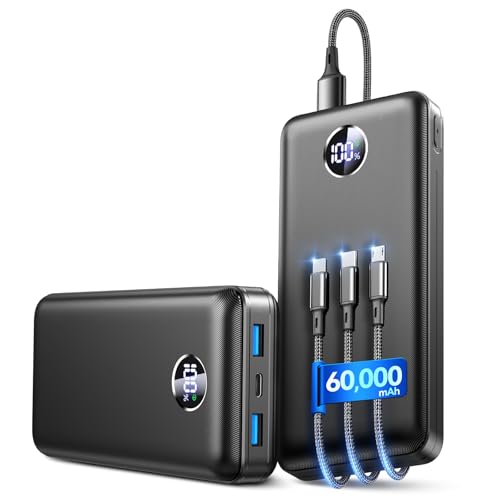
Pros
- High listed 60,000mAh capacity provides extensive reserve power for prolonged power outages and remote outings.
- Integrated 3-in-1 cable eliminates clutter by offering USB-C, iOS, and Micro-USB plugs directly on the unit.
- Digital battery display shows the exact remaining charge percentage instead of vague LED indicator dots.
- Supports broad fast-charging protocols including Power Delivery, Quick Charge, SCP, FCP, and AFC up to 22.5W.
Cons
- Nominal capacity of 60,000mAh generally exceeds standard airline carry-on limits (100Wh), making it unsuitable for commercial flights without prior carrier approval.
- Charging up to five devices simultaneously shares the overall power output, resulting in slower individual charging speeds.
- Requires a separately purchased fast-charging wall adapter to replenish such a massive battery pack efficiently.
The IAPOS 60000mAh portable charger is a high-capacity external battery pack engineered for users who need extensive off-grid power for multiple devices. With a manufacturer-listed 60,000mAh capacity and 22.5W maximum output, this charger best suits road trippers, campers, festival attendees, and emergency-preparedness planners looking to maintain battery reserves through long power interruptions. The tethered cable design particularly caters to multi-device owners who want to charge smartphones, tablets, and mobile electronics without packing a tangle of loose cords.
Real-world charging flexibility is driven by broad protocol support and multi-port connectivity. The power bank supports USB Power Delivery (PD), Quick Charge (QC), SCP, FCP, and AFC, allowing it to supply up to 22.5W of wired power to compatible devices. The manufacturer states that compatible phones can reach up to 60% battery in 30 minutes, though actual charging speeds depend on connected hardware protocols and thermal limits. The unit can charge up to five devices simultaneously using its two standard USB-A ports, one USB-C port, and the integrated 3-in-1 cable featuring USB-C, iOS, and Micro-USB connectors.
Physically, the charger measures 5.9 by 2.95 by 1.1 inches and weighs 0.97 pounds (15.5 ounces), sporting an ink-black finish with a scratch-resistant outer shell. While noticeably substantial in hand, the exterior remains relatively manageable for storage inside a backpack, glove compartment, or storm-preparedness bin. The front surface includes an integrated intelligent digital display that indicates precise battery percentage, eliminating guesswork about how much energy remains. The tethered 3-in-1 cable slots neatly into the body for streamlined everyday transport.
Daily operation is straightforward, with automatic device detection managed by an internal intelligent chipset. You can plug in multiple electronics simultaneously, such as an iPhone, an Android tablet, and wireless earbuds. Recharging the large internal cell array requires planning, as a power bank of this nominal capacity takes considerable time to replenish. To achieve reasonable recharge times, users should connect the power bank to a compatible fast-charging USB-C wall adapter, which must be supplied separately since only a 3-in-1 cable is included in the package.
The most critical limitation for buyers involves air travel regulations and total output sharing. Because a 60,000mAh nominal capacity significantly exceeds the standard 100Wh threshold enforced by the FAA and international airlines, this battery pack is generally restricted on commercial passenger flights without prior airline approval. Additionally, while the unit can power five gadgets simultaneously, the 22.5W peak power is split among connected ports, reducing charging speeds when several power-hungry devices are plugged in at once. It also does not supply the high-wattage power required for USB-C laptops.
For emergency backup, camping trips, and multi-phone family outings where wall sockets are unavailable, the IAPOS 60000mAh battery pack represents a strong choice with versatile cable connectivity. However, airline commuters and business travelers needing lightweight, flight-approved carry-on packs or 65W laptop charging should opt for a smaller, dedicated travel power bank. If long runtime, cord-free convenience, and multi-device backup are your top priorities, this high-capacity unit makes a practical addition to any emergency kit or road-trip setup.
The IAPOS power bank offers comprehensive port flexibility designed to accommodate diverse charging standards simultaneously. It includes two USB-A output ports, one USB-C port, and a built-in 3-in-1 charging cable equipped with USB-C, iOS, and Micro-USB connectors.
This arrangement allows users to power up to five electronic devices at the same time, making it practical for multi-device owners who want to eliminate cable clutter. The integrated cable ensures you always have the right connector available for modern Android phones, Apple devices, older peripherals, and portable electronics.
Equipped with a Multi-Safety Architecture, the IAPOS portable charger incorporates an AI intelligent chipset that actively monitors electrical performance. This protective system guards against common risks including overcharging, short circuits, overcurrent, and excessive operating temperatures.
These onboard safeguards help preserve the lifespan of connected smartphone batteries and sensitive electronics like tablets, drones, and wireless earbuds. As with all high-capacity lithium battery packs, users should avoid exposing the device to extreme heat, moisture, or physical impacts to ensure dependable operation.

Frequently Asked Questions
Can high-capacity power banks over 30,000mAh be taken on commercial flights?
No, external battery packs exceeding 27,000mAh (roughly 100 watt-hours) are generally restricted from commercial airline cabins under standard aviation safety rules. The LanLuk 40,800mAh and RGVOTA 38,800mAh models explicitly note that they cannot be carried on passenger flights. These oversized units are built specifically for road trips, camping, emergency power outages, and extended off-grid use.
Does a USB-C port automatically guarantee fast charging?
No, a USB-C port refers only to the connector shape and does not guarantee high-speed charging capabilities. Rapid charging requires dedicated protocol support like USB Power Delivery or Quick Charge across the charger, cable, and connected phone. Packs such as the IAPOS 22.5W charger explicitly support these protocols, enabling faster power delivery to compatible devices than standard 5W ports.
How does charging multiple devices at once affect output speeds?
Charging multiple gadgets simultaneously divides the power bank’s total wattage across all active ports, lowering individual charging speeds. While a multi-port unit can keep five devices connected at once, sharing the maximum wattage ceiling means each phone receives a smaller power share. For the fastest recharge on a primary handset, connecting a single phone directly yields the best speed.
What is the difference between advertised mAh and usable battery capacity?
Advertised milliamp-hours describe the total internal cell capacity at nominal voltage, whereas actual delivered energy is lower due to normal conversion losses. Internal lithium cells operate around 3.7 volts and must step up to standard USB voltages, generating minor heat and energy loss during transfer. Consequently, no battery pack delivers 100 percent of its nominal capacity to external devices.
Can these portable chargers power USB-C laptops?
No, portable chargers with maximum outputs of 22.5W or 25W generally do not provide enough power to run standard USB-C laptops. While a notebook might accept a very slow trickle charge while powered completely off, active laptop operation typically requires 45W to 65W. Comparing options like a universal Anker power bank under 25 dollars or reviewing a best Anker power bank with wall plug can help identify which dedicated power accessories match your exact mobile hardware.






Write Your Review
No reviews yet. Be the first to share your experience!