


Running out of phone battery during a weekend camping trip or extended outdoor excursion turns essential navigation and emergency communication into an immediate headache. Carrying multiple loose charging cords and waiting near scarce electrical outlets wastes valuable time away from the trail. Investing in an easy setup solar power bank under 100 dollars provides an accessible off-grid safety net without breaking your gear budget. Units equipped with multi-panel solar arrays and integrated cords simplify outdoor battery management by eliminating forgotten accessories. Exploring an iphone 17 solar power bank alternative highlights different charging speeds and portable configurations.
A high listed capacity such as a 48000mAh lithium-polymer battery delivers extensive backup reserve, though users should distinguish nominal capacity from actual usable output after standard voltage conversion losses. Foldable four-panel arrays capture daylight noticeably faster than single-panel backup bricks, yet wall recharging remains the fastest method to replenish high-capacity packs before leaving home. Versatile ports and built-in charging cables allow concurrent power delivery across several devices, including wireless charging pads for Qi-compatible phones. Shoppers on tighter budgets might consider an ultra fast solar power bank under 40 dollars, though spending slightly more secures larger battery reserves and multiple charging surfaces.
Pros
- Substantial 48,000 mAh battery capacity delivers extensive reserve energy for multiple recharges away from wall outlets
- Four foldable solar panels provide viable supplemental off-grid replenishment during sunny outdoor excursions
- Built-in array of four charging cables and a wireless surface means users do not need to bring separate wires
- Simultaneous multi-device support allows powering up to seven compatible phones, accessories, or tablets at once
- Bidirectional USB-C port handles both charging the power bank and outputting up to 5V/3A to external devices
Cons
- Substantial 1.57-inch thickness and heavy form factor make it impractical for everyday pocket carry
- Exceeds typical 100-watt-hour commercial airline carry-on thresholds, making it unsuitable for passenger flight travel
- Maximum USB-C output is rated at 5V/3A (15W), which lacks the higher-wattage USB Power Delivery protocols needed for laptops
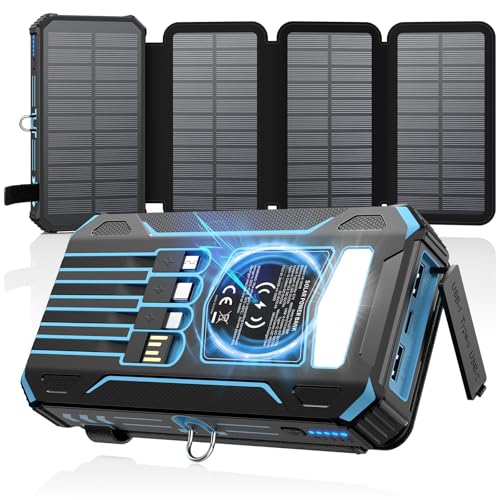
This is a heavy-duty, high-capacity portable solar power bank engineered specifically for outdoor adventures, multi-day camping trips, road travel, and household emergency backup. The SOARAISE 48000mAh model combines a large lithium-polymer battery reserve with a four-panel folding solar array, integrated output cables, standard USB ports, and a wireless charging deck. It best suits outdoor enthusiasts, families on camping trips, and emergency preppers who prioritize maximum stored runtime and standalone charging convenience over lightweight pocket portability.
The central functional advantage of this battery pack is its expansive multi-device power delivery. The manufacturer lists a nominal battery capacity of 48,000 mAh, which provides ample reserve power for repeatedly topping up smartphones, headlamps, tablets, and portable GPS units. Charging output is anchored by a 5V/3A USB-C port, which the manufacturer states can boost an iPhone from 15% to 60% in roughly 30 minutes. In addition to the USB-C port, the pack includes two USB-A output ports, four attached cables (USB-C, Phone connector, USB-A, and Micro-USB), and a top-mounted wireless charging pad. This versatile configuration supports charging up to seven devices simultaneously, making it an effective shared power station for group outings.
In terms of physical build and design, the unit measures approximately 6.38 inches long, 3.43 inches wide, and 1.57 inches thick. The four foldable solar panels unfold outward to maximize sun exposure during basecamp use and fold securely against the thick blue housing when packed. The four integrated cables snap flush into dedicated grooves on the chassis, minimizing clutter and preventing snagging in a backpack. While the thick housing adds noticeable mass, the integrated structure protects the internal cells and keeps all necessary charging connectors attached to the unit at all times.
Daily operation and recharging require an understanding of how large-capacity battery packs function. For routine preparation before a trip, replenishing the battery bank via the bidirectional 5V/3A USB-C input from a standard wall adapter is the fastest and most dependable method. The four high-efficiency solar panels serve as a supplemental off-grid charging solution, capturing ambient sunlight while resting at a campsite or strapped to gear. Given the immense 48,000 mAh capacity, direct solar exposure is intended to extend operating time and provide emergency top-ups rather than rapidly recharging the depleted battery pack from zero to full.
Buyers must consider a few distinct trade-offs before choosing this model. The most significant restriction involves air travel: a nominal 48,000 mAh battery capacity far exceeds standard FAA and airline carry-on limits, which typically cap unapproved lithium-ion consumer batteries at 100 watt-hours (roughly 27,000 mAh). Consequently, this battery pack is strictly an overland, road-trip, camping, and home-emergency device rather than a flight companion. Additionally, while the 5V/3A (15W) output is sufficient for rapid phone charging, it does not support higher-wattage USB Power Delivery (PD) protocols required to power modern USB-C laptops.
The SOARAISE 48000mAh Solar Power Bank is highly recommended for car campers, overlanders, cabin owners, and emergency-kit planners who want an all-in-one charging station that requires no loose cords. Users who need an ultra-lightweight commuter battery, a fast laptop charger, or an airline-approved travel companion should choose a smaller, dedicated USB PD power bank instead. For off-grid preparedness and multi-device wilderness utility, its combination of folding solar panels, integrated cables, and massive battery capacity provides solid practical value.
The SOARAISE power bank stands out from conventional single-panel solar chargers by incorporating four foldable high-efficiency solar panels. According to manufacturer specifications, this multi-panel array gathers solar energy up to five times faster than standard single-panel alternatives, providing meaningful trickle charging when completely disconnected from grid power during long outdoor stays.
Versatility is further enhanced by its ability to power up to seven compatible devices at once. With four integrated cords (USB-C, Phone, USB-A, and Micro-USB), two USB-A output ports, a bidirectional USB-C port, and a wireless charging pad, the unit can simultaneously supply power across modern and legacy electronics without requiring you to carry a separate pouch of charging cables.
When planning trips, travelers must note that the 48,000 mAh capacity places this battery pack well above the standard 100-watt-hour threshold enforced by most commercial airlines for carry-on luggage. Because lithium-polymer power banks of this size are prohibited on commercial flights, this charger is intended strictly for ground-based travel, including road trips, RV outings, and backpacking expeditions.
Measuring approximately 1.57 inches thick, this model prioritizes rugged reserve capacity over pocket-friendly dimensions. It is best carried inside a backpack side sleeve, gear tote, or glove compartment where its integrated cables and durable casing can serve as a dependable, self-contained basecamp charging hub.

Pros
- Substantial 48,000 mAh nominal battery capacity provides extensive power reserves away from wall outlets
- Four built-in cables offer complete all-in-one charging convenience without packing extra cords
- Fold-out four-panel solar array significantly improves outdoor solar energy capture compared to single-panel alternatives
- Supports wired, port-based, and wireless charging simultaneously for up to seven devices
Cons
- Substantial 1.57-inch thickness and heavy build make it impractical for standard pocket carry
- High 48,000 mAh nominal capacity exceeds the standard 100 Wh airline carry-on threshold for commercial flights
- Maximum 5V/3A (15W) output does not support high-wattage USB Power Delivery for charging laptops
The SOARAISE 48000mAh Solar Power Bank is an outdoor-focused, high-capacity portable charger engineered for campers, road trippers, emergency-preparedness shoppers, and multi-device users who spend extended time away from AC outlets. Equipped with a massive 48,000 mAh lithium-polymer battery and four foldable solar panels, this unit serves primarily as a self-contained power hub. It is best suited for outdoor recreation, base camps, and severe weather backup where carrying separate cables and finding wall power are difficult.
Charging capability focuses on device versatility and simultaneous power sharing. The charger features a 5V/3A (15W) USB-C port that the manufacturer states can boost an iPhone from 15% to 60% in approximately 30 minutes, alongside two standard USB-A outputs and an integrated wireless charging pad. The system supports charging up to seven devices at the same time across its cables, ports, and wireless surface. Compatible phones include the iPhone 12 through iPhone 17 series as well as Samsung Galaxy S21 through S24 models. Buyers should understand that nominal battery capacity does not equal delivered energy to devices due to normal voltage conversion, thermal overhead, and cable resistance.
The build design emphasizes all-in-one convenience with an outdoor aesthetic. Measuring 6.38 by 3.43 by 1.57 inches, the unit combines a rugged black shell with high-visibility orange accents for quick locating in a backpack or survival tote. Rather than relying on a single small solar cell, it incorporates four fold-out solar panels that unfold to capture sunlight and snap securely against the casing for transport. Four built-in charging cables-USB-C, Phone, Micro-USB, and USB-A-tuck cleanly into molded grooves on the chassis, preventing cable tangles and ensuring support for both modern and legacy devices.
Daily operation and recharging depend on your power source and environment. While the quad-panel solar system is rated by the manufacturer to harvest energy up to five times faster than standard single-panel banks, portable solar charging remains an emergency and supplementary option rather than a quick replacement for grid electricity. For routine use, users should fully replenish the 48,000 mAh pack via wall adapter prior to leaving home, utilizing the solar panels to top off energy during sunny outdoor activities.
There are several realistic limitations buyers must consider before purchasing this model. At over 1.5 inches thick, this battery pack is noticeably bulky and unsuitable for everyday pocket carry or slim purse storage. In addition, its 48,000 mAh rating at typical 3.7V lithium-polymer voltage translates to roughly 177 Wh, which exceeds the standard 100 Wh limit set by the FAA and major international airlines for passenger carry-on bags. Furthermore, the 5V/3A charging ceiling provides standard smartphone fast charging but lacks the higher-wattage USB Power Delivery or PPS protocols required to power full-size laptops.
This solar portable charger is an outstanding choice for outdoor enthusiasts, tailgaters, road trippers, and families preparing home emergency storm kits who need high-capacity backup and total cable independence. Commuters seeking a lightweight pocket companion or air travelers needing a TSA-friendly flight charger should look toward smaller 10,000 mAh or 20,000 mAh battery packs. For off-grid resilience and multi-device camping convenience, the SOARAISE 48000mAh model offers exceptional utility in a durable package.
The SOARAISE 48000mAh Solar Power Bank delivers wide-ranging device connectivity designed to streamline mobile charging without requiring loose cords. The integrated cable array features dedicated USB-C, Phone, Micro-USB, and USB-A plugs, ensuring immediate compatibility with modern smartphones, older electronics, and rechargeable camping accessories.
Beyond the built-in cables, the power bank includes three dedicated ports: two USB-A output ports and a bidirectional USB-C input/output port rated up to 5V/3A. Together with the top-mounted wireless pad, the unit can distribute power to as many as seven connected devices simultaneously, functioning as a practical charging station for group outings and family trips.
Featuring four foldable high-efficiency solar panels, this portable charger captures sunlight up to five times faster than traditional single-panel solar banks according to manufacturer claims. The folding panel design unfolds quickly to maximize surface area under direct sun and folds flat against the body for easy packing.
While the solar panels provide valuable off-grid maintenance and emergency power during extended wilderness trips or power outages, natural solar charging speeds depend heavily on sunlight intensity and outdoor conditions. For best results, users should fully charge the battery via a wall charger before trips, using solar input to supplement power while off the grid.
Frequently Asked Questions
Can the solar panels completely recharge a 48000mAh battery pack from empty?
Solar panels function primarily as emergency backup recharging rather than the primary daily power source. While four foldable panels collect substantially more solar energy than a single built-in panel, refilling a massive 48000mAh reserve strictly via sunlight requires sustained outdoor sun exposure over multiple sunny days. Wall charging via the 5V/3A USB-C input remains the standard method for a full charge before heading outdoors.
How fast does the USB-C port charge connected phones?
The USB-C output provides up to 5V/3A fast charging for compatible smartphones and tablets. According to manufacturer specifications, this 15W rate can boost an iPhone from 15 percent to 60 percent in approximately 30 minutes under ideal conditions. Devices with higher power demands will charge at standard rates governed by the 3A current limit rather than high-wattage USB Power Delivery protocols.
Can you charge multiple devices at the same time on an easy setup solar power bank under 100 dollars?
Yes, these battery packs support multi-device simultaneous charging across built-in cables, output ports, and the wireless pad. The hardware integrates four built-in cords along with two standard USB-A ports and wireless charging. Connected devices share the internal power bus, so overall charging speeds distribute across all active connections.
Does the wireless charging pad work with any phone?
Wireless charging functions with standard Qi-compatible smartphones, including recent iPhone and Samsung Galaxy series. Alignment directly on the designated pad area is required because these chargers do not include magnetic locking rings. Thick phone cases or metal attachments should be removed before charging to ensure clean induction transfer.
Can this easy setup solar power bank under 100 dollars charge an Apple Watch or smart wearable?
Yes, wearables can charge through the built-in USB cables or standard USB-A ports using appropriate charging pucks. For dedicated magnetic pucks designed specifically for smart accessories, pairing your gear with a specialized power bank that charges apple watch models may be more practical. The integrated cables on this unit focus on general smartphone and accessory connections.
Is an easy setup solar power bank under 100 dollars permitted on commercial airline flights in 2026?
Most commercial airlines limit carry-on power banks to 100 watt-hours without prior carrier authorization. While nominal figures like 48000mAh appear large, airline regulations assess watt-hour ratings rather than nominal milliamp-hour ratings. Always verify the manufacturer watt-hour label on the device casing before packing it in your carry-on luggage, and never place spare lithium batteries in checked baggage.




Write Your Review
No reviews yet. Be the first to share your experience!