


Sudden power outages during severe storms instantly turn a dying smartphone into a critical safety concern. Having a reliable off-grid power reserve makes all the difference when household wall outlets stop working and communication lines go quiet. A dependable solar power bank hand crank radio bridges that gap by combining manual mechanical charging, solar top-offs, and emergency broadcast reception into one self-sufficient unit. After carefully evaluating listed hardware specifications, battery capacities ranging from 7400mWh to 37000mWh, and practical user feedback, selecting the right backup device comes down to realistic output needs. While shoppers exploring heavy-duty solar backup options often prioritize raw power storage, emergency radios focus on resilience and situational awareness.
Standard power banks can easily run dry during extended multi-day blackouts, leaving you without weather updates or phone connectivity. A multi-functional emergency crank radio counters this issue with an integrated hand crank generator, compact solar panels, and dedicated AM, FM, and NOAA weather band tuners. Some compact models feature 2000mAh (7400mWh) internal cells designed for a quick emergency phone boost, while higher-capacity 10000mAh units offer multiple recharges for handheld devices. Unlike everyday consumer battery packs reviewed in easy setup solar gear guides, these survival-oriented tools prioritize survival lighting, SOS sirens, and analog or DSP radio clarity to keep you informed off the grid.

Pros
- Massive 10,000mAh internal battery capacity provides far more backup runtime than standard 2,000mAh crank units.
- Multiple off-grid recharge options including a hand crank generator and integrated solar panel ensure usability when the power grid fails.
- All-in-one emergency preparedness tool integrating a phone charger, NOAA/AM/FM radio, multi-mode flashlight, reading light, and compass.
- IPX6 water-resistant rating shields the housing against splashing water and rain spray in wet weather conditions.
Cons
- USB output is limited to standard 5V/1A (5W), which charges modern smartphones significantly slower than dedicated fast-charging power banks.
- Requires manual station tuning and does not include automatic NOAA hazard alert wake-up features or SAME technology.
- Does not include a 3.5mm headphone jack and does not support simultaneous multi-device charging.
The Leaton Emergency Hand Crank Radio is a multi-functional emergency portable power bank and survival radio designed specifically for home readiness, storm preparedness, camping, and vehicle emergency kits. Unlike standard pocket chargers that rely entirely on an existing electrical outlet to recharge, this unit is engineered around off-grid survival. It serves individuals facing severe weather disruptions, hurricanes, winter freezes, and outdoor excursions where access to grid electricity is cut off, providing both critical news reception and reserve battery life for communication devices.
In terms of charging performance, the unit features an internal 10,000mAh rechargeable battery cell paired with a single 5V/1A USB-A output port. The manufacturer notes that this 10,000mAh specification represents internal cell capacity rather than net delivered output, meaning natural voltage conversion losses apply during power transfer. Users should reasonably expect roughly 1 to 1.5 full recharges for a standard modern smartphone, such as an iPhone 14. Because the output is limited to 5 watts (5V/1A), charging will be steady rather than fast, functioning primarily as a reliable lifeline to maintain phone connectivity during extended outages rather than a high-speed top-up tool.
The physical build of the device prioritizes rugged durability, measuring approximately 6.2 x 2.5 x 3.9 inches and weighing around 1.3 pounds. The shell is rated IPX6 for water resistance, protecting the internal electronics against heavy splashes, sprays, and damp outdoor environments, though it is not submersible. Built directly into the exterior are a multi-mode LED flashlight with High, Low, and SOS flashing options, a flip-up 1.3W wide-angle reading light, a mechanical compass on the top casing, and a fold-out metal telescopic antenna for the analog AM, FM, and NOAA weather bands.
Recharging the power bank itself is flexible thanks to three independent inputs: a modern USB-C charging port, a fold-out hand crank, and a top-mounted solar panel. For standard preparation, users should fully replenish the internal battery via a standard USB-C wall connection before packing the unit. In emergency situations, approximately one minute of continuous, steady hand cranking produces enough power for roughly 15 to 20 minutes of radio listening. The solar panel serves primarily as a trickle-maintenance source under direct sunlight. To maintain long-term battery cell health, the manufacturer recommends topping off the battery via USB-C every three to six months during storage.
While the Leaton radio delivers excellent multi-tool functionality, buyers should understand its deliberate hardware tradeoffs. The 5V/1A output does not support modern USB Power Delivery, Quick Charge, or multi-device output sharing, and it cannot power high-draw hardware like laptops or tablets efficiently. Furthermore, the radio tuner requires manual dial operation; it lacks digital station scanning, automatic NOAA emergency alerts, SAME local code filtering, and a 3.5mm headphone jack. Listening occurs exclusively through the integrated loudspeaker, and phone charging operates one device at a time.
For homeowners, outdoor enthusiasts, and families building a 72-hour disaster kit, the Leaton 10000mAh Emergency Radio provides high practical value as a self-reliant safety tool. While everyday commuters and power-hungry tech users will prefer a dedicated, fast-charging USB-C PD power bank for routine carry, this model is an outstanding choice for anyone seeking dependable storm insurance, versatile lighting, and emergency phone power that will not leave them stranded when electrical outlets go dark.
The Leaton Emergency Radio provides essential backup power via its dedicated 5V/1A USB-A output port, allowing users to keep essential mobile devices running when grid power is unavailable. The 10,000mAh internal battery capacity ensures a dependable reserve to revive dead smartphones for emergency calls, mapping, and text communication during blackouts or roadside breakdowns.
Because the output is fixed at 5 watts, charging is slower than what users experience with wall-powered fast chargers or dedicated USB-C Power Delivery battery packs. The product is purposefully designed for emergency reliability rather than rapid charging speed, making it critical for buyers to manage expectations regarding top-off times during storm situations.
Having secondary charging options through the built-in hand crank and solar panel provides peace of mind that a standard flat battery pack cannot offer. Even if the internal 10,000mAh cell is completely depleted during an extended off-grid scenario, manual cranking can generate sufficient energy to power the radio or push critical emergency juice to a connected smartphone.

Pros
- Integrated 2000mAh battery provides direct emergency backup power for phones and small tablets without wall outlets
- Triple power support lets you generate power via hand crank or solar, or use AAA batteries when regeneration is not practical
- Combines multiple essential survival tools including NOAA radio reception, two distinct lights, and an SOS alarm
- Lightweight build under 0.7 pounds ensures effortless packing in vehicles, travel gear, or home emergency packs
- Backed by the manufacturer with a limited lifetime warranty
Cons
- The 2000mAh internal capacity is strictly designed for emergency power boosts and will not provide multiple full recharges for modern smartphones
- Hand crank and solar inputs are intended for supplemental emergency power generation rather than rapid battery recharging
- Product specifications do not list fast charging protocols or modern USB Power Delivery standards
The FosPower Model A1 (FOSPWB-2376) is a multi-source emergency weather radio with an integrated portable power bank designed for emergency kits, outdoor adventurers, and preparedness-focused households. Unlike standard consumer charging bricks that rely exclusively on pre-charged lithium cells, this unit pairs a 7400mWh (2000mAh) internal backup battery with NOAA weather alerts, illumination tools, and an SOS alarm. It best suits individuals who need an off-grid backup resource to keep mobile devices operational when electrical service is unavailable during storms, camping trips, or blackouts.
Regarding charging capability, the manufacturer lists an internal battery capacity of 7400mWh (2000mAh), which is configured to supply emergency power to mobile phones or small tablets. Because modern smartphones frequently carry batteries ranging from 3000mAh to 5000mAh, this 2000mAh capacity is engineered to provide emergency top-ups rather than multiple complete battery cycles. The primary value lies in reviving a depleted phone enough to place emergency calls, send text messages, or check local status updates when traditional power outlets are dead.
The build design emphasizes portable utility, featuring compact dimensions of 6.2 x 2.9 x 2.1 inches and a total weight of approximately 0.68 pounds. Physical functionality is centered around three separate power replenishment methods: a fold-out manual hand crank lever, an integrated solar panel, and an internal bay for AAA batteries. In addition to power delivery, the housing integrates two lighting tools, consisting of a focused 1W flashlight for path navigation and a 4-LED reading light for ambient illumination during power disruptions.
Handling and everyday readiness are straightforward whether the radio is stored in a vehicle trunk, a camping pack, or a home emergency closet. Recharging the internal battery pack can be initiated ahead of time or handled manually off-grid through the solar panel and hand crank. The option to insert AAA batteries offers immediate functionality without manual winding or direct sunlight. The bright orange casing provides high visibility, allowing users to quickly spot the unit in dark storage bins or during sudden nighttime power outages.
The most important limitation of the FosPower Model A1 involves its capacity and charging speed relative to dedicated everyday power banks. A 2000mAh cell cannot replace a high-capacity 10000mAh or 20000mAh power bank for daily commuting or laptop charging. Furthermore, manual crank winding and small solar panels naturally require time and physical effort to regenerate energy, making those features supplemental emergency solutions rather than fast primary charging methods.
The FosPower Model A1 is an excellent recommendation for campers, road trippers, and families seeking an affordable, all-in-one emergency power and radio unit. Users who prioritize high-wattage fast charging, laptop support, or daily multi-device power should choose a dedicated USB-C Power Delivery battery pack instead. For those who want reliable access to emergency weather broadcasts, emergency lights, and an alternative power source that operates without the electrical grid, this unit provides solid practical value.
The FosPower Model A1 integrates a 7400mWh (2000mAh) internal battery pack engineered specifically to deliver emergency power to phones and small tablets. While a 2000mAh capacity is smaller than standard standalone power banks, it is sized to provide critical backup runtime to communicate during utility outages or outdoor emergencies.
A standout characteristic of this model is its three-way power generation system. Users can regenerate energy using the built-in hand crank lever or the integrated solar panel during extended off-grid situations. For immediate power without physical winding, the radio can also operate using standard AAA batteries, offering dependable flexibility when normal charging adapters cannot be used.
Beyond its mobile device charging capability, the FosPower Model A1 functions as an emergency communication hub by receiving up-to-the-second NOAA weather alerts as well as standard AM and FM radio stations. This gives users immediate access to storm tracking, local news, and civil emergency broadcasts when cellular towers or internet services fail.
The unit also incorporates dual illumination sources to handle blackouts, including a 1W directional flashlight and a 4-LED reading light. For severe distress situations, a built-in SOS alarm function is included to produce audible alerts that help emergency responders locate individuals in need of assistance.
Pros
- Integrated Lightning, USB-C, and Micro USB cables remove the hassle of carrying separate charging wires in emergencies.
- Four versatile power inputs give users alternative methods to harvest power when standard electrical outlets are unavailable.
- Built-in NOAA weather band and AM/FM radio receiver provide dependable information during severe weather and grid failures.
- Compact dimensions of 6.49 x 1.9 x 2.9 inches make it easy to store in a desk drawer, camper, or vehicle emergency kit.
Cons
- The 2000mAh (7400mWh) battery capacity is designed for essential phone top-ups rather than multiple full recharges on modern smartphones.
- Manual hand cranking and solar panel recharging generate power gradually, serving primarily as emergency fail-safes rather than rapid power inputs.
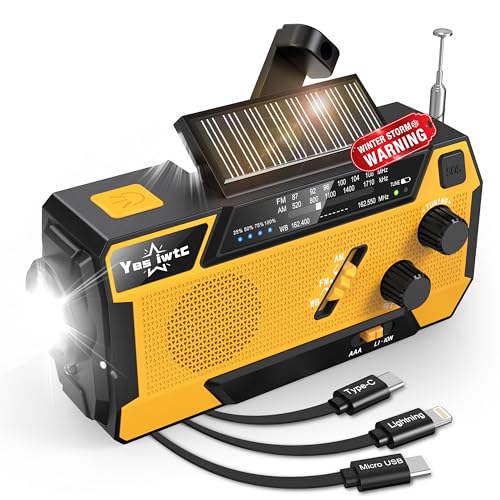
The yesiwtc Emergency Radio is a multifunctional emergency survival device that incorporates a 7400mWh (2000mAh) portable battery pack, three built-in charging cords, a NOAA weather tuner, and multiple lighting tools. Rather than serving as a standard high-capacity everyday power bank, this unit is engineered specifically for storm preparedness, emergency kits, outdoor camping, and roadside safety. It offers mobile device users a self-contained power reserve when traditional electrical infrastructure is offline.
Charging capability centers on a 7400mWh internal battery that provides emergency backup energy through three integrated cables: Lightning, USB-C, and Micro USB. Having all three major connectors built directly into the housing allows users to connect iPhones, modern Android smartphones, and legacy accessories simultaneously without searching for loose cables in the dark. Because the capacity is rated at 2000mAh, the stored power is intended to deliver critical battery percentages for urgent phone calls, navigation, or messages during blackouts, rather than fully replenishing multiple high-draw devices.
The physical design measures 6.49 x 1.9 x 2.9 inches, balancing hand-held portability with multi-tool utility. Along with its internal battery bank, the chassis houses an extendable radio antenna, an internal DSP chip for clear NOAA and AM/FM signal reception, a three-level emergency flashlight (low, mid, and high), a 6-LED fold-out reading light, and a high-volume SOS alarm. An included lanyard attaches to the casing, ensuring secure handling while walking or managing camp tasks in wet or windy environments.
Recharging the device itself offers four distinct options to ensure readiness regardless of power availability. Routine pre-charging is handled through its USB-C port, which provides the fastest and most convenient method to prime the battery before travel or hurricane season. When grid power is unavailable, users can regenerate power using the fold-out manual hand crank or the top-mounted solar panel. For immediate continuous operation without manual effort, the unit also accepts AAA batteries to power the radio, lights, and alarm features.
Understanding practical limitations is essential when evaluating this hybrid portable charger. With a listed nominal capacity of 2000mAh (7400mWh), the device prioritizes survival utility over the rapid, multi-cycle charging power found in dedicated high-output USB-C PD power banks. Manual cranking and solar energy harvesting naturally take significant physical effort and time to produce usable charge, functioning primarily as vital disaster backups rather than everyday fast-charging solutions.
For homeowners, outdoor enthusiasts, and drivers who want an all-in-one emergency tool that combines NOAA weather radio tracking with an emergency phone charger, the yesiwtc unit represents a practical and cost-effective choice. Users seeking a daily-carry battery pack to charge tablets, laptops, or smartphones multiple times per day will be better served by a high-capacity power bank. However, for those prioritizing integrated charging cords, off-grid power generation, and emergency lighting in a compact package, this model delivers dependable peace of mind.
The yesiwtc emergency radio features a four-way power architecture engineered to keep essential electronics functioning when municipal power fails. The primary method for preparing the unit before an event is the USB-C input port, which allows quick charging from standard wall adapters, car sockets, or solar generators.
In extended off-grid situations where standard power sources are unavailable, the integrated hand crank provides manual kinetic regeneration, while the built-in solar panel passively collects ambient sunlight. For immediate, zero-downtime operation, a dedicated compartment supports standard AAA batteries, ensuring weather alerts and emergency lights remain accessible during severe storms.
Emergency device charging is streamlined through the three tethered output cables, including USB-C, Lightning, and Micro USB. This permanently attached configuration ensures that you can immediately deliver a vital energy boost to compatible smartphones and small handheld electronics without having to locate matching external cables in an emergency.
Pros
- High 10,000mAh (37,000mWh) battery capacity provides substantial backup power compared to typical compact emergency radios.
- Multiple off-grid recharge options including a fold-out hand crank and top-mounted solar panel offer emergency power resilience.
- Automatic NOAA scan monitors 7 weather alert bands to warn of approaching storms, tornadoes, and hurricanes even while users sleep.
- Practical bundle inclusions like the aluminized thermal blanket and 5-in-1 survival bracelet add genuine utility to emergency kits.
Cons
- Solar panel and hand crank inputs serve primarily as slow emergency trickle-charging methods rather than rapid daily rechargers.
- Noticeably bulkier and heavier (6.5 x 2.4 x 3.5 inches) than standard pocket-friendly everyday-carry power banks.
- Manufacturer specifications do not detail exact USB output wattage or specific fast-charging protocols.
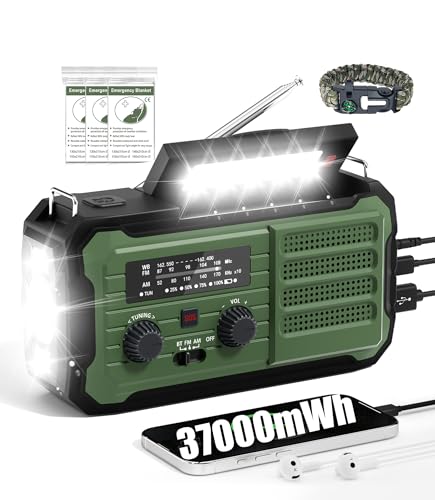
The Vokida 10,000mAh Emergency Weather Radio is an all-in-one emergency portable power bank and NOAA alert receiver designed for emergency preparedness, severe weather blackouts, and off-grid outdoor excursions. Unlike standard consumer battery packs that only supply USB power, this unit integrates emergency radio reception, lighting, signaling tools, and multiple manual energy harvesting mechanisms. It is primarily built for homeowners, campers, hikers, and families who need dependable communication and device power when municipal electrical grids fail.
In terms of charging performance, the unit houses a 10,000mAh (37,000mWh) internal lithium-ion battery pack capable of delivering power through its standard USB output port. This nominal 37Wh rating offers ample capacity to top up modern smartphones during a blackout, though buyers should remember that usable delivered energy will vary due to normal voltage conversion, thermal overhead, and cable resistance. The radio also supports three distinct replenishment methods: electrical recharging of the internal battery, an integrated solar panel for ambient light capture, and an integrated hand crank for manual power generation when all external electrical sources are depleted.
The physical construction features a rugged Army Green chassis measuring 6.5 x 2.4 x 3.5 inches, striking a balance between portable carrying comfort and multifunctional utility. Across the exterior, the device integrates a bright emergency flashlight, a 3.5mm headphone jack for private alert listening, and an emergency SOS button that activates a high-decibel siren and a flashing red distress beacon. In addition to the radio itself, the package includes a 55-gram reflective aluminized thermal blanket designed to preserve body heat and block wind, alongside a 5-in-1 survival paracord bracelet equipped with 10 feet of cordage, an emergency whistle, a compass, a cutting blade, and a magnesium fire rod.
Day-to-day operation is straightforward whether stored in a storm closet or packed for a wilderness trip. Users can keep the internal lithium-ion cell fully charged before planned outages or travel, relying on the solar panel for supplemental daytime trickle charge or the fold-out mechanical hand crank for manual emergency top-offs. The radio dial and automatic scanning system actively search the 7 official NOAA weather channels, remaining capable of waking or alerting the user if severe weather warnings for tornadoes, hurricanes, floods, or winter storms are broadcast.
Realistic limitations should be considered before relying on this device for routine charging tasks. The manual hand crank and compact solar panel are engineered for emergency lifeline situations rather than rapid full battery recharges, meaning full replenishments from empty are best handled through standard power connections prior to an emergency. Furthermore, the manufacturer data does not list dedicated USB Power Delivery (PD) or Quick Charge ratings, so users should anticipate standard USB charging speeds rather than high-wattage rapid phone charging.
The Vokida Emergency Radio Power Bank is an excellent option for disaster-prep kits, emergency vehicle storage, and outdoor recreation where backup power and weather monitoring are critical. Shoppers who strictly want an ultra-slim, lightweight pocket charger for daily office commuting will be better served by a dedicated flat power bank. However, for buyers seeking a multi-functional emergency hub that combines a substantial 10,000mAh battery reserve with severe weather alerts, manual off-grid power generation, and essential survival gear, this model represents practical value.
The core power source of the Vokida emergency radio is a 10,000mAh rechargeable lithium-ion battery rated at 37,000mWh (37Wh), providing a stable reserve of energy for mobile devices. Through its built-in USB output port, users can connect their standard charging cables to power smartphones, GPS units, headlamps, and basic emergency electronics during extended outages.
The device is built for resilience through three practical charging approaches: standard internal battery charging, manual hand crank operation, and a built-in solar panel. While standard charging prepares the battery prior to storms, the hand crank and solar collector ensure that users are never completely cut off from power generation during multi-day off-grid emergencies or extended natural disasters.
Pros
- Multiple off-grid recharge options including a fold-out hand crank, top solar panel, and internal rechargeable battery.
- Lightweight 231g design packs easily into emergency supply kits, camping gear, and glove compartments.
- Combines weather hazard monitoring, an SOS alarm, and multi-mode lighting with emergency phone-charging capability.
- Built-in 2000mAh battery provides a practical backup power source for essential communication during grid failures.
Cons
- Modest 2000mAh (7400mWh) capacity is intended strictly for emergency top-offs rather than multiple full smartphone recharges.
- Solar and hand-crank charging methods require extended time or sustained manual effort to generate substantial phone power.
- Analog radio tuner relies on manual dial calibration rather than automated digital station seeking.
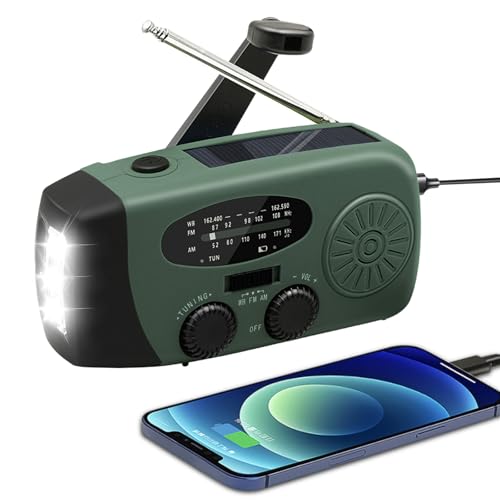
The WVL Emergency Weather Radio is a multi-purpose portable power and survival accessory engineered to provide backup electricity, disaster alerts, and lighting during power outages and off-grid excursions. Packed with a 2000mAh (7400mWh) internal lithium-ion rechargeable battery, this device targets campers, hikers, road-trippers, and home emergency planners who want reliable power redundancy when municipal electrical grids go down. Rather than acting as a replacement for high-capacity daily charging packs, this unit focuses on survival utility by blending emergency mobile power delivery with NOAA weather band radio reception, an SOS distress siren, and bright LED illumination.
Charging performance on this device is intentionally structured around emergency communication needs rather than rapid multi-device replenishment. The listed 2000mAh capacity provides enough stored energy to deliver a partial top-off to modern smartphones or small tablets, allowing users to call for help, send text alerts, or check vital emergency updates. Because nominal battery capacity does not translate entirely into delivered charge due to natural voltage conversion losses and operating efficiency, buyers should not expect multiple complete phone recharges. Instead, the unit excels as a dedicated off-grid safety net that keeps communication lines operational when standard wall outlets and car chargers are inaccessible.
The physical housing balances rugged outdoor durability with compact travel convenience. Measuring 5.9 by 3.07 by 2.4 inches (130 by 50 by 60 millimeters) and weighing approximately 231 grams, the radio is small enough to fit inside a backpack side pouch, emergency go-bag, or glove box. Built into the Navy Green chassis is an energy-efficient 1.5W LED flashlight with three operational lighting modes, as well as a fold-out motion-sensor reading lamp. These integrated lighting tools allow users to inspect camp surroundings or navigate darkened hallways without burning through their smartphone battery simply to use its flashlight.
Day-to-day handling and power management are supported by three distinct recharging methods: the pre-charged internal lithium-ion battery, an integrated manual hand crank, and a top-mounted solar panel. For routine travel preparation, the internal battery can be topped up in advance. In prolonged off-grid or disaster scenarios where electrical infrastructure is down, users can deploy the hand crank to generate manual power or position the solar panel in direct sunlight for supplemental energy. Analog tuning dials provide simple, manual adjustment across AM, FM, and preset NOAA weather frequencies, ensuring quick access to official storm warnings, tornado watches, and hurricane bulletins without depending on cellular reception.
The most important limitation to recognize is the relatively small battery reserve compared to dedicated power banks. With a 2000mAh internal cell, this unit will not fully recharge larger flagship smartphones or power high-draw electronic equipment. Furthermore, while the solar panel and mechanical hand crank are invaluable during emergencies, both methods naturally produce trickle-level charging current, meaning substantial power restoration requires patience and steady manual effort. In addition, the analog radio interface lacks digital station presets, requiring users to manually dial in stations with care to achieve clear reception.
For emergency-kit shoppers, outdoor travelers, and families preparing for severe weather, the WVL Emergency Weather Radio offers dependable value as a self-sustaining backup device. It is an excellent choice for anyone who needs an affordable, off-grid communication and lighting hub capable of reviving a drained smartphone in a crisis. Buyers who require multi-port fast charging, high-wattage USB Power Delivery, or full-day laptop power will want a separate high-capacity power bank, but this multi-functional radio remains a smart, low-maintenance safety asset for any severe-weather toolkit.
The WVL Emergency Weather Radio houses an internal 2000mAh lithium-ion rechargeable battery with a listed energy capacity of 7400mWh. This compact capacity is sized specifically to give smartphones and small mobile electronics a crucial boost during severe power disruptions, helping users sustain essential communication without access to standard charging adapters.
Recharging flexibility is the standout feature of this power source, providing three operational charging pathways: an internal rechargeable battery, a built-in fold-out hand crank, and a top-facing solar panel. While the hand crank and solar cells serve primarily as emergency recovery tools rather than rapid chargers, they ensure that the radio, lighting systems, and USB output can still receive power even during extended, multi-day blackout conditions.
Designed for severe weather readiness, the WVL radio features standard analog tuning that connects to AM, FM, and dedicated NOAA weather alert bands. This direct radio connection allows families and outdoor travelers to monitor real-time updates regarding hurricanes, tornadoes, storms, and regional evacuation orders without depending on vulnerable cellular networks.
In addition to broadcast reception, the unit includes an integrated SOS siren alarm to signal nearby rescue teams during an emergency. Combined with the 1.5W multi-mode LED flashlight and the motion-sensing reading light, the radio acts as an all-in-one survival station for home blackouts, roadside vehicle kits, and backcountry camping trips.

Pros
- Multi-source power options including hand crank, solar charging, and built-in battery offer reliable off-grid redundancy
- Lightweight 0.49-pound design makes it exceptionally easy to pack into emergency kits, car trunks, or hiking bags
- Built-in USB output provides vital backup power to smartphones for essential emergency calls and messages
- Integrated NOAA weather alerts, AM/FM radio, and 1W LED flashlight combine multiple survival tools into one compact device
Cons
- The 2000mAh capacity is modest and intended for emergency top-ups rather than delivering multiple full charges to modern smartphones
- Hand crank and solar charging functions are low-output emergency backup methods that require considerable time to generate power
- Features basic USB connectivity rather than high-wattage fast charging or multi-port output
The RunningSnail Emergency Radio is a specialized multi-purpose survival device designed to serve as both an emergency information receiver and a backup portable charger. Built primarily for severe weather preparedness, outdoor excursions, and home disaster kits, this unit provides off-grid energy redundancy when standard wall outlets are unreachable. It targets homeowners in hurricane or wildfire zones, campers, vehicle owners, and emergency-kit shoppers who need reliable access to vital alerts and basic smartphone power during a blackout.
In terms of charging performance, the unit is equipped with a 2000mAh internal rechargeable battery and a USB output port compatible with most standard USB-powered mobile devices. This 2000mAh capacity is specifically intended as an emergency reserve rather than an everyday high-capacity power bank. Because modern smartphones commonly feature batteries ranging from 3000mAh to 5000mAh, the stored energy in this unit is meant to provide a critical partial top-up for sending distress texts, making emergency phone calls, or checking disaster updates rather than delivering multiple full recharges.
The physical design emphasizes compact, durable utility. Measuring 5 by 1.8 by 2.4 inches and weighing just 0.49 pounds, the radio takes up minimal room in a storm kit, glove compartment, or hiking pack. The exterior incorporates an integrated 1W LED flashlight for navigation in the dark, an analog tuner for AM, FM, and NOAA weather broadcast reception, and a retractable antenna that helps pull in radio signals in low-reception areas.
Operating and recharging the internal power bank is geared entirely toward off-grid survival. Users have three distinct power sources: manual hand cranking, the integrated top-mounted solar panel, and recharging the internal battery via USB before heading out. While the hand crank and solar panel provide valuable peace of mind during prolonged power outages when no wall electricity is available, both methods generate power incrementally and are engineered for emergency replenishment rather than rapid high-speed charging.
The main limitation of this device relates to its charging output and battery size. With a nominal 2000mAh battery rating and standard USB output, it lacks advanced fast-charging protocols such as high-wattage USB Power Delivery, nor can it power larger electronics like tablets or laptops. Buyers should view the portable charging function strictly as a safety lifeline rather than a replacement for high-capacity power banks used for daily commuting or heavy travel.
This emergency radio is an excellent addition for safety-conscious buyers, road trippers, and outdoor adventurers who need an affordable, all-in-one emergency backup solution with zero reliance on disposable batteries. Shoppers seeking to charge modern phones multiple times over a long weekend will want a separate high-capacity power bank, but for keeping communication lines open and receiving NOAA weather alerts during severe weather events, the RunningSnail radio provides dependable practical value.
The 2000mAh internal battery in the RunningSnail Emergency Radio acts as a focused power reserve for essential communication gear. By plugging a compatible USB charging cable into the radio's USB port, users can pull power directly from the internal cell to revive a depleted smartphone for vital calls, location sharing, or emergency coordinates during a blackout.
The dual off-grid generation systems - the mechanical hand crank and the mini solar panel - offer continuous power generation when traditional electrical infrastructure fails. The manual hand crank allows users to mechanically spin internal gearing to generate current on demand, ensuring that communication devices can receive a functional charge even during extended, multi-day utility disruptions.
Frequently Asked Questions
Can a solar power bank hand crank radio fully charge a smartphone?
Yes, but the total recharge amount depends strictly on the radio’s rated battery capacity and the smartphone’s battery size. A compact 2000mAh (7400mWh) emergency radio typically provides a critical 20% to 50% boost to modern smartphones, while a larger 10000mAh (37000mWh) unit can supply roughly 1 to 1.5 full charges. Internal energy conversion losses and 5V/1A output limits mean these devices are designed for emergency calls and safety updates rather than rapid multi-device charging.
How long does it take to charge an emergency radio using the hand crank?
Hand cranking is designed for short-term emergency runtime rather than fully replenishing an empty power bank. Approximately one minute of brisk cranking typically yields 15 to 20 minutes of radio reception or several minutes of flashlight operation based on manufacturer ratings. Manually filling an entire 2000mAh or 10000mAh internal cell by hand would take hours of continuous effort, making wall charging via USB-C the primary method to prepare before a storm.
What is the difference between 7400mWh and 10000mAh in an emergency radio?
The primary difference lies in total stored energy capacity, where 7400mWh translates to roughly 2000mAh at 3.7 volts, while a 10000mAh cell stores around 37000mWh. A 7400mWh power bank keeps the radio lightweight and compact for go-bags while providing basic emergency top-offs. In contrast, a 10000mAh emergency battery stores nearly five times more energy, similar to specialized units seen in comparisons like Anker solar power bank designs, making it better suited for multi-day outages.
Do solar panels on a hand crank radio charge the battery quickly?
No, built-in solar panels on compact emergency radios charge the internal battery very slowly due to their small surface area. These miniature photovoltaic panels are primarily engineered to trickle-charge the unit and prevent natural battery self-discharge when exposed to sunlight. For rapid replenishment before travel or storms, using a dedicated wall plug or USB-C input is much faster, a balance also common when evaluating a solar power bank with wall plug.
Do all emergency crank radios feature automatic NOAA weather alerts?
No, many budget emergency radios require manual dial tuning across standard NOAA weather frequencies rather than offering automated hazard sirens. Radios with manual tuning require you to rotate the tuning knob to find local broadcast towers, whereas models with automatic scan features monitor alerts even while in standby mode. Checking the product specifications for automated alert scanning ensures you receive warning sirens for tornadoes or flash floods while asleep.
Can you charge modern USB-C devices from an emergency hand crank radio in 2026?
Yes, most modern units include standard USB-A output ports or integrated cables compatible with USB-C and Lightning devices. Models like the yesiwtc emergency radio even include built-in charging cables to eliminate the hassle of carrying loose cords during an evacuation. Keep in mind that emergency radios typically output power at standard 5V/1A rates rather than high-wattage USB Power Delivery, ensuring broad compatibility for communication lifelines.




Write Your Review
No reviews yet. Be the first to share your experience!