


Unexpected blackouts and extended outdoor trips quickly turn a dying phone or offline GPS into a genuine safety concern. Off-grid travel demands reliable energy reserves that do not tether you to standard household wall outlets. Investing in a heavy-duty solar power bank 90000mah or dedicated portable DC power station provides the stored watt-hours necessary to keep mobile devices, drones, and portable electronics running during emergencies. Balancing total watt-hour capacity against physical bulk remains essential when packing gear for remote campsites or weather emergencies. Many outdoor enthusiasts also check out popular solar power bank options to ensure continuous backup when away from grid electricity.
Manufacturers design these high-capacity power solutions with varying battery chemistries, ranging from standard lithium-polymer cells to durable LiFePO4 battery packs that maintain extended cycle life. Technical specifications reveal critical differences in high-speed USB Power Delivery support, multi-panel solar input rates, and built-in charging cables. Multi-panel folding designs offer faster field recharging, while compact battery packs paired with external solar panels often provide better overall thermal efficiency and port versatility. Shoppers seeking lighter everyday carry gear might examine portable solar battery chargers under $100 before committing to a massive high-wattage power station. Understanding these specific charging protocols, wattage thresholds, and port layouts guarantees your chosen solar power bank 90000mah matches your actual off-grid energy demands.

Pros
- Dual 140W USB-C two-way ports deliver exceptional high-wattage charging for power-hungry devices.
- Robust 288Wh LiFePO4 battery cells offer enhanced longevity and impact-resistant construction.
- Seven total DC ports allow simultaneous charging across smartphones, tablets, laptops, and 12V car accessories.
- Compact dimensions make it much easier to pack for camping or vehicle storage than bulky AC generators.
Cons
- DC-only output design means there are no standard three-prong 120V AC household wall outlets.
- Initial setup requires activation using an 18W or higher USB-C wall charger connected specifically to ports USB-C2 or USB-C3.
- Carrying strap is sold separately rather than included in the package.
The Anker SOLIX C300 DC is an outdoor-focused 288Wh portable DC power station tailored for mobile power users, campers, road trippers, remote professionals, and emergency-kit builders. Unlike full-size portable power stations that rely on heavy internal AC inverters, this DC-dedicated unit eliminates AC wall outlets to maximize electrical efficiency and minimize overall footprint. It serves as an ultra-high-capacity charging hub for users needing dependable off-grid backup for multiple smartphones, tablets, cameras, USB-C laptops, and 12V automotive accessories.
Charging performance centers around a 300W total output ceiling distributed across seven dedicated DC ports. The configuration includes two bidirectional 140W USB-C ports compatible with modern high-speed USB Power Delivery (PD 3.1) standards, one 100W USB-C port, one 15W USB-C port, two 12W USB-A ports, and a regulated 120W car auxiliary socket. This layout gives users the versatility to power high-draw laptops and mobile electronics simultaneously, though actual power delivery will dynamically adjust based on connected device limits and combined load.
Measuring 4.89 by 7.87 by 4.72 inches in a dark gray finish, the SOLIX C300 DC features an impact-resistant enclosure that is approximately 30 percent smaller than comparable capacity power stations. Internally, Anker incorporates long-lasting LiFePO4 (lithium iron phosphate) battery cells managed by intelligent temperature control sensors, providing improved thermal stability compared to conventional lithium-ion cells. Anker includes a 3-year guarantee, and the exterior features mounting points for an optional carrying strap, though the strap itself is sold separately.
Initial setup requires a specific first-time activation step, where users must connect an 18W or higher USB-C charger to either the USB-C2 or USB-C3 port to wake the station from shipping mode. For ongoing maintenance and field recharging, the station supports dual PD 3.1 USB-C inputs that can replenish the 288Wh pack to 80 percent in approximately one hour when utilizing adequate high-wattage power sources. Users can also recharge via a 12V vehicle socket or a compatible 60W to 100W solar panel, making off-grid turnaround straightforward.
The primary limitation of the SOLIX C300 DC is its lack of standard AC household plugs, meaning any appliances requiring 120V alternating current cannot plug in directly. Solar compatibility is also restricted, as Anker explicitly notes that the C300 DC does not support 5V/3A USB-C solar panels like the SOLIX PS30, nor high-wattage arrays like the PS200 or PS400. Furthermore, as a renewed product offering, buyers should verify included documentation and the 60cm 140W USB-C charging cable upon delivery.
For road trippers, tech-heavy campers, remote workers, and families preparing an emergency power cache, the Anker SOLIX C300 DC represents one of the most efficient DC-first battery stations on the market. Buyers who require 120V AC wall plugs for small household appliances should choose a conventional inverter-equipped generator instead. However, for those looking to charge modern USB-C laptops, phones, and 12V gear with minimal bulk, its dual 140W ports and robust LiFePO4 chemistry provide exceptional value.
Port selection on the Anker SOLIX C300 DC is tailored specifically for modern digital gear and vehicle accessories, offering seven total DC outputs. The primary connections consist of two bidirectional 140W USB-C ports engineered for high-wattage laptops and rapid power delivery, alongside an additional 100W USB-C port and a standard 15W USB-C port for mobile devices.
For legacy peripherals and vehicle equipment, the front panel supplies two 12W USB-A ports alongside a standard 120W car cigarette lighter style socket. This combination allows simultaneous charging for handheld devices, smartwatches, camping lanterns, and 12V coolers without requiring bulky plug adapters.
Recharging the 288Wh LiFePO4 battery pack is flexible, supporting high-speed dual PD 3.1 USB-C inputs that can bring the battery up to 80 percent in roughly one hour when connected to compatible high-wattage chargers. The package includes a 60cm 140W USB-C to USB-C cable to facilitate rapid recharging out of the box.
For field use away from wall outlets, the C300 DC can be charged using a 12V car outlet or connected to compatible 60W or 100W solar panels. Shoppers should note that solar panels outputting 5V/3A via USB-C or large arrays such as the SOLIX PS200 and PS400 are explicitly unsupported by this model.
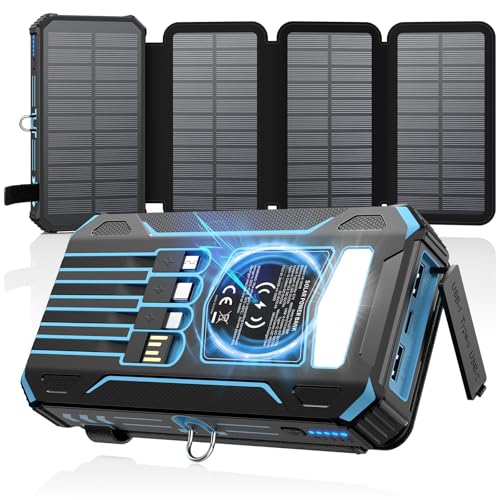
Pros
- Substantial 48,000 mAh battery capacity delivers extensive reserve energy for multiple recharges away from wall outlets
- Four foldable solar panels provide viable supplemental off-grid replenishment during sunny outdoor excursions
- Built-in array of four charging cables and a wireless surface means users do not need to bring separate wires
- Simultaneous multi-device support allows powering up to seven compatible phones, accessories, or tablets at once
- Bidirectional USB-C port handles both charging the power bank and outputting up to 5V/3A to external devices
Cons
- Substantial 1.57-inch thickness and heavy form factor make it impractical for everyday pocket carry
- Exceeds typical 100-watt-hour commercial airline carry-on thresholds, making it unsuitable for passenger flight travel
- Maximum USB-C output is rated at 5V/3A (15W), which lacks the higher-wattage USB Power Delivery protocols needed for laptops
This is a heavy-duty, high-capacity portable solar power bank engineered specifically for outdoor adventures, multi-day camping trips, road travel, and household emergency backup. The SOARAISE 48000mAh model combines a large lithium-polymer battery reserve with a four-panel folding solar array, integrated output cables, standard USB ports, and a wireless charging deck. It best suits outdoor enthusiasts, families on camping trips, and emergency preppers who prioritize maximum stored runtime and standalone charging convenience over lightweight pocket portability.
The central functional advantage of this battery pack is its expansive multi-device power delivery. The manufacturer lists a nominal battery capacity of 48,000 mAh, which provides ample reserve power for repeatedly topping up smartphones, headlamps, tablets, and portable GPS units. Charging output is anchored by a 5V/3A USB-C port, which the manufacturer states can boost an iPhone from 15% to 60% in roughly 30 minutes. In addition to the USB-C port, the pack includes two USB-A output ports, four attached cables (USB-C, Phone connector, USB-A, and Micro-USB), and a top-mounted wireless charging pad. This versatile configuration supports charging up to seven devices simultaneously, making it an effective shared power station for group outings.
In terms of physical build and design, the unit measures approximately 6.38 inches long, 3.43 inches wide, and 1.57 inches thick. The four foldable solar panels unfold outward to maximize sun exposure during basecamp use and fold securely against the thick blue housing when packed. The four integrated cables snap flush into dedicated grooves on the chassis, minimizing clutter and preventing snagging in a backpack. While the thick housing adds noticeable mass, the integrated structure protects the internal cells and keeps all necessary charging connectors attached to the unit at all times.
Daily operation and recharging require an understanding of how large-capacity battery packs function. For routine preparation before a trip, replenishing the battery bank via the bidirectional 5V/3A USB-C input from a standard wall adapter is the fastest and most dependable method. The four high-efficiency solar panels serve as a supplemental off-grid charging solution, capturing ambient sunlight while resting at a campsite or strapped to gear. Given the immense 48,000 mAh capacity, direct solar exposure is intended to extend operating time and provide emergency top-ups rather than rapidly recharging the depleted battery pack from zero to full.
Buyers must consider a few distinct trade-offs before choosing this model. The most significant restriction involves air travel: a nominal 48,000 mAh battery capacity far exceeds standard FAA and airline carry-on limits, which typically cap unapproved lithium-ion consumer batteries at 100 watt-hours (roughly 27,000 mAh). Consequently, this battery pack is strictly an overland, road-trip, camping, and home-emergency device rather than a flight companion. Additionally, while the 5V/3A (15W) output is sufficient for rapid phone charging, it does not support higher-wattage USB Power Delivery (PD) protocols required to power modern USB-C laptops.
The SOARAISE 48000mAh Solar Power Bank is highly recommended for car campers, overlanders, cabin owners, and emergency-kit planners who want an all-in-one charging station that requires no loose cords. Users who need an ultra-lightweight commuter battery, a fast laptop charger, or an airline-approved travel companion should choose a smaller, dedicated USB PD power bank instead. For off-grid preparedness and multi-device wilderness utility, its combination of folding solar panels, integrated cables, and massive battery capacity provides solid practical value.
The SOARAISE power bank stands out from conventional single-panel solar chargers by incorporating four foldable high-efficiency solar panels. According to manufacturer specifications, this multi-panel array gathers solar energy up to five times faster than standard single-panel alternatives, providing meaningful trickle charging when completely disconnected from grid power during long outdoor stays.
Versatility is further enhanced by its ability to power up to seven compatible devices at once. With four integrated cords (USB-C, Phone, USB-A, and Micro-USB), two USB-A output ports, a bidirectional USB-C port, and a wireless charging pad, the unit can simultaneously supply power across modern and legacy electronics without requiring you to carry a separate pouch of charging cables.
When planning trips, travelers must note that the 48,000 mAh capacity places this battery pack well above the standard 100-watt-hour threshold enforced by most commercial airlines for carry-on luggage. Because lithium-polymer power banks of this size are prohibited on commercial flights, this charger is intended strictly for ground-based travel, including road trips, RV outings, and backpacking expeditions.
Measuring approximately 1.57 inches thick, this model prioritizes rugged reserve capacity over pocket-friendly dimensions. It is best carried inside a backpack side sleeve, gear tote, or glove compartment where its integrated cables and durable casing can serve as a dependable, self-contained basecamp charging hub.

Pros
- Up to 20W fast charging output via USB-C for modern smartphones and handheld electronics
- Rugged IPX5 water resistance, shockproofing, and dust sealing withstand outdoor exposure
- Charges up to three devices at the same time using combined wired and wireless outputs
- Dual super-bright flashlights and compass carabiner add practical emergency preparedness value
- Lightweight 0.58-pound profile clips easily to hiking bags or packs into travel luggage
Cons
- Compact solar panel is intended primarily for emergency top-offs rather than rapid daily recharging
- Connecting multiple devices simultaneously distributes power and lowers individual charging speeds
- Maximum 20W output is engineered for phones and small mobile electronics rather than USB-C laptops
The BLAVOR Solar Power Bank 10,000mAh is a rugged portable charger engineered for outdoor enthusiasts, campers, travelers, and emergency-prep users who need durable off-grid backup power. Built around a 10,000mAh Lithium-cobalt battery pack, this unit combines traditional wired power with a wireless charging surface and an emergency solar panel. It best suits American smartphone users, hikers, and commuters seeking a resilient secondary power source that can withstand unpredictable weather while keeping essential mobile gear operational.
In terms of charging performance, the unit features an upgraded USB-C output supporting up to 20W fast charging alongside wireless charging functionality. According to manufacturer claims, the 20W wired connection can power an iPhone 15 up to 65% in approximately 30 minutes, with broad compatibility spanning iPhone, iPad, Samsung Galaxy, and other USB-powered mobile devices. The manufacturer also estimates that a fully charged 10,000mAh battery can recharge an iPhone 8 up to 3.6 times, an iPhone 14 Pro up to 2.2 times, or an iPad Air once. Users can charge up to three devices simultaneously using the available wired and wireless outputs, though connecting multiple devices will divide overall output power.
The physical design emphasizes field durability, featuring flame-retardant ABS and PC construction wrapped in a rubberized protective coating with waterproof silicone port sealing. Measuring 5.9 x 3.1 x 0.8 inches and weighing roughly 0.58 pounds, the battery pack remains comfortably portable for backpacks, daypacks, or glove compartments. It carries an IPX5 water-resistance rating along with dustproof and shockproof qualities to endure outdoor exposure. Dual integrated super-bright flashlights provide nighttime visibility around camp, while the included compass carabiner lets hikers secure the charger directly to exterior pack webbing.
Routine operation is straightforward, with dedicated ports for wired connections and a dedicated surface for wireless charging. Recharging the internal battery pack is primarily completed through its wired input for speed and consistency before heading out on trips. While the integrated solar panel provides an auxiliary method to harvest sunlight, solar inputs on compact hand-held chargers are inherently gradual and best reserved for emergency top-offs rather than daily replenishments. The lightweight profile and included attachment clip make it simple to monitor battery status while trekking or commuting.
Important practical limitations should be weighed before relying solely on this charger in remote locations. First, the 20W peak output is optimized for smartphones, earbuds, and small tablets, meaning it is not designed to power USB-C laptops that require higher wattage profiles. Second, simultaneous multi-device charging will naturally distribute the power budget, reducing individual port speeds across connected gear. Finally, the nominal 10,000mAh capacity will experience standard conversion and circuit losses during wired and wireless transfers, so delivered energy will be lower than the raw battery cell rating.
For hikers, road trippers, and emergency-kit planners wanting an affordable, weather-resistant charger with fast wired and wireless options, the BLAVOR 10,000mAh Solar Power Bank is a practical and versatile choice. Everyday commuters who only need pocketable power for office use may prefer a slimmer, non-rugged power bank without exterior outdoor tools. However, for outdoor recreation and reliable emergency backup, its combination of 20W USB-C output, IPX5 protection, integrated dual flashlights, and durable Lithium-cobalt construction offers solid utility.
The BLAVOR portable charger delivers power through a 20W USB-C fast-charging output as well as an integrated wireless charging pad. This dual-format design accommodates modern smartphones such as iPhone and Samsung Galaxy devices, along with portable accessories like wireless earbuds. The charger supports powering up to three devices simultaneously, providing flexible backup options during outdoor outings or power outages.
Because total power is shared when multiple devices are connected, the fastest charging rates are achieved when plugging a single device directly into the 20W USB-C port. Actual charging speeds will always depend on device reception limits, cable capability, and operating temperatures.
Engineered for outdoor survival and demanding environments, the charger features an IPX5 water-resistant, dustproof, and shock-resistant chassis. The housing combines flame-retardant ABS and PC materials with internal silicone seals and a tactile rubber skin-feel exterior to resist drops and adverse weather.
BLAVOR utilizes a Lithium-cobalt battery composition, which the manufacturer states provides 50% more cycle life compared to standard lithium-polymer cells. Integrated dual super-bright flashlights and an included compass carabiner deliver functional utility for nighttime navigation and gear attachment.

Pros
- Durable LiFePO4 battery pack rated for over 3,500 charge cycles, far outlasting standard lithium cells
- Dual AC wall outlets and a 45W USB-C PD port accommodate laptops and everyday electronics
- Ultra-quiet fanless construction operates without disruptive background noise
- Rapid recharging technology replenishes the battery up to 80 percent in 1.5 hours
Cons
- 100W AC output limit is unsuitable for high-draw heating appliances, coffee makers, or hair dryers
- Solar charging panel and solar connection cable must be purchased separately
- At 2.54 pounds, it is heavier and bulkier than standard pocket smartphone power banks
The Daran 89.6Wh Portable Power Station is a compact, multi-output mobile power bank engineered for users who need more versatility than a standard pocket charger can deliver. Built with durable LiFePO4 battery cells and dual AC sockets, this 2.54-pound generator alternative bridges the gap between pocket battery packs and bulky home backup stations. It serves remote workers running laptops away from wall sockets, campers wanting quiet off-grid charging, photographers managing camera gear, and families building portable emergency kits.
Charging capability centers around an 89.6Wh capacity pack paired with seven distinct output connections. Users get two standard AC wall sockets capable of delivering 100W continuous output with a 200W surge peak, suitable for running compatible laptops, small electronics, or compact equipment. For mobile electronics, the unit includes two USB-C ports offering up to 45W and 15W respectively, alongside two USB-A ports delivering up to 18W and 15W for smartphones, tablets, or earbuds. A dedicated 60W DC5521 port adds auxiliary 12V connectivity, while the manufacturer notes compatibility with devices such as drones, cameras, and mini-coolers within the 100W threshold.
Measuring 6.5 by 3.3 by 4 inches, the enclosure adopts a dark gray finish designed with a practical soft carry handle for convenient transit in backpacks or vehicle trunks. A clear LED status display indicates real-time operational status and remaining battery level, guarded by a protective peel-away shipping film. Operation is completely silent thanks to a fanless thermal structure, making it unobtrusive when placed beside a sleeping bag or on a quiet desk. For blackout preparedness and outdoor nights, an integrated four-level LED flashlight offers both continuous illumination and SOS signaling modes, secured by a long-press accidental-touch activation mechanism.
Replenishing the internal battery is straightforward, with the manufacturer providing four distinct recharge pathways. Owners can charge via a standard AC wall socket, bidirectional USB-C PD, a 12V vehicle port, or an external solar panel. Fast-charging technology allows the battery to reach an 80 percent charge in approximately 1.5 hours, and the system even supports simultaneous AC and DC input charging to maximize turnaround speed. An internal battery management system (BMS) incorporates 12 safety safeguards that monitor voltage, current, and internal temperatures during both discharge and recharge cycles.
Realistic operational limits revolve primarily around power output and physical footprint. The AC sockets are strictly capped at 100W total output, meaning this unit cannot run high-draw household appliances such as coffee makers, blenders, hair dryers, or space heaters. In addition, while 2.54 pounds is relatively lightweight for an AC-equipped power station, it remains significantly heavier and bulkier than standard 10,000mAh smartphone chargers. Buyers planning to recharge with solar energy should also note that the solar panel and connection cables must be purchased separately.
The Daran 89.6Wh Power Station is a sensible choice for road trippers, students, and mobile professionals seeking an all-in-one power hub with genuine AC utility and USB-C fast charging. The standout reason to choose this model over conventional lithium-ion battery packs is its LiFePO4 battery chemistry, which delivers a rated lifespan exceeding 3,500 cycles for sustained reliability. Those requiring sustained output above 100W for demanding appliances will need a larger power station, but users needing dependable power for laptops, phones, and travel essentials will find great utility in this compact design.
The Daran power station features seven total output ports to support multiple devices at once. The two standard three-prong AC outlets share up to 100W of continuous output (200W peak), making them suitable for compatible laptops, small drones, and low-draw desktop gear.
Mobile charging is anchored by two USB-C ports and two USB-A ports. The primary USB-C connection delivers up to 45W Power Delivery for rapidly charging modern USB-C laptops, tablets, and flagship smartphones, while the secondary USB-C port provides 15W. The USB-A ports output up to 18W and 15W respectively, allowing legacy charging cables to operate alongside modern Type-C connections.
A 60W DC5521 round barrel port provides direct 12V output for compatible auxiliary equipment. Because the unit offers such varied port options, users can charge an array of gear including cameras, smartphones, and low-power travel devices without carrying separate wall adapters.
At the core of this power bank is an 89.6Wh lithium iron phosphate (LiFePO4) battery pack. Unlike conventional NCM lithium-ion cells that typically degrade after 500 to 1,000 charge cycles, this LiFePO4 chemistry is rated for over 3,500 life cycles, offering substantial long-term durability across years of routine use.
Safety is managed through an advanced integrated Battery Management System (BMS) that actively tracks 12 protective metrics. This system oversees cell voltage, current output, and thermal conditions to safeguard against common electrical issues such as overcharging, overcurrent, and short circuits.
For optimal battery calibration and gauge accuracy, the manufacturer recommends fully discharging and recharging the battery pack twice upon initial unboxing. The listed 89.6Wh capacity also provides a helpful baseline for comparing the unit against airline carry-on regulations, though travelers should always verify specific carrier battery policies before flying.

Pros
- Dual high-wattage USB-C ports (140W and 100W) handle demanding laptops and tablets simultaneously
- Recharges to 80% in only 50 minutes from a wall outlet, with flexible solar, car, and USB-C recharging options
- Durable LiFePO4 battery chemistry backed by a 3-year warranty for reliable long-term use
- Compact 4.19-pound design is 39% smaller than typical power stations in this capacity range
- Includes a 60W solar panel and necessary cables right out of the box for off-grid backup
Cons
- Features DC outputs only and lacks standard 120V AC household wall outlets
- The matching shoulder carry strap is sold separately and not included in the box
- Solar input is capped at 60W and explicitly incompatible with Anker SOLIX PS30, PS200, or PS400 panels
The Anker SOLIX C200 DC Portable Power Station with 60W Solar Panel is a specialized, high-capacity DC power hub designed for mobile tech users, campers, road trippers, and remote professionals. Unlike bulkier emergency generators that feature heavy internal AC inverters, this unit focuses entirely on high-efficiency DC and USB power delivery. Featuring a 192Wh energy capacity and an overall 200W output threshold, it is engineered for travelers who need to keep USB-C laptops, smartphones, tablets, cameras, and handheld electronics powered off the grid.
Charging performance is anchored by an advanced five-port DC configuration. The primary connection is a bidirectional 140W USB-C port supporting the USB Power Delivery (PD) 3.1 standard, capable of delivering serious charging wattage to compatible power-hungry notebooks. A second USB-C port supplies up to 100W, a third USB-C port provides 15W for smaller accessories, and dual USB-A ports offer 12W each for legacy cables. With up to 200W of total simultaneous output, the SOLIX C200 DC easily distributes power across multiple devices without requiring separate wall bricks for each gadget.
In terms of physical design, the SOLIX C200 DC is roughly 39% smaller than comparable portable power stations, measuring approximately 7.28 by 3.94 by 4.33 inches and weighing 4.19 pounds. The housing features a durable dark gray finish, integrated attachment points for an optional carry strap, and a clear layout that keeps all five charging ports accessible on the front panel. Under the hood, Anker utilizes Lithium Iron Phosphate (LiFePO4/LFP) battery chemistry, which is well-regarded for its thermal stability, extended cycle lifespan, and safety, reinforced by a 3-year manufacturer warranty.
Recharging versatility is a major highlight for travelers and outdoor enthusiasts. When connected to a wall outlet, the station can recharge to 80% in approximately 50 minutes. For off-grid travel, the included 60W solar panel connects via an included solar-to-XT-60 cable and extension cord, fully replenishing the battery in about 4 hours under direct sunlight. Users can also recharge via a vehicle 12V auxiliary port or through the bidirectional 140W USB-C port. The box includes a 60cm 140W USB-C to USB-C charging cable, meaning users have high-speed cabling ready immediately.
The most important limitation to consider is that the SOLIX C200 DC is strictly a DC power station with no 120V AC household plug outlets. It cannot power small kitchen appliances, CPAP machines requiring standard AC plugs, or tools that rely on a standard wall plug. Additionally, the solar input is limited to 60W, and the manufacturer explicitly notes that this station is not compatible with Anker SOLIX PS30, PS200, or PS400 solar panels. Shoppers should also be aware that while the chassis supports a shoulder strap for transport, the strap itself is sold separately.
The Anker SOLIX C200 DC bundle is an outstanding choice for digital nomads, outdoor photographers, campers, and road travelers who primarily charge modern USB-C and USB-A devices. Its combination of 140W PD 3.1 charging, durable LiFePO4 cells, 50-minute wall recharge, and bundled 60W solar panel delivers exceptional portable convenience. Buyers needing traditional three-prong AC wall outlets should consider an inverter-equipped generator instead, but those focused on clean, high-speed DC mobile power will find this system exceptionally capable.
The Anker SOLIX C200 DC offers five dedicated DC outputs to power a full workstation away from an electrical outlet. The main port is a 140W USB-C port using the PD 3.1 protocol, which operates bidirectionally for both high-speed device charging and power bank recharging. It is accompanied by a secondary 100W USB-C port, a 15W USB-C port, and two 12W USB-A ports, delivering a shared maximum output of up to 200W across connected devices.
Recharging flexibility allows users to replenish the 192Wh battery through several distinct methods. From an AC wall outlet, the unit can reach an 80% charge level in just 50 minutes. When traveling off-grid, the bundled 60W solar panel and XT-60 cable can replenish the station in approximately 4 hours in strong sunlight. Recharging is also supported via standard 12V car auxiliary outlets or through high-wattage USB-C PD 3.1 chargers using the included 140W USB-C cable.
At the core of the SOLIX C200 DC is a 192Wh Lithium Iron Phosphate (LiFePO4) battery pack. LFP chemistry offers distinct advantages in durability, maintaining a longer operating lifespan and superior thermal stability compared to conventional lithium-ion cells. Anker pairs this robust battery design with a 3-year manufacturer warranty for dependable multi-year performance on the road or in emergency readiness kits.
The bundled 60W solar panel provides an eco-friendly charging option for camping, van life, and field work. The package includes both an extension cable and a solar-to-XT-60 charging cable for straightforward outdoor setup. Note that the solar input circuitry is engineered specifically for matching 60W solar inputs and is explicitly incompatible with Anker SOLIX PS30 5V/3A USB-C panels, PS200 panels, and PS400 panels.

Pros
- Four built-in cables provide immediate plug-and-play charging for iPhone, Android, and legacy Micro-USB devices.
- Substantial 49,800 mAh nominal capacity offers extended power reserve for long camping weekends and power outages.
- Versatile charging options combine 22.5W wired fast charging with a 15W wireless pad.
- Rugged IP65-rated body and multi-mode emergency flashlight provide practical utility for outdoor use.
Cons
- Bulky 1.28-inch thick housing and heavy overall footprint make it awkward for standard pocket carry.
- The large 49,800 mAh capacity is likely to exceed typical airline carry-on battery limits without prior approval.
- Solar charging speed is naturally limited by the small surface area and is suitable primarily for emergency replenishment.
The BLASOUL Solar Power Bank is a high-capacity external battery pack engineered specifically for outdoor recreation, emergency backup preparedness, and multi-device mobile users. Outfitted with a nominal 49,800 mAh lithium-polymer battery, built-in cables, and an integrated solar cell, this unit serves as a self-contained mobile power station. It best suits campers, hikers, road trippers, and homeowners preparing for severe weather outages who require dependable backup power without packing a tangled assortment of separate charging accessories.
Charging performance is anchored by versatile wired and wireless options, delivering up to 22.5W through supported Power Delivery 3.0 and Quick Charge 3.0 standards. The dedicated built-in USB-C cable provides up to 20W when used alone, which the manufacturer states can take an iPhone 14 up to 60 percent in approximately 30 minutes. In addition to tethered charging, the unit features an elevated 15W wireless charging pad compatible with wireless-capable devices such as recent Apple iPhone and Samsung Galaxy handsets. Buyers should note that nominal battery capacity represents internal cell storage rather than net delivered energy, as routine voltage conversion and environmental factors naturally influence usable output.
The physical casing measures 7 by 3.66 by 1.28 inches and is built to withstand demanding conditions, featuring an IP65 rating for water, dust, and shock resistance. Cable management is neatly integrated into the frame, stowing three output connectors (Lightning, USB-C, and Micro-USB) along with a USB-A input cable directly within molded channels. An ultra-bright LED flashlight is integrated into the housing, offering steady beam, SOS emergency beacon, and strobe signaling modes for nighttime campsite navigation and roadside breakdowns.
Replenishing the power bank itself can be accomplished either via an external wall adapter using the built-in USB-A lead or through compatible USB-C inputs. While the integrated solar panel provides auxiliary top-off capability when exposed to direct sunlight, solar replenishment is fundamentally slow due to the compact surface area and should be treated as an off-grid safety net rather than a daily charging method. Because of the substantial 1.28-inch profile and heavy battery mass, the charger is much better suited for storage in backpacks, dry bags, or emergency bins than everyday jacket pockets. Furthermore, because a 49,800 mAh lithium battery rating significantly exceeds standard 100Wh airline carry-on limits, air travelers should consult airline policies and avoid counting on this unit for standard commercial flight travel.
The primary limitations of this power bank stem directly from its heavy-duty capacity and ruggedized build. Everyday commuters looking for an ultralight, pocket-friendly charger will find the substantial dimensions cumbersome for quick urban transit. In addition, integrated cables cannot be individually swapped or upgraded if a single connector experiences wear over time, meaning users must handle the tethered leads carefully. Full AC wall replenishment also requires dedicated planning before heading outdoors, as relying on the solar panel alone to fill an empty battery pack of this size is impractical.
The BLASOUL 49800mAh Solar Power Bank is an excellent match for outdoor enthusiasts, remote field workers, and families assembling storm-ready emergency kits. Minimalist commuters and airline passengers will be better served by a slim, lower-capacity power bank that complies smoothly with standard flight regulations. However, for anyone needing multi-day battery reserves, broad cross-device compatibility, and all-in-one cable convenience away from electrical grids, this rugged charger offers outstanding practical value.
Wired charging speeds on the BLASOUL battery pack reach up to 22.5W via compatible PD 3.0 and QC 3.0 fast-charging protocols. The integrated USB-C cable delivers up to 20W output when used independently, offering rapid power delivery to modern smartphones, action cameras, and portable camping gadgets.
Wireless charging functionality supports up to 15W maximum output for Qi-enabled devices. Users can simply place an iPhone, Samsung Galaxy, or compatible wireless earbud case on the designated charging zone, eliminating the need to untangle cords during downtime at camp or at a work desk.
Outdoor resilience is reinforced by an IP65 weather-resistant casing designed to repel dust, splashes, rain, and minor trail impacts. The rugged exterior makes it a dependable companion for kayaking, fishing, backpacking, and unpredictable outdoor environments.
Emergency functionality is bolstered by the top-mounted LED illumination system and solar charging strip. The flashlight toggles between continuous steady light, an emergency SOS distress pulse, and a rapid strobe signal, while the built-in solar panel provides passive trickle replenishment during extended grid failures.

Pros
- Substantial 48,000 mAh nominal battery capacity provides extensive power reserves away from wall outlets
- Four built-in cables offer complete all-in-one charging convenience without packing extra cords
- Fold-out four-panel solar array significantly improves outdoor solar energy capture compared to single-panel alternatives
- Supports wired, port-based, and wireless charging simultaneously for up to seven devices
Cons
- Substantial 1.57-inch thickness and heavy build make it impractical for standard pocket carry
- High 48,000 mAh nominal capacity exceeds the standard 100 Wh airline carry-on threshold for commercial flights
- Maximum 5V/3A (15W) output does not support high-wattage USB Power Delivery for charging laptops
The SOARAISE 48000mAh Solar Power Bank is an outdoor-focused, high-capacity portable charger engineered for campers, road trippers, emergency-preparedness shoppers, and multi-device users who spend extended time away from AC outlets. Equipped with a massive 48,000 mAh lithium-polymer battery and four foldable solar panels, this unit serves primarily as a self-contained power hub. It is best suited for outdoor recreation, base camps, and severe weather backup where carrying separate cables and finding wall power are difficult.
Charging capability focuses on device versatility and simultaneous power sharing. The charger features a 5V/3A (15W) USB-C port that the manufacturer states can boost an iPhone from 15% to 60% in approximately 30 minutes, alongside two standard USB-A outputs and an integrated wireless charging pad. The system supports charging up to seven devices at the same time across its cables, ports, and wireless surface. Compatible phones include the iPhone 12 through iPhone 17 series as well as Samsung Galaxy S21 through S24 models. Buyers should understand that nominal battery capacity does not equal delivered energy to devices due to normal voltage conversion, thermal overhead, and cable resistance.
The build design emphasizes all-in-one convenience with an outdoor aesthetic. Measuring 6.38 by 3.43 by 1.57 inches, the unit combines a rugged black shell with high-visibility orange accents for quick locating in a backpack or survival tote. Rather than relying on a single small solar cell, it incorporates four fold-out solar panels that unfold to capture sunlight and snap securely against the casing for transport. Four built-in charging cables-USB-C, Phone, Micro-USB, and USB-A-tuck cleanly into molded grooves on the chassis, preventing cable tangles and ensuring support for both modern and legacy devices.
Daily operation and recharging depend on your power source and environment. While the quad-panel solar system is rated by the manufacturer to harvest energy up to five times faster than standard single-panel banks, portable solar charging remains an emergency and supplementary option rather than a quick replacement for grid electricity. For routine use, users should fully replenish the 48,000 mAh pack via wall adapter prior to leaving home, utilizing the solar panels to top off energy during sunny outdoor activities.
There are several realistic limitations buyers must consider before purchasing this model. At over 1.5 inches thick, this battery pack is noticeably bulky and unsuitable for everyday pocket carry or slim purse storage. In addition, its 48,000 mAh rating at typical 3.7V lithium-polymer voltage translates to roughly 177 Wh, which exceeds the standard 100 Wh limit set by the FAA and major international airlines for passenger carry-on bags. Furthermore, the 5V/3A charging ceiling provides standard smartphone fast charging but lacks the higher-wattage USB Power Delivery or PPS protocols required to power full-size laptops.
This solar portable charger is an outstanding choice for outdoor enthusiasts, tailgaters, road trippers, and families preparing home emergency storm kits who need high-capacity backup and total cable independence. Commuters seeking a lightweight pocket companion or air travelers needing a TSA-friendly flight charger should look toward smaller 10,000 mAh or 20,000 mAh battery packs. For off-grid resilience and multi-device camping convenience, the SOARAISE 48000mAh model offers exceptional utility in a durable package.
The SOARAISE 48000mAh Solar Power Bank delivers wide-ranging device connectivity designed to streamline mobile charging without requiring loose cords. The integrated cable array features dedicated USB-C, Phone, Micro-USB, and USB-A plugs, ensuring immediate compatibility with modern smartphones, older electronics, and rechargeable camping accessories.
Beyond the built-in cables, the power bank includes three dedicated ports: two USB-A output ports and a bidirectional USB-C input/output port rated up to 5V/3A. Together with the top-mounted wireless pad, the unit can distribute power to as many as seven connected devices simultaneously, functioning as a practical charging station for group outings and family trips.
Featuring four foldable high-efficiency solar panels, this portable charger captures sunlight up to five times faster than traditional single-panel solar banks according to manufacturer claims. The folding panel design unfolds quickly to maximize surface area under direct sun and folds flat against the body for easy packing.
While the solar panels provide valuable off-grid maintenance and emergency power during extended wilderness trips or power outages, natural solar charging speeds depend heavily on sunlight intensity and outdoor conditions. For best results, users should fully charge the battery via a wall charger before trips, using solar input to supplement power while off the grid.
Frequently Asked Questions
How many watt-hours does a 90,000mAh battery provide?
A 90,000mAh rating translates to approximately 288Wh to 333Wh depending on the nominal cell voltage. For instance, the Anker SOLIX C300 DC rates its 90,000mAh capacity at 288Wh using a 3.2V LiFePO4 internal configuration. Knowing the watt-hour rating is crucial because usable energy accounts for voltage conversion rather than raw milliamp-hours alone. Internal circuitry and charging conversion steps will deliver slightly less than the nominal rating to your connected devices.
Can a 90,000mAh solar power bank charge a laptop?
Yes, provided the power station or battery pack supports sufficient USB Power Delivery output wattage. Laptops typically demand at least 45W to 65W via USB-C PD, while larger workstations can utilize up to 140W PD 3.1 connections. Units like the Anker SOLIX C300 DC feature dual 140W two-way USB-C ports capable of powering demanding notebooks. Compact smartphone-oriented power banks with 15W to 20W outputs will not deliver adequate charging speed for most modern laptops.
Can you bring a 90,000mAh solar power bank on an airplane?
No, a true 90,000mAh battery pack exceeds commercial airline carry-on limits. Aviation safety guidelines generally restrict passenger lithium batteries to 100Wh without airline approval, or up to 160Wh with special carrier permission. A 90,000mAh unit yields around 288Wh, placing it well above the maximum permitted threshold for aircraft cabins and checked luggage. Travelers requiring flight-compliant backup must select smaller battery packs rated strictly at 100Wh or below.
How long does solar charging take on high-capacity power banks?
Direct solar recharge times vary dramatically based on panel wattage, sun intensity, and battery capacity. A large 288Wh portable station paired with a 100W solar panel can reach an 80% charge in a few hours of direct sunlight, whereas pocket-sized banks with tiny integrated panels recharge much more slowly. Integrated solar panels on compact chargers serve primarily as emergency trickle chargers rather than primary daily power sources. For substantial emergency backup, you can explore a whole home coverage solar power bank setup to handle extensive residential outages.
What is the advantage of LiFePO4 batteries in a solar power bank 90000mah?
LiFePO4 cells offer significantly greater cycle life and thermal stability compared to conventional lithium-polymer batteries. A LiFePO4 battery pack often sustains over 3,000 charging cycles before dropping to 80% original capacity, compared to roughly 500 cycles for traditional cells. They also provide enhanced stability during high-temperature exposure and sustained power draws. For buyers curious about alternative power cell designs, reviewing a solar power bank without standard lithium battery cells provides insight into evolving off-grid energy storage designs.
Does charging multiple devices simultaneously reduce output speeds?
Yes, multi-device charging often divides the available power budget across active ports. Dedicated power stations provide independent high-wattage circuits, while smaller multi-port solar banks share current when multiple phones or accessories plug in at once. Using built-in cables alongside external USB ports may drop fast-charging protocols down to standard 5V/3A shared output. Checking the manufacturer combined output specifications ensures all connected devices receive adequate power.





Write Your Review
No reviews yet. Be the first to share your experience!