


Low-battery alerts right before boarding create needless stress when airport terminal outlets are occupied. Yes, can you fly with a power bank in carry on bags, as aviation safety guidelines require spare lithium-ion battery packs to travel exclusively in cabin baggage rather than checked luggage. The primary restriction limits battery capacity to 100 watt-hours (Wh) or less for unrestricted travel. A high-capacity portable charger delivers backup energy during long transit, but carrying excessive weight remains a practical tradeoff. Reviewing a detailed specs comparison of power bank features helps clarify how manufacturer mAh ratings translate into regulated watt-hour limits.
Travelers needing laptop power often look at high-output units like the Anker Prime series, which provides up to 140W USB Power Delivery while remaining at 99.75Wh to comply with security rules. Meanwhile, compact 10,000mAh magnetic chargers offer lighter everyday carry for smartphone power. Budget-conscious passengers often prefer a universal Anker power bank under 25 dollars for straightforward, pocket-sized recharging that passes security checkpoints without hassle.
Pros
- Exceptional 300W total combined output with up to 140W single-port USB-C laptop fast charging
- Generous 26,250mAh (99.75Wh) capacity is designed to comply with standard sub-100Wh airline carry-on regulations
- Industry-leading 250W dual USB-C recharge input minimizes downtime between uses
- Onboard digital display and companion app provide accurate real-time wattage, battery status, and control
- Comprehensive bundle includes a fast-charging base, travel pouch, and heavy-duty 240W USB-C cable
Cons
- Substantial 1.31-pound weight and 1.5-inch thickness make it better suited for backpacks than pockets
- Reaching maximum 140W charging requires high-wattage compatible devices and 5A-rated cabling
- Higher-tier investment designed for power users rather than casual smartphone top-ups
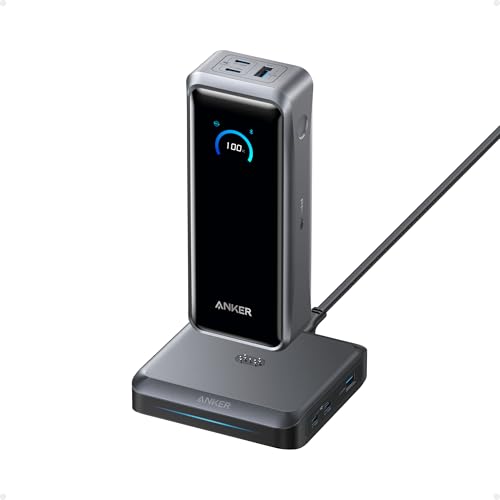
The Anker Prime 26,250mAh 300W Power Bank is a high-output, workstation-grade portable charger designed primarily for traveling professionals, remote creatives, and tech enthusiasts who carry multiple power-hungry devices. While standard power banks are designed to handle phones and low-draw accessories, this unit is engineered to serve as a mobile power hub capable of charging high-performance laptops and mobile electronics simultaneously without dropping wattage below usable thresholds.
In terms of output capability, the battery pack delivers up to 300W of total power across its two USB-C ports and single USB-A port. Individual USB-C output reaches up to 140W when paired with a compatible 5A cable, allowing it to charge large notebooks at maximum rates. According to manufacturer laboratory data, that 140W output can push a MacBook Pro (M4 Pro) to 50% battery in approximately 27 minutes, or an iPhone 16 Pro to 50% in about 26 minutes. The rated capacity of 26,250mAh represents 99.75Wh of stored energy, which the manufacturer estimates can supply up to 0.8 charges for an M4 MacBook Pro, though delivered energy will vary depending on device efficiency, active background loads, and thermal conditions.
Hardware design and usability stand out through the inclusion of a high-resolution smart digital display integrated into the Phantom Gray chassis. This screen provides instant visibility into input wattage, output wattage per port, and estimated remaining battery runtime. For advanced control, users can pair the unit via a mobile app to monitor battery health metrics and manually adjust power distribution profiles across the connected ports, adding an extra layer of customization for sensitive electronics.
Recharging the power bank itself is equally rapid, supporting up to 250W maximum input power when utilizing both USB-C ports concurrently. This capability significantly reduces turnaround time for users transitioning between hotel rooms, airports, or client offices. The package also includes a dedicated fast-charging base, a protective travel pouch, and a 3.3-foot USB-C to USB-C cable rated for 240W, ensuring you have the necessary accessories to leverage high-speed charging immediately.
The primary tradeoffs of this device center around its physical footprint and specialized focus. Weighing 1.31 pounds and measuring 6.3 by 2.5 by 1.5 inches, it is substantially bulkier than everyday pocket chargers and is meant to be carried in a backpack, messenger bag, or briefcase. Furthermore, everyday smartphones and smaller gadgets cannot draw anywhere near the 140W ceiling, meaning buyers who only carry a single phone will not fully utilize the advanced multi-port power allocation hardware inside.
For business travelers, photographers, software developers, and students carrying high-draw laptops alongside phones and tablets, the Anker Prime 300W Power Bank is an exceptionally capable companion. Shoppers seeking a lightweight, budget-friendly battery just for emergency phone calls should look toward smaller pocket-sized models. However, if your daily routine depends on maintaining reliable workstation power away from a wall outlet, this charger offers an outstanding blend of raw output speed, airline-conscious capacity, and monitoring intelligence.
The Anker Prime power bank stands out for its high single-port capability and overall multi-device throughput. With a maximum single-port USB-C output of 140W, it can easily fulfill the fast-charging requirements of modern 16-inch laptops and other high-demand devices that support USB Power Delivery over high-amperage cables.
When running multiple devices at once, the system dynamically manages its 300W total ceiling across two USB-C ports and one USB-A port. This multi-port configuration allows users to keep two full-sized laptops powered at standard operating speeds while simultaneously charging a smartphone or accessory through the USB-A port without causing device resets or aggressive power drops.
Airline travel regulations generally place strict limitations on the size of lithium-ion battery packs brought into passenger cabins. The Anker Prime 26,250mAh battery is rated at 99.75Wh, which sits deliberately just below the 100Wh limit commonly established by the FAA, TSA, and international aviation authorities for carry-on electronics without requiring special airline approval.
Because lithium battery guidelines require spare battery packs to remain in carry-on baggage rather than checked luggage, the included travel pouch helps protect the ports and screen from scratches inside a backpack. Travelers should always verify current airline rules and individual carrier policies before departure to ensure complete compliance.


Pros
- Massive 300W combined total output with up to 140W single-port delivery for laptops
- Industry-leading 250W dual-port recharge capability minimizes power bank downtime
- Integrated digital display and app control provide real-time status and power management
- Includes a high-wattage 240W USB-C cable and carrying pouch in the package
- Sub-100Wh capacity rating (99.75Wh) aligns with general commercial airline battery guidelines
Cons
- Substantial weight of roughly 1.32 pounds makes it noticeably bulky for casual pocket carry
- Achieving maximum 250W recharge speeds requires separate high-output dual USB-C wall adapters
- Manufacturer explicitly notes that this power bank is not compatible with Starlink Mini
The Anker Prime Power Bank (26,250mAh, 300W) is a high-output portable charging station designed specifically for power users, business travelers, and remote workers who need to run demanding electronic equipment away from wall outlets. Engineered primarily as a multi-device charging solution, its central appeal is the ability to deliver high-wattage USB-C Power Delivery to power-intensive laptops, tablets, and smartphones simultaneously without severe power throttling.
Charging performance is led by a combined 300W maximum output distributed across two USB-C ports and one USB-A port. For single-device demands, the primary USB-C connection outputs up to 140W when connected with an appropriate 5A cable, which the manufacturer states can charge a MacBook Pro (M4 Pro) to 50 percent in 27 minutes or an iPhone 16 Pro to 50 percent in 26 minutes. The nominal battery capacity is listed at 26,250mAh with an energy rating of 99.75Wh. Usable energy transferred to connected electronics will naturally be lower than nominal capacity due to internal voltage conversions, cable resistance, and device charging overhead.
The build quality reflects a premium, solid desktop-and-travel aesthetic finished in Phantom Gray, measuring 6.3 by 2.5 by 1.5 inches and weighing approximately 1.32 pounds. A built-in smart color display clearly exhibits real-time power draw, individual port outputs, remaining battery percentage, and battery health details. Additionally, onboard Bluetooth allows connectivity to a dedicated mobile app, giving users the uncommon ability to view active diagnostic metrics and manually customize power allocations directly from their smartphone.
Recharging the power bank is exceptionally fast thanks to Anker's dual-port input design, which accepts up to 250W of total input power. The manufacturer notes that this input speed can restore the battery to 40 percent in 10 minutes or 50 percent in just 13 minutes, making it well suited for quick airport layovers or brief morning turnarounds. The package includes a 3.3-foot 240W-rated USB-C to USB-C charging cable, a travel pouch, and a 24-month warranty, though the high-wattage wall adapters required to hit peak recharge speeds must be supplied separately.
In terms of practical limitations, the device's 1.32-pound weight and 1.5-inch thickness make it distinctly larger than standard everyday-carry phone batteries, requiring space in a briefcase or backpack rather than a pocket. Furthermore, the manufacturer explicitly lists that this battery pack is not compatible with the Starlink Mini. Users should also remember that achieving full 140W single-port charging or 250W dual-port recharging requires high-grade cables and compatible high-power input sources.
This power bank is an outstanding choice for digital nomads, content creators, and corporate travelers who depend on high-wattage USB-C laptops and require rapid battery replenishment on demanding schedules. Casual smartphone users seeking a lightweight pocket charger for occasional phone top-ups should consider a smaller, lower-capacity power bank instead. For users requiring maximum power delivery, comprehensive telemetry, and rapid turnaround speeds, this model offers exceptional portable capability.
The core capability of this power bank is its 300W aggregate output across three ports, enabling simultaneous high-speed power distribution without drastic drops in performance. The two USB-C ports provide modern high-wattage Power Delivery profiles, while the legacy USB-A port supports smaller peripherals such as wireless earbuds, smartwatches, or secondary mobile devices.
With a maximum single-port rating of 140W, the charger provides sufficient throughput to keep demanding workstations like Apple MacBook Pro laptops operating at full processing capacity under heavy workloads. Device-level charging rates will always depend on the specific intake capabilities of the receiving hardware, cable ratings, and ambient thermal conditions.
An integrated full-color smart screen eliminates guesswork by presenting real-time operating metrics directly on the face of the unit. The display reports active input and output wattages on every individual port, current internal charge levels, and estimated time to full recharge or depletion.
For users seeking greater control, built-in app pairing lets you monitor diagnostics from a connected mobile device. The application enables manual adjustments to output thresholds, allowing users to prioritize specific ports depending on whether a laptop or phone requires urgent charging priority.
The Anker Prime power bank is built with a stated energy capacity of 99.75Wh, placing it just below the standard 100Wh threshold established by the Federal Aviation Administration (FAA) and Transportation Security Administration (TSA) for passenger carry-on baggage.
While this capacity makes it viable for air transit in carry-on luggage, travelers should always store spare lithium-ion batteries in cabin baggage rather than checked bags. Because airline policies and regional civil aviation authorities can enforce varying guidelines, confirming rules with your specific carrier before international departure is recommended.

Pros
- Clear digital LED percentage display eliminates guesswork compared to standard four-dot LED lights.
- Compact, slim profile sits comfortably against your phone without obstructing the rear camera module.
- Supports simultaneous dual-device charging via the wireless surface and 20W USB-C wired port.
- Strong magnetic alignment holds tightly to MagSafe-compatible iPhones and magnetic Android cases.
Cons
- Requires a magnetic case or magnetic adapter ring to magnetically snap onto Android smartphones like Samsung Galaxy models.
- Charging two devices at once splits power output and may reduce individual charging speeds.
- Wired charging delivers faster and more energy-efficient power transfer than the wireless pad.
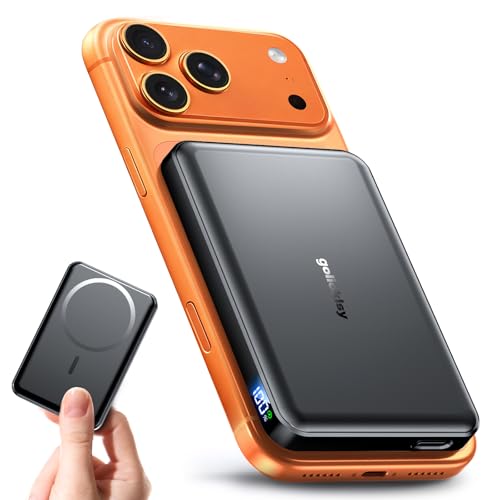
The golioklsy 10000mAh Magnetic Power Bank is a compact portable battery pack engineered primarily for everyday commuters, frequent travelers, and smartphone users who want snap-on wireless convenience without blocking their phone camera. Combining magnetic wireless charging with a 20W USB-C wired port, this battery pack is tailored for owners of MagSafe-compatible iPhone models and Android devices equipped with magnetic cases who need pocket-friendly backup power on busy days.
In terms of power output, the charger features a versatile dual-charging design that allows users to power two devices simultaneously using both wireless and wired connections. The manufacturer lists up to 20W USB-C wired charging alongside wireless output up to 15W or 20W depending on configuration, providing flexible top-up options for supported smartphones. While the 10000mAh nominal capacity provides substantial reserve energy - with manufacturer estimates suggesting roughly 1.5 to 2.2 full recharges for modern standard and larger phone models - actual delivered energy will naturally be lower due to normal conversion losses, thermal dissipation, and wireless transfer inefficiencies.
The physical layout of the battery pack emphasizes ergonomic handling and clear visual feedback through an integrated digital LED battery percentage display. Measuring roughly 3.7 by 2.6 by 0.55 inches with a lightweight design around 0.26 pounds (with package specifications noting up to 4.12 by 2.7 by 0.66 inches), the power bank is deliberately contoured so it does not obstruct rear camera lenses on supported phones during use. The built-in magnetic array and nano-adsorption surface provide firm attachment to compatible phones or magnetic cases, preventing slipping or accidental dislodging during active movement.
Using the charger on a daily commute or flight is straightforward thanks to real-time status monitoring and simple plug-and-charge operation. Users can monitor exact remaining power on the digital readout rather than guessing between vague indicator dots, making it easier to plan recharges before heading out. With its compact footprint, the pack easily slips into a jacket pocket, commuter backpack, or carry-on bag, serving as reliable backup power during flights, road trips, or campus study sessions.
Despite its convenient form factor, the battery pack has specific practical limitations that buyers should weigh. Magnetic wireless attachment requires direct compatibility with MagSafe hardware on iPhone series 12 through modern iterations, while Android devices such as Samsung Galaxy models require an external magnetic phone case to achieve alignment. Furthermore, charging two devices at once divides power output, and wireless charging inherently generates more ambient warmth and transfers power less efficiently than a dedicated direct-wired USB-C connection.
This magnetic power bank is a compelling choice for iPhone and magnetic-case Android users who prioritize a lightweight, camera-friendly form factor with an informative LED percentage screen for daily carry. Shoppers seeking multi-day off-grid power, heavy-duty laptop charging, or certified Qi2 speeds may need a larger-capacity or dedicated high-wattage charging brick instead. For everyday urban commutes, school days, and weekend travel, its balance of 10000mAh nominal capacity and 20W wired backup delivers dependable convenience.
The golioklsy portable charger is engineered to work directly with MagSafe-compatible iPhone models from the iPhone 12 series onward, snapping onto the device without requiring extra hardware. The compact profile ensures that even on smaller devices like the iPhone mini or standard models, the charger does not intrude into the camera field of view.
For Android smartphones such as Samsung Galaxy or Google Pixel devices, wireless power transfer is supported, but magnetic adhesion requires a magnetic phone case or magnetic ring adapter. The built-in 20W USB-C port offers universal wired compatibility, allowing users to plug in standard USB-C cables to charge tablets, wireless earbuds, or secondary phones reliably.

Frequently Asked Questions
What is the maximum watt-hour limit for a power bank on an airplane?
The Federal Aviation Administration (FAA) and TSA allow lithium-ion batteries rated up to 100 watt-hours (Wh) in carry-on baggage without airline approval. Battery packs rated between 101Wh and 160Wh require special airline authorization, while anything exceeding 160Wh is prohibited. High-capacity models like the Anker Prime 26,250mAh pack are built at exactly 99.75Wh to stay compliant.
Can you put a power bank in checked luggage?
No, spare lithium battery packs are strictly prohibited in checked baggage under federal aviation regulations. In the cargo hold, undetected thermal runaway presents an unmanageable fire risk. Carrying your portable charger in the passenger cabin ensures flight crews can quickly inspect and handle any unexpected thermal issues.
How do you calculate watt-hours from battery mAh?
Multiply the listed milliamp-hour (mAh) rating by nominal cell voltage (typically 3.7V), then divide by 1,000. A standard 10,000mAh external battery calculates to 37Wh, resting well below the 100Wh legal threshold. Airport security screeners look for clearly legible manufacturer markings on the shell, so ensure the factory label remains readable.
Can you fly with multiple power banks in your carry on?
Yes, most domestic airlines permit passengers to carry multiple power banks rated under 100Wh for personal electronics without strict numerical limits. However, packs between 101Wh and 160Wh are strictly capped at two units with airline permission. Examining top rated Anker power bank Amazon customer reviews helps flyers select durable units suited for rigorous airport travel.
Does an integrated wall plug make airport travel easier?
Yes, picking a model like the best Anker power bank with wall plug eliminates loose charging bricks and extra cables from your personal bag. These two-in-one chargers plug directly into terminal AC wall sockets to replenish both internal cells and connected smartphones simultaneously, saving valuable space in carry-on luggage.






Write Your Review
No reviews yet. Be the first to share your experience!