


Living off the grid in a camper often reveals how fast everyday electronics deplete auxiliary coach batteries. Portable charging stations solve this problem by supplying dedicated electricity for phones, laptops, cameras, and medical equipment without touching vehicle reserves. Selecting the Best Power Bank For Rv delivers dependable off-grid energy through clean pure sine wave inverters and durable battery chemistry. Based on product specifications and user feedback, well-designed stations balance watt-hour storage with multiple output ports. For campers weighing capacity against portability, reviewing a specs comparison of power bank features helps clarify how watt-hour ratings translate into daily performance.
Modern road trips demand flexible recharging methods when parked away from standard campground utility hookups. Built-in solar input ports, 12V car sockets, and wall adapters keep these versatile battery stations replenished under diverse travel conditions. Campers also utilize specialized solar power bank options for off-grid power to keep essential navigation and communication gear fully operational. Pairing adequate capacity with intelligent battery management systems ensures your gear stays charged without the fumes or noise of fuel generators.

Pros
- Includes a high-efficiency 60W monocrystalline solar panel rated at 20.5% conversion efficiency
- Solar panel includes direct USB-C and USB-A outputs for direct daytime device charging without the station
- Lightweight 5.08-pound form factor makes transport straightforward for camping and remote work
- Multiple recharging methods allow recharging from wall outlets, vehicle sockets, or solar power
Cons
- Strict 300W AC limit cannot run heating appliances, coffee makers, hair dryers, or air compressors
- Requires regular cycling and maintaining charge between 60% and 80% rather than long-term inactive emergency storage
- The solar panel junction box is not waterproof and must be protected from wet weather
This is a compact portable power station and solar generator kit designed primarily for outdoor camping, road trips, and mobile power needs. Combining a 300W power station with an included 60W foldable solar panel, the ZeroKor bundle is aimed at campers, travelers, and outdoor users who need dependable electricity away from standard wall outlets. It provides an all-in-one charging station capable of operating small electronics, mobile devices, and low-wattage camping accessories.
Charging versatility is a key strength of this system. The main power station features two AC outlets supporting appliances up to 300W max, one DC port rated at 9V-12.6V/10A max, three standard 5V/3A USB ports, and one Quick Charge USB port capable of 5V/3A and 9V/2A outputs. In addition, the included 60W solar panel has its own integrated junction box with a USB-A port (5V/3A, 9V/2A, 12V/1.5A) and a USB-C port (up to 15V/2A max), enabling direct daytime device charging independently of the main battery pack.
In terms of physical design and portability, the power station weighs approximately 5.08 pounds and measures 8.5 x 6.7 x 4.1 inches. Its black and orange housing incorporates an integrated carry handle and a built-in multi-mode LED flashlight that provides both a reading mode and an SOS mode for outdoor emergencies. Internal protection is managed by an integrated Battery Management System (BMS) that monitors against short circuits, over-current, over-voltage, overload, and excessive temperatures, assisted by an internal cooling fan that activates automatically based on internal operating temperatures.
Recharging the power station can be handled through multiple methods depending on your location. The unit accepts input from a standard household AC adapter, a 12V vehicle charging cable, or the included 60W solar panel via its DC5521 port using a built-in MPPT controller for improved solar charging efficiency. When using the solar panel, users can also power compatible USB-C and USB-A smartphones, tablets, or cameras directly in sunlight without depleting the main battery unit.
The biggest limitation of this generator setup is its 300W continuous AC output threshold. High-draw electrical appliances, particularly those with heating elements or built-in air compressors such as coffee makers, hair dryers, and water pumps, will exceed the unit's capacity and trigger protection shutdowns. Furthermore, the manufacturer advises against using the system solely as an inactive emergency backup; maintaining internal battery performance requires periodic charging and discharging, ideally keeping capacity between 60% and 80% to avoid entering a battery protection state. Additionally, the solar panel junction box is not waterproof and must remain dry during operation.
For outdoor campers, road trippers, and mobile workers looking for a lightweight, all-in-one solar charging solution for laptops, phones, and low-draw camping gear, this bundle offers strong practical utility. Users requiring whole-home emergency power or the ability to run high-wattage kitchen appliances will need a much larger power station class, but for portable, off-grid charging of personal tech, the ZeroKor 300W kit provides a capable and complete setup.
The included 60W solar panel uses monocrystalline solar cells with a listed conversion efficiency of 20.5%, designed to deliver better performance in limited light conditions than polycrystalline alternatives. It connects to the power station through a DC5521 interface supporting 13V-23V input, taking advantage of the station's built-in MPPT charge controller to optimize incoming solar power.
The solar panel functions as an independent charging accessory thanks to its integrated junction box. It provides a DC output (18V/3.3A, 60W max), a USB-A port supporting Quick Charge profiles up to 12V/1.5A, and a USB-C output supporting up to 15V/2A (30W max). This allows direct daytime charging for compatible smartphones, tablets, and small digital devices even when the main generator is not connected, though the junction box must be kept away from rain and moisture.
Safety features are built directly into the power station via its internal Battery Management System (BMS). The system actively monitors operational conditions to provide short-circuit protection, over-current protection, over-voltage protection, overload protection, and overheating protection. An automatic cooling fan engages and disengages dynamically based on the unit's internal operating temperature during heavy use.
Proper battery maintenance is necessary to keep the portable generator operating reliably over time. The manufacturer highlights that battery performance depends on regular cycling; leaving the battery depleted or uncharged for extended periods can cause it to enter a protection state. For optimal battery preservation, keep the charge level between 60% and 80% when storing, and avoid connecting devices that exceed the 300W maximum limit.

Pros
- Upgraded LiFePO4 battery chemistry offers over 4,000 cycles to 70% capacity for exceptional long-term lifespan.
- Integrated 100W USB-C PD port allows rapid charging of modern laptops and mobile devices directly.
- Versatile array of six total outputs lets you power AC equipment and DC electronics simultaneously.
- Compact 7-pound chassis and molded top handle make it easy to carry around campsites or transport in vehicles.
Cons
- Continuous 300W AC output cannot operate high-wattage heating or kitchen appliances like hair dryers, blenders, or microwaves.
- Solar panels for outdoor renewable recharging must be purchased separately.
- The 292Wh energy capacity exceeds typical airline carry-on limits, restricting travel strictly to ground transport.
The Jackery Explorer 300 is a lightweight portable power station designed to provide practical off-grid electricity for campers, outdoor photographers, road trippers, and homeowners preparing for power interruptions. Built around a 292Wh internal battery and an easy-carry handle, this unit serves as a bridge between pocket-sized USB battery packs and heavy home-backup generators. It best suits mobile professionals and outdoor recreationists who want to run mobile electronics, camera equipment, or CPAP gear without adding heavy bulk to their travel gear.
Charging capabilities center on a versatile six-port layout that can supply power to multiple devices at once. Output options include two AC outlets delivering a combined 300W continuous output with a 600W surge peak, one 100W USB-C Power Delivery port, two USB-A ports, and a standard 120W car port. The 100W USB-C port is particularly useful for laptop users and modern smartphone owners, delivering direct high-speed power without the need to plug an extra AC charging adapter into the station.
Durability is anchored by long-lasting LiFePO4 (lithium iron phosphate) battery cells. The manufacturer specifies that this chemistry delivers over 4,000 charge cycles before dipping to 70% capacity, offering substantially longer service life than older traditional lithium-ion packs. The unit weighs between 7.1 and 7.5 pounds and measures 9.1 inches long, 5.2 inches wide, and 7.8 inches high, making it compact enough to store easily on a vehicle floorboard, in a tent corner, or on a work table.
Recharging the 292Wh power station is straightforward whether at home or on the road. Jackery includes an AC wall adapter for standard household charging and a 12V car charging cable for topping up the station during transit. For off-grid use, the system pairs with Jackery solar panels; the manufacturer notes that an optional 100W solar panel can restore the station to 80% capacity in approximately 2.8 hours, while a 40W panel can reach 80% in roughly 7.5 hours depending on sun exposure.
While this power station delivers broad functionality for small electronics, buyers should understand its output limits before purchasing. The 300W continuous AC inverter limit means it cannot power high-draw appliances such as coffee makers, electric skillets, or space heaters. Furthermore, because it features a 292Wh capacity, this unit cannot be carried onto commercial passenger aircraft under standard 100Wh to 160Wh airline rules, so it is strictly intended for road trips, car camping, and ground-based travel.
For campers, van lifers, remote workers, and emergency kit shoppers looking for a durable, easily transportable power hub, the Jackery Explorer 300 is an excellent choice. Its inclusion of an efficient LiFePO4 battery pack, a 100W USB-C PD connection, and dual AC sockets creates a balanced off-grid solution. Users requiring whole-house emergency coverage or high-draw kitchen appliance support should look to higher-capacity systems, but mobile users will find the Explorer 300 an ideal everyday portable generator.
The Explorer 300 offers six simultaneous charging ports to handle both AC-powered hardware and modern mobile devices. The two AC outlets deliver 300W of rated continuous power and can manage short peak surges up to 600W, providing plenty of headroom for CPAP machines, camera battery chargers, and small field tools.
For modern USB devices, the power station features an advanced 100W USB-C Power Delivery port that can power compatible laptops, tablets, and phones at top speeds without requiring a wall block. Two standard USB-A ports accommodate legacy cables, while the built-in 120W 12V car port supplies power to car fridges, portable inflators, and 12V accessories.
Featuring upgraded LiFePO4 battery chemistry, the Explorer 300 delivers a capacity of 292Wh and maintains more than 4,000 cycles to 70% capacity. This represents a significant lifespan advantage over standard lithium-ion batteries, translating to over a decade of regular use under typical camping or emergency conditions.
Recharging options are versatile, with both an AC household adapter and a 12V car charger cable included in the box. Users who prefer renewable off-grid power can connect optional Jackery solar panels, reaching an 80% charge in about 2.8 hours using a 100W panel or approximately 7.5 hours using a compact 40W panel under ideal sunlight conditions.
Pros
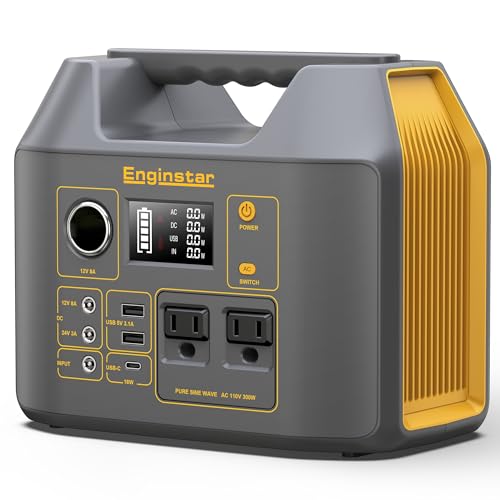
- Pure sine wave AC inverter delivers clean, stable electricity to protect laptops, CPAP machines, and sensitive electronics
- Versatile port selection includes AC outlets, 18W USB-C, standard USB-A, 12V car socket, and multi-voltage DC outputs
- Lightweight 6.5-pound form factor with a sturdy built-in carry handle, integrated utility light, and clear LCD display
- Includes both a household wall charger and a 12V vehicle charging cable in the package
Cons
- Cannot power high-draw heating or cooking appliances exceeding 300 watts, such as microwaves, induction cookers, or space heaters
- USB-C port is rated at 18W, which charges phones and tablets quickly but does not deliver high-wattage laptop fast charging
- Recharging the power station via the standard AC wall adapter takes approximately 7 hours
The EnginStar 296Wh Portable Power Station is a compact, multi-port solar generator and rechargeable battery station engineered for campers, road trippers, mobile workers, and home emergency preparedness kits. Designed around a 296 watt-hour lithium-ion battery pack and a 300W pure sine wave inverter, this unit bridges the gap between everyday pocket power banks and heavy industrial generators. It serves users who need off-grid electricity for standard electronics such as laptops, smartphones, CPAP units, cameras, drones, and small 12V appliances without the noise, fumes, or bulk of gas-powered equipment.
Real-world charging versatility centers on a comprehensive array of output ports designed to power multiple devices at the same time. The front panel features two 110V pure sine wave AC outlets that deliver stable current up to a 300W continuous rating, helping prevent electrical noise or system glitches on sensitive equipment like laptops and medical CPAP machines. Mobile connectivity is supported by an 18W USB-C fast-charge port and two standard USB ports rated at 5V/3.1A for phones and tablets. For mobile living and road trips, the station provides a 12V cigarette-lighter car port for mini-fridges, alongside two dedicated DC barrel outputs (12V 8A and 24V 3A) capable of powering portable vacuums and specialized hobby gear.
Physical construction balances functional durability with easy transport, weighing in at approximately 6.5 pounds with a compact frame measuring 9 by 5.5 by 7.5 inches. The exterior housing incorporates a molded carry handle, a high-visibility LCD screen that monitors power levels, and an integrated LED flashlight for campsite illumination or roadside assistance. Internally, the battery pack uses lithium-ion chemistry managed by a smart Battery Management System (BMS) designed to protect against short circuits, overcharging, over-discharging, overheating, and overload scenarios. The manufacturer rates the battery cells for over 1,000 charge cycles, providing solid longevity for regular seasonal use.
Recharging the EnginStar power station can be handled through three distinct methods, depending on whether you are at home, on the road, or off the grid. The included home wall charger replenishes the 296Wh battery in approximately 7 hours from a standard household outlet, while the supplied 12V car charger cable enables charging directly from a vehicle accessory port during long drives. For off-grid outdoor use, the unit can be connected to an external solar panel (sold separately). During operation, turning on the AC output triggers a brief 3 to 5 second self-check indicated by a red triangle on the display before steady power delivery begins. Long-term storage guidelines suggest keeping the battery between 40% and 70% charge and topping it up every 3 to 6 months in a temperature-controlled environment between 40°F and 100°F.
Realistic limitations stem primarily from the maximum 300W continuous output rating and the specific port specifications. This station cannot run high-wattage heating or heavy motor-driven appliances such as microwaves, induction cooktops, full-sized refrigerators, electric grills, or space heaters. Furthermore, while the 18W USB-C port provides quick charging for smartphones and smaller tablets, it does not supply the 45W to 100W USB Power Delivery wattage that some high-performance laptops prefer when charging under heavy loads, meaning laptops are best charged via the AC outlets with their dedicated power adapters. Additionally, at 296Wh, this battery exceeds the standard 100Wh threshold generally permitted for carry-on luggage on commercial airlines, making it strictly a ground-based travel and outdoor companion.
The EnginStar 296Wh Portable Power Station is best suited for car campers, weekend road trippers, remote professionals, and homeowners looking for an affordable, lightweight backup power hub for essential gadgets and low-draw gear. Shoppers requiring high-wattage capacity for kitchen appliances or rapid USB-C laptop charging should look toward larger, higher-output power stations. However, for buyers seeking pure sine wave reliability, versatile 12V and USB outputs, and three-way recharging in a manageable 6.5-pound package, this model delivers tremendous practical value.
The EnginStar power station features an extensive port layout designed to handle household electronics, mobile devices, and vehicle accessories simultaneously. It includes two 110V AC pure sine wave outlets capable of safely powering devices that draw up to 300W, making it suitable for laptops, cameras, CPAP machines, and small fans. Pure sine wave current ensures that sensitive electronic circuitry operates smoothly without buzzing or risk of operational faults.
For mobile and direct-current gear, the station provides an 18W fast-charging USB-C port, two standard USB ports rated at 5V/3.1A, and a 12V DC vehicle socket intended for travel accessories like mini fridges. Additionally, two dedicated DC outputs (12V 8A and 24V 3A) offer expanded flexibility for specialized equipment such as portable vacuums and hobby electronics, minimizing the need for bulky AC adapters on the road.
Equipped with a 296 watt-hour lithium-ion battery pack, this power station is built for long-term reliability with an operational rating of more than 1,000 charge cycles. A built-in Battery Management System (BMS) continuously regulates battery health by safeguarding against overcharging, over-discharging, short circuits, overheating, and electrical overloading. These protection systems help ensure safe energy distribution across all AC, DC, and USB outputs.
To preserve battery performance over years of use, the manufacturer recommends maintaining the stored battery between 40% and 70% capacity during periods of inactivity and recharging every 3 to 6 months. Operating and storing the unit within recommended temperatures between 40°F and 100°F (4°C to 35°C), away from direct sunlight and heat sources, ensures maximum battery stability and lifespan.

Pros
- Versatile 10-port output selection accommodating AC, DC, USB-A, USB-C, and wireless charging simultaneously
- Pure sine wave 500W AC inverter protects sensitive motors and sensitive electronic devices from electrical distortion
- Capable 60W USB-C PD port delivers rapid charging for compatible modern laptops, tablets, and phones
- Quiet, fume-free lithium battery operation makes it safe for indoor residential use and vehicle camping
Cons
- At 14.1 pounds, it is designed for vehicle transport or home backup rather than casual backpack carry
- Internal battery capacity of 519.48Wh exceeds airline carry-on limits and cannot be brought on passenger flights
- The 500W maximum continuous limit cannot run high-wattage heating appliances like hair dryers, space heaters, or standard microwaves
The GRECELL 500W Portable Power Station is a high-capacity mobile energy station designed to deliver off-grid electricity for outdoor recreation, road trips, and home emergency preparedness. Engineered around a 519.48Wh (140,400mAh) lithium battery core and a 500W pure sine wave AC inverter, this unit bridges the gap between handheld pocket power banks and heavy fuel-powered generators. It primarily serves campers, overland travelers, remote professionals needing field power for laptops, and individuals seeking dependable backup power for CPAP machines, mobile phones, and compact 12V appliances during power interruptions.
Charging versatility is one of the system's most notable attributes, offering ten distinct outputs that can operate simultaneously. The interface features two 120V pure sine wave AC outlets (rated up to 500W total), one USB-C Power Delivery port capable of up to 60W output (20V/3A), three USB-A Quick Charge 3.0 ports rated at 18W each, two 12V/5A DC barrel ports, a 12V/10A car accessory socket, and a top-mounted 10W wireless charging pad. The 60W USB-C port allows users to charge modern USB-C laptops, iPads, and fast-charge compatible smartphones quickly, while the pure sine wave inverter ensures clean electrical current that prevents motor hum and protects sensitive microprocessors in medical and audio gear.
In terms of physical design, the power station measures 11.57 by 7.95 by 7.95 inches and weighs 14.1 pounds, placing it firmly in the category of transportable base-camp power hubs. The exterior housing is constructed for rugged utility with a molded top handle for carrying, clear port grouping, and an integrated digital display screen that provides real-time monitoring of remaining battery level, input charging status, and active load output wattage. Having an integrated 10W wireless charging surface directly on the top panel adds everyday convenience, letting users lay down a Qi-compatible phone for a top-up without monopolizing a physical USB port or carrying an extra cable.
Recharging the power station itself is straightforward, with three supported replenishment methods designed for home, vehicle, and off-grid use. When plugged into a standard residential wall outlet, the unit achieves a full recharge in approximately 6 to 7 hours using the included AC adapter. Mobile charging through a 12V vehicle cigarette lighter port requires around 7 to 8 hours, while connecting a compatible 100W solar panel in direct sunlight can replenish the battery in roughly 6 to 9 hours. Operational handling is simple, though users must manually turn off the AC inverter toggle when finished, as leaving the inverter active can slowly deplete the battery through phantom draw even when no appliances are plugged in.
Prospective buyers should keep practical operational boundaries in mind before purchasing. The 500W maximum rating means this unit cannot support high-draw thermal appliances such as full-sized kitchen blenders, electric heaters, toasters, or hair dryers that require heavy surge or continuous wattage. Additionally, because the 519.48Wh battery capacity substantially exceeds federal carry-on thresholds (typically 100Wh to 160Wh with airline approval), this unit is strictly restricted from commercial passenger flights. Safe long-term storage also requires routine maintenance, with the manufacturer advising a full recharge cycle at least once every three months to preserve the internal lithium cells.
The GRECELL 500W Power Station is an excellent investment for vehicle campers, mobile content creators, tailgaters, and homeowners wanting reliable backup for lighting, communication, personal medical equipment, and portable refrigeration. Shoppers who only require day-trip phone top-ups or an everyday backpack charger will be much better served by a pocket-sized 10,000mAh to 20,000mAh power bank. For anyone seeking substantial energy reserves, multi-device versatility, and clean pure sine wave power in a quiet, zero-emission package, this unit delivers exceptional off-grid utility.
The GRECELL 500W Power Station features ten output options tailored for modern multi-device setups. Wired digital devices can utilize the dedicated 60W USB-C Power Delivery port, which supports voltages up to 20V at 3A to run USB-C laptops, tablets, and mobile devices at high efficiency. In addition, three Quick Charge 3.0 USB-A ports supply up to 18W each, providing fast charging profiles for standard mobile phones, handheld gaming devices, GPS units, and camera batteries without reducing power to the other connections.
For household electronics and automotive accessories, the unit provides dual 120V AC pure sine wave outlets capable of supporting continuous loads up to 500W. 12-volt equipment is supported via a standard 12V/10A car accessory socket alongside dual 12V/5A DC barrel jacks, which are well-suited for running mini-refrigerators, CPAP systems, or camp lights. A built-in 9V/1.1A (10W max) wireless charging pad situated on the top surface provides straightforward wireless replenishment for compatible phones, eliminating cable clutter during shared use.
Recharging options allow for flexible power replenishment depending on your location. The unit charges from 0 to 100 percent in 6 to 7 hours using a standard AC home wall outlet, 7 to 8 hours using a standard 12V vehicle socket, or 6 to 9 hours when connected to a compatible 100W solar panel under optimal sunlight. When connecting third-party solar equipment or custom charging adapters, the input voltage must remain at or below 23V to prevent damaging the internal charging circuitry.
Comprehensive hardware safeguards are managed by an onboard Battery Management System (BMS). This protection system monitors cell operation in real time to guard against overvoltage, overcurrent, short circuits, and extreme operating temperatures. Combined with pure sine wave inverter technology that ensures smooth electrical frequency delivery, the system helps safeguard connected sensitive electronics while maximizing overall lithium battery service life.

Pros
- Complete solar kit bundling both the portable battery station and a 40W monocrystalline solar panel in one package
- Offers flexible output connectivity including dual AC outlets, 12V DC, USB-C, and multiple USB-A ports
- Weighs only 3.32 pounds with a built-in handle, making it easy to carry for camping and outdoor activities
- Supports AC pass-through charging for simultaneous power station recharge and device operation
- Includes multiple charging accessories: AC adapter, 12V car charging cable, cigarette lighter adapter, and 10 solar DC tips
Cons
- AC inverter is strictly limited to 100W maximum, preventing use with high-draw appliances like coffee makers, hair dryers, or air compressors
- Exact watt-hour (Wh) and milliamp-hour (mAh) internal battery capacities are not explicitly stated in manufacturer specifications
- The solar panel junction box is not waterproof and must be protected from rain and moisture
The ZeroKor Portable Power Station with 40W Solar Panel is a compact, entry-level off-grid power hub designed for campers, road trippers, and emergency home power preparedness during storms or unexpected outages. This all-in-one generator kit pairs an AC-capable lithium-ion battery unit with a foldable monocrystalline solar panel to provide power for consumer electronics without the noise, fumes, or maintenance of gas-powered generators. Weighing approximately 3.32 pounds, the system focuses on portable backup power for travelers, outdoor hobbyists, and emergency-kit planners seeking reliable electricity away from standard wall outlets.
Power delivery across the power station is anchored by two standard AC outlets supporting a combined continuous output limit of up to 100W. Output ports also feature a dedicated DC barrel port rated from 9V to 12.6V at up to 10A, dual standard USB ports sharing a 5V/3.1A maximum, one Quick Charge USB-A port delivering up to 9V/2A, and a USB-C port supporting 5V/3A and 9V/2A. This configuration is intended for recharging consumer electronics such as smartphones, tablets, cameras, drone batteries, and low-power laptops drawing under 100W. Because the manufacturer data specifies a 100W power rating without listing an explicit watt-hour or milliamp-hour capacity, delivered runtime depends entirely on the active wattage of connected hardware.
The physical build of the power station measures 7.59 by 3.74 by 6.16 inches in a black and gray enclosure, featuring an integrated carrying handle and a multi-mode LED flashlight with an emergency SOS signaling function. Included in the package is a 40W foldable monocrystalline solar panel engineered with a 22.8% cell conversion efficiency rating. The solar panel features its own independent output box equipped with a USB-A port (up to 12V/1.5A), a USB-C port capable of up to 15V/2A (30W), an 18V/2.23A DC interface, and ten interchangeable DC connector adapters for broad compatibility with compatible power devices.
Recharging the portable battery pack can be accomplished using three distinct methods: the included AC wall power adapter, an included 12V car charging cable, or the 40W solar panel via its DC5521 connection with built-in MPPT charge regulation. The station supports AC pass-through charging, enabling connected devices to receive power while the internal battery pack recharges. For long-term battery health, the manufacturer recommends recharging the lithium-ion unit at least once every half month when not in active use and storing the battery at a 60% to 80% charge level.
A notable limitation of this system is the strict 100W maximum capacity of the internal AC inverter. High-wattage household appliances such as electric coffee makers, hair dryers, water pumps, blenders, or tools featuring built-in air compressors exceed the operating threshold and will trigger overload protection. Additionally, while the solar panel is designed for outdoor daytime use, its integrated junction box is not waterproof and must remain completely dry during outdoor setup.
For shoppers seeking an accessible, lightweight backup power kit for weekend tent camping, road trips, mobile device management, or basic household blackout kits, the ZeroKor 100W solar generator package delivers strong convenience. Buyers who need to run heavy-duty appliances, CPAP machines, or high-draw heating elements will require a larger, higher-wattage power station. Users focusing on keeping phones, tablets, cameras, and low-draw laptops operational off the grid will find this bundled solar and battery system practical and easy to transport.
The ZeroKor power station offers multi-port versatility across both AC and DC standards. Output options on the battery unit include two AC outlets capped at 100W total, one DC port (9V-12.6V/10A max), two shared USB-A ports (5V/3.1A max), one Quick Charge USB-A port (5V/3A, 9V/2A max), and one USB-C port (5V/3A, 9V/2A max). This allows simultaneous powering of multiple personal mobile devices within the inverter's aggregate power boundaries.
The bundled 40W foldable solar panel functions as an independent charging station as well as a generator recharge source. It features monocrystalline cells rated at 22.8% conversion efficiency, an 18V/2.23A DC output for the power station, a USB-A port with multi-voltage support (5V/3A, 9V/2A, 12V/1.5A), and a USB-C port (5V/3A, 9V/3A, 12V/2.5A, 15V/2A max) capable of directly charging small consumer electronics in direct sunlight.
Internal system protection is monitored by an integrated Battery Management System (BMS). The system provides automated safeguards against short circuits, over-current, over-voltage, overload, and overheating conditions, while operating with low noise and zero gas emissions during outdoor and indoor emergency scenarios.

Frequently Asked Questions
What capacity is practical for the Best Power Bank For Rv?
A capacity between 250Wh and 550Wh provides the ideal balance of portability and runtime for charging laptops, cameras, and phones. Compact models like the 292Wh Jackery Explorer 300 or 519.48Wh GRECELL station supply sufficient energy without crowding camper living areas. Larger capacities deliver extended runtime but add weight and require longer charging cycles.
Can a portable power station run heavy RV appliances like microwaves?
No, portable stations rated from 100W to 500W cannot operate high-draw appliances such as microwaves, air conditioners, or coffee makers. These battery stations feature pure sine wave AC inverters built specifically for low-wattage electronics like laptops, drones, CPAP units, and camping lamps. Exceeding rated continuous wattage causes the internal battery management system to shut down output for safety.
How do you recharge the Best Power Bank For Rv while boondocking?
You can recharge an RV battery station using portable solar panels, a 12-volt vehicle carport outlet, or standard AC wall outlets before departure. Models equipped with built-in MPPT charge controllers optimize solar conversion from compatible panels under direct sunlight. For quick top-ups at rest stops, packing a compact power bank with wall plug provides handy secondary charging for personal mobile accessories.
What is the difference between watt-hours and milliamp-hours in power stations?
Watt-hours describe total stored electrical energy regardless of voltage, while milliamp-hours only indicate charge capacity at a specific nominal cell voltage. Evaluating power stations in watt-hours gives a realistic metric for comparing runtime across both alternating current and direct current outlets. When comparing options in 2026, watt-hour ratings eliminate ambiguity stemming from varying internal battery configurations.
Does the Best Power Bank For Rv support CPAP machines for off-grid sleeping?
Yes, stations with at least 290Wh capacity and pure sine wave AC outlets or 12V DC ports easily power standard CPAP machines overnight. Connecting a CPAP to the 12-volt DC port avoids inverter conversion losses, preserving energy until morning. Disabling the heated humidifier and heated hose reduces power consumption significantly during wilderness trips.




Write Your Review
No reviews yet. Be the first to share your experience!