


Staring at a dying screen during a flight or remote work session brings instant frustration when outlets are absent. A battery pack can replenish a computer only when its port delivers enough wattage and supports USB Power Delivery. Many mobile professionals ask, do power banks work on laptops without causing errors or sluggish drain? The answer is yes, but success requires matching your machine’s power threshold with suitable battery specs. An ordinary phone charger will trigger a slow-charging warning or fail to power the system entirely.
Evaluating portable power requires analyzing listed output, charging protocols, and port layouts. A capable dedicated laptop portable charger usually supplies 65W to 140W from a single USB-C connection to charge notebooks quickly. Frequent travelers must also watch total energy, as a travel power bank under 100Wh remains compliant with standard airline carry-on guidelines while keeping work gear running all day.




Pros
- Substantial 165W total output supports simultaneous fast charging for two laptops at 100W and 65W.
- Built-in retractable cable keeps travel setups tidy and eliminates the hassle of carrying loose cords.
- Informative full-color TFT display shows real-time wattage diagnostics, runtime estimates, and battery life.
- Genuine aluminum unibody build provides solid exterior durability and efficient thermal dissipation.
- Comes complete with a high-spec 240W USB-C cable and storage pouch straight out of the box.
Cons
- Weighs approximately 1.46 pounds, making it noticeably heavier than standard phone-only battery packs.
- A compatible 65W or higher wall charger must be supplied separately to achieve the fastest recharge speeds.
- The mechanical retractable cable contains internal moving parts that require careful handling over extended use.
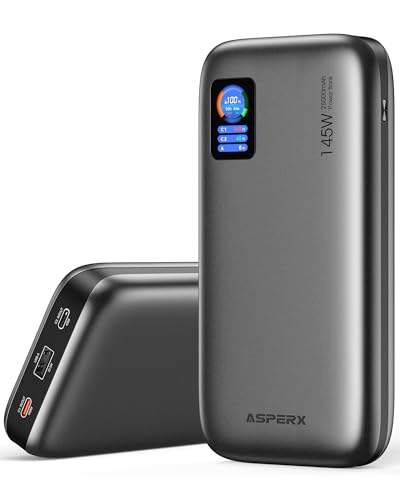
The AsperX 165W Laptop Power Bank is a high-output portable charger equipped with a 20,000mAh nominal capacity, an integrated retractable cable, and an aluminum unibody enclosure. Designed primarily for mobile professionals, college students, and frequent flyers, this device solves the challenge of charging power-hungry USB-C laptops and smartphones away from wall outlets without carrying loose cables.
The power bank is engineered to deliver a maximum combined output of 165W, featuring a top single-port rate of 100W. According to manufacturer specifications, the unit can simultaneously supply 100W to one computer and 65W to a second computer, making it suitable for multi-device laptop and mobile setups. In addition to high-draw computers, pressing and holding the power button activates a dedicated Small Power Mode, which optimizes power delivery for low-draw accessories such as smartwatches, headphones, and small portable fans.
The exterior chassis is constructed from a genuine aluminum alloy unibody rather than painted plastic, providing structural rigidity and roughly 40 percent better heat dissipation during intense charging tasks. On the front of the enclosure sits a large color TFT screen that monitors operational metrics in real time, displaying current battery percentage, estimated remaining runtime, and live input/output wattage. Screen brightness is adjustable to maintain clear visibility whether working under outdoor sunlight or inside dim airline cabins.
Handling and setup are straightforward thanks to the built-in retractable cord, which pulls out smoothly to plug directly into compatible devices and stows flush against the housing when not in use. Recharging the power bank itself supports an input rate of up to 65W, allowing users to rapidly replenish the 20,000mAh cell using an external high-power USB-C wall adapter. The package also includes a separate 240W high-speed USB-C to USB-C cable and a dedicated carrying pouch, making it easy to store in a backpack, briefcase, or carry-on bag.
Potential buyers should account for the physical footprint and weight of the battery pack. At 1.46 pounds and measuring 6.56 by 3.21 by 1.08 inches, it carries meaningful heft compared to pocket-sized phone chargers. Additionally, realizing the full 65W recharging speed requires a separate high-wattage wall adapter, which is not included in the box. Users must also ensure their laptop supports USB-C charging rather than data-only transfer, as some older or proprietary notebook ports cannot receive power over USB-C.
This portable charger is an exceptional match for business commuters, digital nomads, and multi-device tech users who require true laptop-grade charging speeds in a self-contained, cable-integrated package. Those who only need an occasional phone top-up may find the 1.46-pound aluminum form factor unnecessarily heavy, but for anyone looking to power two laptops or high-drain mobile gear simultaneously on the road, the combination of 165W dual output, live TFT diagnostics, and 20,000mAh capacity provides outstanding portable utility.
With a maximum combined output rating of 165W, this battery pack is capable of powering demanding hardware that standard power banks cannot support. A single port can deliver up to 100W, which aligns with the higher charging requirements of full-size USB-C laptops and power-intensive devices.
When running two laptops simultaneously, the intelligent power allocation delivers 100W to one computer and 65W to the second, maintaining rapid charging speeds across both machines without severe throttling. For low-current accessories, the integrated Small Power Mode prevents the charger from shutting down prematurely when powering smartwatches or wireless earbuds.
Input performance is equally robust, supporting recharging rates of up to 65W. While the actual recharge speed depends on the power adapter used, utilizing a 65W or higher USB-C wall charger ensures minimal downtime between trips.
The unibody enclosure is made from authentic aluminum alloy, offering superior structural strength and enhanced thermal management compared to traditional plastic casings. The metal housing helps dissipate heat away from the internal battery cells during sustained high-wattage charging cycles.
The unit features a large, full-color TFT display that provides complete visibility over power dynamics. Users can check current battery level, expected operating time remaining, real-time input and output wattage, and adjust display brightness for comfortable viewing indoors or outside.
The built-in retractable cable system simplifies cable management by keeping the primary charging line contained within the chassis. When additional reach is required, the included 240W USB-C to USB-C cable ensures full compatibility with maximum power standards.


Pros
- Integrated 100W AC outlet powers small electronics that require standard two-prong or three-prong plugs
- Bidirectional 65W USB-C PD port supports laptop charging and recharges the bank in 1.5 hours
- Listed 98Wh energy rating complies with standard 100Wh airline carry-on limits
- Four versatile output ports accommodate both modern USB-C gear and legacy USB-A accessories
Cons
- AC outlet output is capped at 100W, making it unsuitable for high-draw heating elements or large appliances
- The 6.7 x 2.6 x 2.6-inch tower design is bulkier than flat, pocket-sized smartphone power banks
- Achieving the 1.5-hour recharge time requires a separate 65W USB-C wall adapter not detailed as included
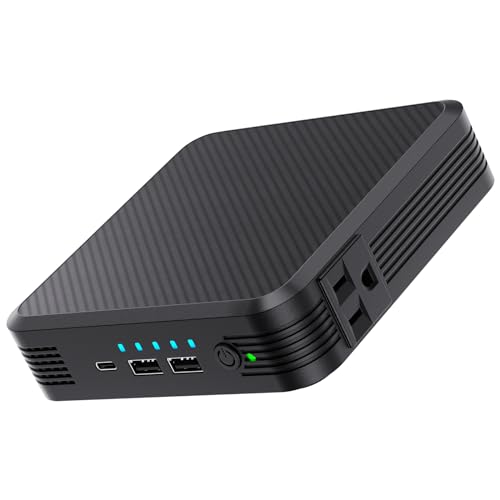
The Paopaoyu 100W AC Outlet Portable Power Bank is a versatile high-capacity backup charger engineered for remote workers, business travelers, campers, and emergency home backup kits. Combining an integrated AC socket with modern USB Power Delivery ports, this unit eliminates complete reliance on wall plugs when working away from a desk. It provides substantial off-grid energy in a standalone tower format, making it particularly useful for keeping essential mobile gear operational during flights, road trips, field assignments, or unexpected electrical outages.
Equipped with a listed nominal capacity of 27,000 mAh and an energy rating of 98Wh, this power bank delivers multi-device flexibility through four distinct output ports. The primary feature is a 100W AC outlet capable of handling portable electrical appliances that draw less than 100 watts. For modern mobile electronics, a bidirectional 65W USB-C Power Delivery port provides high-speed charging for compatible laptops, tablets, and smartphones. Additional connectivity includes an 18W USB-A port and a 12W USB-A port, allowing users to power cameras, handheld devices, and older mobile accessories without carrying separate adapter plugs.
In terms of build and layout, the Paopaoyu charger adopts a block-style tower aesthetic measuring 6.7 by 2.6 by 2.6 inches. This structured footprint keeps the AC outlet and USB array easily accessible on desktop workspaces, airline tray tables, or camp tables while minimizing horizontal surface clutter. Because the battery capacity is listed at 98Wh, the unit falls just beneath the general 100Wh limitation enforced by the FAA and TSA for passenger carry-on baggage. While the column shape is too substantial for pocket carry, it slips neatly into commuter backpacks, camera cases, and emergency prep bags.
Recharging the power bank is efficient thanks to the 65W input capability on the USB-C port, which the manufacturer states can replenish the 27,000 mAh battery in approximately 1.5 hours when connected to a compatible high-wattage power adapter. Operating connected devices is largely plug-and-play, allowing power delivery across USB-A, USB-C, and AC connections depending on total demand. Everyday operation remains straightforward whether positioned on an airport terminal bench, an office desk away from wall sockets, or an outdoor picnic table.
Prospective buyers must recognize the operational limits of a 100W AC inverter. Electrical appliances requiring sustained or surge power above 100 watts, such as household hair dryers, electric kettles, or high-draw tools, will trigger the built-in overload protection mode. Furthermore, achieving the advertised 1.5-hour recharge turnaround necessitates a separate 65W USB-C wall charger. While the 98Wh energy rating complies with general airline carry-on guidelines, individual carrier policies can vary, and actual delivered energy will reflect standard voltage conversion losses and AC inversion efficiency.
For mobile professionals, frequent flyers, outdoor enthusiasts, and emergency planners who need reliable AC and 65W USB-C power in a single transportable package, the Paopaoyu 100W AC Power Bank offers strong utility. Shoppers looking strictly for a slim, pocket-friendly phone battery may prefer smaller 5,000 mAh or 10,000 mAh power banks. However, if your gear kit demands an AC socket and laptop-grade USB-C output without exceeding airline capacity limits, this versatile multi-port unit represents a practical and capable choice.
The Paopaoyu power bank provides four dedicated outputs to accommodate both modern USB electronics and standard AC wall plugs. The 100W AC outlet handles laptops, camera battery chargers, and compact personal appliances drawing under 100W. The bidirectional USB-C port supports 65W Power Delivery for both charging compatible laptops and rapidly recharging the power bank itself. For legacy devices, an 18W fast-charge USB-A port and a standard 12W USB-A port provide dedicated connections for smartphones, earbuds, and accessories.
Safety architecture on this power bank includes FCC, CE, and RoHS certifications alongside built-in protection against overcharging, overvoltage, overcurrent, and short circuits. If an attached device exceeds the 100W threshold on the AC outlet, an automatic safety shutoff activates to protect the battery and internal inverter. With an explicit energy rating of 98Wh, the battery bank is designed to comply with standard TSA and FAA passenger carry-on thresholds under 100Wh, though travelers should always verify specific carrier guidelines before flying.
Frequently Asked Questions
What wattage does a power bank need to charge a laptop?
Most modern laptops require at least 45W to 65W of USB Power Delivery output to charge effectively under active use. Lightweight ultrabooks can sometimes charge on 30W, but larger performance machines often need 100W to charge while running heavy programs. If the wattage is too low, the laptop may deplete faster than the pack charges it.
Does any USB-C power bank work for laptop charging?
No, a standard USB-C port does not guarantee laptop charging support. The port must feature USB Power Delivery (USB PD) with higher voltage negotiation profiles like 20V. Basic phone chargers supply lower voltages that laptops reject. Confirm that your notebook charges over USB-C and that the power pack explicitly lists high-wattage PD output.
Are laptop power banks permitted on airplanes?
Yes, airline security rules permit laptop power banks in carry-on baggage if they do not exceed 100 watt-hours (Wh). Battery packs rated at 20,000mAh (roughly 72Wh to 74Wh) or 25,000mAh (around 92.5Wh) fall safely below this regulatory ceiling. Never place external lithium batteries in checked luggage, as regulations mandate they stay in the cabin.
Why does a notebook display a slow charger notification?
This notification appears when the power bank’s negotiated output is lower than your laptop’s original wall charger rating. While a 30W or 45W connection might trickle-charge the battery during sleep mode, the system warns that active use will outpace incoming current. Using a pack with 65W or higher PD output usually eliminates this warning.
What capacity should you look for when buying a laptop power bank?
A listed capacity of 20,000mAh to 27,000mAh offers the best balance of delivered energy and bag-friendly weight. A budget 20000mAh portable charger typically provides around one complete recharge for a standard laptop after accounting for conversion efficiency losses. Packs exceeding 30,000mAh add considerable bulk and can violate airline restrictions.
How does charging multiple devices affect laptop power delivery?
Connecting extra devices usually reduces the wattage routed to your computer. Multi-port power banks often split their internal wattage, causing a 100W port to drop to 65W or 45W once phones or earbuds plug in. For the fastest notebook recharge, use a single dedicated USB-C port without sharing power across other slots.




Write Your Review
No reviews yet. Be the first to share your experience!