


Noticing a battery casing bulge outward triggers immediate safety concerns for mobile users. Understanding what to do with bloated power bank hardware starts with one rule: stop using and stop charging the swollen battery pack immediately. Lithium cells swell when chemical breakdown generates gas under heat or overcharging stress, preventing safe voltage regulation. Once placed in a cool, fire-safe container, the damaged unit should be brought to a certified hazardous waste or electronic recycling center instead of regular trash.
Replacing a compromised charger requires balancing battery capacity against verified protective circuitry. Dependable replacement portable chargers feature safeguards against short circuits and temperature spikes, which buyers can check in a specs comparison of power bank features. Options range from heavy-duty power stations like the powkey 200W Portable Power Bank with AC Outlet to pocket-sized units like the INIU Portable Charger, 10000mAh 30W Fast Charging. Upgrading to safe, modern hardware restores reliable backup power without the risk of battery failure.


Pros
- Two 120V AC outlets with pure sine wave output allow powering small appliances that standard USB power banks cannot support
- Lightweight 3-pound design is compact enough to carry in a bag or store in a vehicle for emergency use
- Multiple output types including AC, USB, and DC provide versatility for different devices and use cases
- Manufacturer lists multiple safety protections including OCP, OVP, short circuit protection, and auto power off protection
- CE, FCC, RoHS, and UL certifications are listed along with factory ISO9001 approval
Cons
- 146Wh capacity is relatively modest, so powering higher-draw AC devices will drain the battery quickly
- Heating appliances are limited to under 100W, and total AC draw must stay under 200W, which restricts what you can plug in
- The manufacturer recommends keeping the battery above 30% and recharging every 3 months to avoid battery degradation, requiring regular maintenance even when not in use
The Powkey 200W is a portable power station rather than a standard USB power bank. It is designed for users who need AC outlet power on the go, not just USB charging. With two 120V AC outlets, four USB ports, and one DC port, it targets campers, road trippers, emergency-kit builders, outdoor event attendees, and anyone who occasionally needs to run small AC-powered appliances away from a wall outlet. This positions it differently from pocket-sized phone chargers - it is a small-scale portable power station meant to bridge the gap between a basic power bank and a full-size generator.
The Powkey 200W lists a 146Wh energy capacity using a Grade A lithium polymer battery. That 146Wh figure describes the total stored energy in the battery, not the exact amount of energy that will reach your devices after conversion losses. The two AC outlets deliver pure sine wave power at 120V with a combined maximum of 200W. Pure sine wave output is a meaningful specification because it produces cleaner current than modified sine wave inverters, which can cause buzzing in speakers, interference in sensitive electronics, and compatibility issues with certain devices. The manufacturer notes that heating products should draw less than 100W, and all connected devices must stay under the 200W combined limit. Users should check the wattage rating of any appliance before plugging it in.
The four USB ports provide additional charging flexibility for smartphones, tablets, and other USB-powered devices, though the product data does not specify individual USB port output wattage or whether any ports support fast-charging protocols like USB Power Delivery or Quick Charge. The DC port adds another output option for compatible accessories. Build quality appears straightforward with a black housing measuring 7.87 x 1.81 x 5.71 inches and a listed net weight of 3 pounds (4 pounds gross weight including all accessories). Four LED indicators serve as the battery level display, providing a simple visual reference rather than a precise percentage readout.
Recharging the Powkey 200W is handled through a 15V/2A DC input, with the manufacturer listing approximately 5-6 hours for a full recharge. This is a reasonable timeframe for a unit of this capacity, and it means you can realistically recharge it overnight or during a workday. The manufacturer emphasizes that the battery should be maintained above 30% charge and recharged at least every three months to prevent degradation - a common recommendation for lithium polymer batteries that users should take seriously to preserve long-term battery health. The unit ships with accessories included in the gross weight, though the product data does not specify whether a wall adapter is included or must be purchased separately.
The most significant limitation of the Powkey 200W is its 146Wh capacity relative to the AC power demands it supports. Running a device that draws 100W from the AC outlet would theoretically deplete the battery in well under two hours after accounting for inverter conversion losses. This makes it suitable for short-duration AC use - charging a laptop, running a small fan, powering a lamp during a brief outage - but not for extended off-grid AC power needs. The 200W cap also means it cannot power hair dryers, space heaters, full-size coffee makers, or other high-draw appliances. Users who need sustained AC power for hours should consider a higher-capacity power station.
The Powkey 200W portable power station is best suited for users who specifically need AC outlet capability in a lightweight, portable package. Campers who want to power a small lamp or charge a laptop at a campsite, families building an emergency power kit for short outages, and road trippers who need to occasionally plug in an AC device will find the most value here. Users who only need to charge phones and tablets would be better served by a standard USB power bank with higher energy density for that purpose. The strongest reason to choose this model is the combination of pure sine wave AC output, multiple port types, and a genuinely portable 3-pound weight - a combination that gives you real outlet power without the bulk of larger power stations.
The Powkey 200W portable power station provides three types of output: two 120V AC outlets, four USB ports, and one DC port. This variety of output types is what distinguishes it from standard USB-only power banks. The AC outlets use pure sine wave inverter technology with a combined maximum output of 200W, which the manufacturer notes is suitable for lamps, phones, laptops, TVs, printers, fans, car pumps, and small appliances as long as total draw stays under 200W.
The product data does not specify individual USB port output ratings, supported fast-charging protocols, or whether any USB ports are USB-C versus USB-A. Buyers who rely on specific fast-charging standards for their smartphones should verify compatibility before purchase. The DC port provides an additional output option, though specific DC output voltage and amperage are not detailed beyond the input specification of 15V/2A for recharging the unit itself.
For recharging, the unit accepts 15V/2A DC input. The manufacturer does not specify whether the included accessories contain a compatible wall adapter or if one must be sourced separately. Users planning to recharge from a vehicle's 12V outlet or solar panel would need to verify input compatibility, as the product data does not mention these recharge methods.
At 3 pounds and 7.87 x 1.81 x 5.71 inches, the Powkey 200W is compact enough to fit in a backpack, carry-on bag, or car trunk without adding significant bulk. This makes it practical for road trips, camping, tailgating, outdoor photography sessions, and situations where temporary AC power would be useful. The relatively slim profile for a power station with AC outlets is one of its distinguishing features.
For air travel, the listed 146Wh energy capacity is a specification travelers should carefully evaluate against current airline and regulatory battery policies. Many airlines reference a 100Wh threshold for lithium batteries carried without special approval, with some allowing batteries between 100Wh and 160Wh with airline approval. The Powkey 200W's 146Wh rating falls in this range, so travelers should verify current rules with their specific airline before attempting to bring it on a flight. Lithium battery policies can vary by carrier and jurisdiction, and this unit should never be placed in checked baggage.
For car-based travel, camping, and outdoor events, the Powkey 200W makes more straightforward sense. Having two AC outlets available at a campsite or in a vehicle provides genuine convenience for powering devices that require standard wall outlets, and the 5-6 hour recharge time means you can top it off from a wall outlet before heading out.
The manufacturer lists several protection systems built into the Powkey 200W: overcurrent protection (OCP), overvoltage protection (OVP), short circuit protection, and auto power off protection. These are standard safety features for portable power stations and are designed to help protect both the unit and connected devices from electrical faults during normal use.
The product lists CE, FCC, RoHS, and UL certifications, along with MSDS and UN38.3 documentation and factory ISO9001 approval. These certifications indicate the manufacturer has submitted the product for relevant compliance testing. The Grade A lithium polymer battery cells are noted as the highest quality available according to the manufacturer.
An important maintenance note from the manufacturer: users should keep the battery level at or above 30% (2 bars on the LED indicator) and recharge the unit at least every 3 months to avoid battery degradation. Lithium polymer batteries can suffer permanent capacity loss if stored at very low charge levels for extended periods, so this recommendation is worth following even if you only use the power station occasionally.
Pros
- Three power banks and a docking station create a convenient always-ready charging ecosystem for households or small groups
- Built-in USB-C and iOS cables mean most smartphone users can charge without packing extra cables
- Each 10,000mAh unit is slim and lightweight enough for everyday carry in a pocket or bag
- Four-color LED battery indicator provides a quick visual check of remaining charge without needing a screen
- Includes 140 themed sticker patterns for personalization, which is a thoughtful touch for families with multiple users
Cons
- No specific fast-charging protocol such as USB Power Delivery or Quick Charge is listed, so charging speeds may be standard rather than fast
- The product does not list specific output wattage, making it difficult to evaluate charging speed compared to competing power banks
- At three units plus a docking station, the complete set takes up more desk or counter space than a single power bank solution
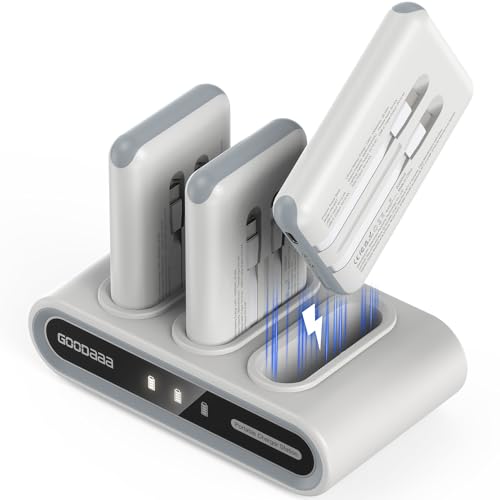
The GOODaaa 3-Pack 10000mAh Portable Charger is a charging station system designed for families, shared households, and small teams who want multiple power banks ready to grab at any time. Rather than a single standalone power bank, this product is a coordinated kit: three individual 10,000mAh slim battery packs plus a docking station that charges all three simultaneously. Each power bank comes with built-in USB-C and iOS cables as well as a USB-C port, which means the entire set can theoretically support up to nine device connections at once. GOODaaa positions this as a grab-and-go solution where you dock a depleted unit when you come home and pick up a fully charged one on your way out.
Each power bank lists a nominal battery capacity of 10,000mAh. That figure represents the internal battery cell capacity, not the exact amount of energy delivered to a connected device - voltage conversion, cable resistance, and other factors always reduce usable output. The product description does not specify output wattage, supported fast-charging protocols like USB Power Delivery or Quick Charge, or exact charging times. Without those details, buyers should expect standard USB charging speeds rather than rapid fast-charging performance. The built-in cables cover USB-C and iOS connectors, which addresses the two most common smartphone cable types in the U.S. market. However, no Lightning-to-USB-C cable specification or data-transfer capability is mentioned, and no laptop compatibility is listed.
Build quality centers on a slim, lightweight form factor. Each power bank measures 4.3 x 2.6 x 0.7 inches and weighs 6.42 oz, which is compact enough to slip into a jeans pocket or a small purse compartment. The docking station itself measures 6.69 x 3.82 x 5.28 inches and uses what GOODaaa calls "thimble" charging contacts - metal contact points that transfer current when each power bank is seated in its dock slot. The manufacturer states these contacts are safety-certified to remain below 45 degrees Celsius (113 degrees Fahrenheit) during operation. A slight warmth during docking is described as normal operating behavior. The kit also includes seven sheets of themed stickers (140 patterns total) so family members can personalize and identify their own power bank.
Daily use follows a straightforward routine: dock all three power banks on the station, let them charge, and grab one whenever you leave. The four-color LED system on each unit shifts through Red, Green, Blue, and Cyan to indicate battery level from 25% to 100%, which provides a quick visual status check without needing a digital display. On the docking station, a battery icon glows dimly while charging and remains steady when full. The manufacturer describes a smart chip inside each unit that provides overcharge protection and short-circuit protection. No additional certifications such as UL or FCC are specified in the product data.
The most notable limitation is the lack of listed output wattage or supported fast-charging standards. Buyers who need USB Power Delivery, PPS, or Quick Charge for faster phone or tablet charging will want to confirm these capabilities before purchasing, as the product data does not mention them. The built-in cables are convenient but may not be replaceable if damaged, and no information is provided about cable length. The system also does not list laptop charging support, wireless charging, or magnetic attachment. For users who primarily need a single high-output power bank rather than a multi-unit family system, a standalone fast-charging USB-C power bank may be a better fit.
The GOODaaa 3-Pack Portable Charger is best suited for families, couples, roommates, or small office teams who want a shared charging station where multiple people can always grab a ready-to-go power bank. The built-in cables and grab-and-go docking concept solve two common frustrations: forgetting to charge your power bank and forgetting to pack a cable. For solo users, single-device fast chargers, or anyone who needs high-wattage USB-C PD output, a different product category would likely serve better. The strongest reason to choose this set is the convenience of always having a charged, cable-equipped power bank waiting by the door.
Each GOODaaa 10,000mAh power bank in this three-pack includes built-in USB-C and iOS cables. This means most iPhone and Android smartphone users can charge their devices directly from the power bank without carrying a separate cable. The addition of a USB-C port on each unit provides a third connection option, which could be used for charging a USB-C device with your own cable or potentially for recharging the power bank itself when away from the dock. The product data does not specify whether the USB-C port functions as input, output, or both, so buyers should verify this detail if USB-C input charging away from the dock is important to them.
Built-in cables are a practical advantage for commuters, students, and travelers who want to minimize what they carry. The tradeoff is that integrated cables typically cannot be replaced if they wear out or break, unlike detachable cable setups. No cable length is specified in the product data. For users who rely on a single cable type - such as USB-C only - the extra iOS cable adds versatility for lending to friends or family members with different devices, which reinforces this product's family-oriented design.
Each individual GOODaaa power bank measures 4.3 x 2.6 x 0.7 inches and weighs 6.42 oz, making it one of the slimmer 10,000mAh options available. At under 0.7 inches thick, the unit can fit in a back pocket, a jacket pocket, or a small bag compartment without adding significant bulk. The 6.42 oz weight is roughly equivalent to a small smartphone, so carrying one throughout the day should not feel burdensome for most users.
The docking station measures 6.69 x 3.82 x 5.28 inches, which is compact enough for a nightstand, entryway table, kitchen counter, or office desk. It serves as a centralized home base rather than a travel accessory. For road trips, the docking station could potentially ride in a car's center console area, though no car-charger adapter or 12V compatibility is mentioned. The overall system is designed so the portable units travel with you while the dock stays at home or in the office.
GOODaaa describes a smart chip inside each power bank that provides overcharge protection and short-circuit protection. The docking station uses metal thimble contact points for current transfer, and the manufacturer states all units are safety-certified to remain below 45 degrees Celsius (113 degrees Fahrenheit) during charging. A slight warmth during dock charging is described as normal operating behavior rather than a defect.
No specific third-party safety certifications such as UL, ETL, or FCC are listed in the available product data. The four-color LED indicator system also serves as a monitoring tool, letting users visually confirm that charging is progressing normally. As with any lithium battery product, users should avoid exposing the power banks to extreme heat, direct sunlight for extended periods, or physical damage, and should not attempt to open or modify the units.
Safe Battery Handling and Replacement FAQs
Can a bloated power bank be repaired or reused?
No, a bloated power bank cannot be repaired or safely reused. Gas expansion indicates permanent internal damage and compromised chemical stability inside the lithium cells. Puncturing the casing or attempting to recharge the battery can trigger thermal runaway and fire hazards. The only safe choice is prompt, responsible disposal.
Where should you safely dispose of a swollen portable charger?
Swollen portable chargers must go to a municipal hazardous waste collection site or an authorized electronics recycling drop-off center. Standard household trash cans and curbside recycling bins cannot handle damaged lithium packs because compactor trucks can crush them and spark fires. Many home improvement stores and municipal depots accept swollen batteries for safe handling. Transport the unit inside a non-flammable container, such as a metal bucket with sand.
What causes portable power banks to swell?
Battery swelling happens when internal electrolytes break down and release gas due to excessive heat, overcharging, or manufacturing defects. Leaving battery packs in hot cars or using substandard wall adapters accelerates this breakdown. Choosing a well-designed power bank with wall plug or verified temperature controls helps prevent harmful electrical stress.
How do you choose a reliable replacement power bank?
Look for replacement chargers equipped with multi-layer circuit protection against overheating, overcharging, and short circuits. Units like the INIU 25000mAh Power Bank offer high-wattage USB-C delivery alongside smart safety protections, while budget shoppers might opt for a reliable universal power bank under 25 dollars. Always match output wattage to your phone or laptop needs.
Can you take a swollen power bank on a flight?
No, commercial airlines and aviation regulators strictly ban damaged or swollen lithium batteries from all passenger aircraft. Swollen packs present severe fire hazards under fluctuating cabin pressures. Even undamaged power banks, such as the airline-approved INIU 25000mAh Power Bank, must always travel in carry-on baggage rather than checked luggage.





Write Your Review
No reviews yet. Be the first to share your experience!