


Carrying an aging battery pack that holds barely any charge or begins to swell creates serious safety concerns alongside persistent low-battery anxiety. Knowing how to dispose a power bank safely means taking spent lithium-ion units to certified electronic waste recyclers or municipal drop-off kiosks rather than tossing them into domestic household trash bins. Upgrading to a modern portable charger requires balancing stored energy capacity against everyday carrying weight, especially when you need reliable power during long commutes or weekend travel. Checking a detailed specs comparison of power bank features helps identify whether higher watt-hour capacity or compact pocket portability best suits your routine. Compact battery packs fit into everyday pockets with ease, but larger power banks deliver multiple full recharges at the expense of added pack weight and bulk.
Selecting a replacement charging companion involves matching your mobile devices with the correct port layout and charging protocols. Newer external battery packs frequently offer rapid USB-C Power Delivery, integrated charging cables, and smart LED digital percentage displays so you aren’t stuck guessing remaining power on the road. If you dislike carrying loose wall adapters and tangled cords, picking the best portable charger with a wall plug or built-in wiring simplifies your routine. Evaluating listed output ratings ensures your next backup battery won’t struggle to recharge your smartphones, tablets, or laptops efficiently.
Pros
- Massive 70,000mAh capacity provides sustained power for extended outdoor trips or severe weather outages.
- Five output ports allow charging multiple phones and small accessories at the same time.
- Supports up to 30W fast charging via USB-A and 20W via USB-C for compatible mobile devices.
- Clear digital LCD screen displays exact remaining battery percentage rather than vague indicator dots.
- Integrated lanyard provides convenient hanging and carrying options around camp or in vehicles.
Cons
- Not permitted on commercial airplanes due to its massive 70,000mAh capacity exceeding passenger flight limits.
- Explicitly not compatible with laptops or high-wattage computing devices.
- Relatively heavy at approximately 1.85 pounds, making it better suited for packs and basecamps than pocket carry.
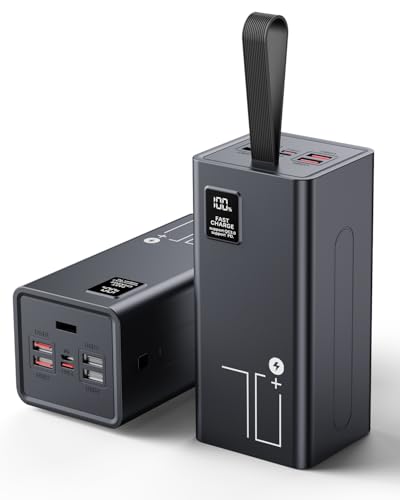
The Liahomco 70,000mAh Power Bank is an ultra-high-capacity portable battery pack engineered primarily for extended off-grid use, multi-day camping trips, road travel, and household emergency backup. Designed for users who need prolonged electrical independence away from wall outlets, this heavy-duty external charger acts as a centralized mobile power hub for smartphones, tablets, and personal electronics. While typical pocket chargers prioritize minimal weight for daily commutes, this unit prioritizes maximum stored energy, making it an excellent match for campers, outdoor festival attendees, families on road trips, and emergency-kit planners.
In terms of charging performance, the battery pack delivers up to 30W fast charging and supports both Power Delivery (PD) and Quick Charge 3.0 protocols. Connectivity includes five total outputs: two 30W USB-A ports, two 15W USB-A ports, and a bidirectional USB-C port offering up to 20W output. The manufacturer notes that compatible smartphones can reach up to a 60 percent charge in roughly 30 minutes under optimal fast-charging conditions. Compatibility extends to a broad range of 5V USB mobile gear, including iPhones, Android devices, tablets, handheld gaming consoles, camping fans, and Bluetooth audio accessories. However, the manufacturer explicitly notes that this power bank is not compatible with laptops, so shoppers seeking notebook power delivery must look elsewhere.
The physical design balances its substantial battery volume with practical handling features, measuring 2.56 x 2.56 x 5.91 inches and weighing approximately 1.85 pounds (30 ounces). The exterior housing features a built-in digital LCD screen that provides real-time tracking of remaining battery percentage, eliminating the ambiguity of standard four-dot LED lights. A firm, integrated lanyard is built directly into the chassis, allowing users to secure the unit to backpack straps, hang it from tent hooks at a campsite, or loop it securely around a wrist to prevent accidental drops. Internal safety circuitry includes built-in protection against overcharging, over-discharging, overheating, overcurrent, and short-circuit events.
Recharging a 70,000mAh battery pack requires patience and an appropriate power source, utilizing either the 18W USB-C input or the secondary Micro-USB input. Connecting devices is straightforward, with the system intelligently adapting output to match the power requirements of connected electronics across its five ports. Because the unit offers dual high-speed 30W ports alongside standard 15W ports, users can prioritize fast charging for depleted phones while simultaneously trickling power into lower-draw accessories like wireless earbuds or fitness trackers. The compact vertical brick profile sits stably on camping tables or nightstands, keeping multi-cable setups organized in shared spaces.
The most significant limitation of this power bank centers on travel regulations: due to its massive 70,000mAh capacity, it is strictly not allowed on commercial passenger aircraft under standard airline battery restrictions. Furthermore, at nearly two pounds, the unit is noticeably heavy and bulky compared to standard 10,000mAh or 20,000mAh everyday-carry chargers, making it impractical for pocket storage. Buyers must also consider that total available charging wattage is distributed across ports during multi-device use, and the lack of laptop support means it cannot serve as an all-in-one workstation charger.
For campers, road trippers, and homeowners preparing for storm-induced power outages, the Liahomco 70,000mAh Power Bank offers an exceptionally cost-effective way to keep essential mobile electronics running for days on end. However, frequent airline passengers and remote workers requiring laptop charging will need to choose a smaller, flight-compliant, high-wattage alternative. If your primary goal is maximizing stored backup energy for off-grid recreation or domestic emergency preparedness, this five-port powerhouse represents a very capable and practical investment.
The Liahomco power bank is equipped with a versatile array of seven total ports, dividing into five output ports and two input ports for flexible device management. The output configuration includes two 30W USB-A ports for Quick Charge 3.0 compatible devices, two standard 15W USB-A ports for secondary electronics, and one 20W USB-C port supporting Power Delivery. For replenishing the power bank itself, users can utilize the 18W fast-charging USB-C input or the secondary Micro-USB port, providing backup convenience if a specific charging cable is unavailable.
While the Liahomco 70,000mAh power bank is a standout companion for outdoor camping and overland vehicle travel, it is fundamentally unsuitable for air travel. Airline regulations prohibit lithium battery packs of this capacity on passenger planes, meaning this unit must remain strictly on the ground. For ground-based adventures, however, the integrated lanyard allows easy suspension inside tents or on pack exteriors, and the massive capacity ensures family devices, rechargeable lanterns, and emergency radios stay powered during extended stays away from electrical infrastructure.

Pros
- Integrated four-cable design eliminates the need to pack separate cords for Apple, Micro-USB, and USB-C devices
- Digital LED percentage display provides an immediate, exact reading of remaining battery life
- Supports charging up to five devices at the same time across ports and built-in cables
- Substantial 50,000 mAh listed capacity delivers days of off-grid mobile device recharges
Cons
- Maximum 22.5W output is designed for phones and tablets, making it unsuitable for high-power USB-C laptops
- A listed 50,000 mAh capacity exceeds standard 100Wh commercial airline carry-on limits without prior carrier approval
- Recharging such a large internal capacity takes several hours depending on the input power source
The YBYP 50000mAh portable charger is an ultra-high-capacity external battery pack engineered for road trippers, outdoor enthusiasts, campers, and household emergency kits. Designed to eliminate the headache of carrying multiple loose charging cords, this power bank integrates four separate cables directly into its compact frame. Weighing 0.75 pounds with physical dimensions of 4.8 by 3.1 by 1.1 inches, it packs a massive nominal battery reservoir into an accessible handheld form factor suitable for backpacks, gear totes, and glove compartments.
In terms of charging performance, the unit is rated for up to 22.5W fast charging through its supported outputs. According to the manufacturer, this output speed can recharge compatible smartphones like the Samsung Galaxy S25 up to 60 percent or an iPhone 17 up to 55 percent in approximately 30 minutes, though real-world charging speeds always depend on device battery limits and operating conditions. With the ability to charge up to five devices simultaneously using its combination of built-in cables and external ports, it easily accommodates phones, tablets, wireless earbuds, and smartwatches, though users should keep in mind that overall wattage is shared among connected electronics.
Hardware connectivity is the primary strength of this battery pack. It features four built-in cables: a Micro-B output, a USB-A input cable for recharging the power bank, a USB-C output, and a Lightning output. In addition to the hardwired cords, the chassis includes a Micro-B input port, a bidirectional USB-C input/output port, and a USB-A output port. A clear front-facing digital LED display indicates precise remaining battery percentage, offering a major upgrade over the vague four-dot status lights found on many competing high-capacity portable chargers.
Managing power on the go is straightforward due to the dual-input recharging setup, which allows users to recharge the power bank using either the integrated USB-A cable, the dedicated Micro-B port, or the bidirectional USB-C port. However, replenishing a 50,000 mAh cell requires patience and a reliable power source. Travel utility is also an important consideration: while this battery is well-suited for road trips, camping, and power outages, travelers should verify airline carry-on regulations before flying, as a 50,000 mAh rating typically exceeds standard 100Wh commercial flight thresholds without explicit airline permission.
Everyday limitations center around power allocation and charging capacity. The 22.5W maximum output is not intended to supply power-hungry USB-C laptops that demand 45W to 100W Power Delivery profiles. Additionally, while the integrated cables provide superb convenience, they are permanently fixed to the body, meaning users must rely on the open ports if an integrated cord sustains physical wear over extended use. The manufacturer integrates an 8-layer safety system covering overcurrent, overvoltage, short circuits, and thermal limits, though operating high-capacity lithium batteries under heavy simultaneous loads will naturally produce mild operational warmth.
This power bank is an excellent investment for families, campers, and emergency-preparedness shoppers who prioritize sustained multi-day smartphone battery life and clutter-free cable storage. Users who require laptop-grade Power Delivery or frequent flyers needing a strictly compliant sub-100Wh carry-on battery should look elsewhere, but for dependable, multi-device off-grid power, this unit offers exceptional versatility.
The YBYP 50000mAh portable charger provides an all-in-one charging setup designed to eliminate the need for third-party cords. The housing integrates four dedicated cables: a Micro-B output for legacy electronics, a USB-A input cable designed to recharge the power bank from any powered USB-A wall socket, a USB-C output cable for modern Android phones and tablets, and a Lightning output cable for compatible Apple devices.
In addition to the built-in cables, the unit features three independent connection ports along its housing. These include a Micro-B input port, a USB-A output port, and a bidirectional USB-C port that functions for both charging the internal battery and powering external electronics. This configuration allows simultaneous connection for up to five devices, making it simple to keep smartphones, tablets, and wearable accessories charged from a single hub.


Pros
- Built-in 110V AC outlet powers devices up to 65W that standard USB-only battery packs cannot run
- Multiple recharging methods supported out of the box with included AC wall adapter and 12V vehicle charging cable
- Manufacturer-listed 88.8Wh capacity rating sits below typical airline battery limits for transparent travel planning
- Integrated multi-mode flashlight adds practical utility for roadside emergencies and outdoor camping
Cons
- Lacks modern USB-C and USB Power Delivery (PD) ports for direct USB-C laptop charging
- Strict 65W AC power ceiling cannot operate high-draw gaming laptops, heating elements, or motorized tools
- At 1.6 pounds, it is heavier and bulkier than standard pocket-sized smartphone battery packs
The ZeroKor 88.8Wh Portable Power Bank is a compact multi-port battery station designed for users who require a standard two-prong 110V AC wall outlet in a portable form factor. Built around an internal 88.8Wh lithium-ion battery pack, this unit bridges the gap between conventional pocket chargers and heavy outdoor power stations. It is primarily built for students, business travelers, campers, and remote workers who need to power low-draw laptops, camera batteries, mini fans, or personal electronics when standard electrical outlets are unavailable.
Charging performance centers on a single 110V AC outlet rated for a maximum continuous output of 65W. For direct mobile device charging, the unit includes two USB-A ports: a Quick Charge USB-1 port supporting 5V/3A and 9V/2A outputs, alongside a standard USB-2 port offering 5V/2.1A output. A high-current DC barrel output rated between 9V and 12.6V at up to 10A expands utility for compatible 12V DC electronics. Connected equipment must stay within the unit's 65W operational envelope, making it suitable for compact laptops, tablets, drones, and smartphones, but unsuitable for high-draw appliances such as hair dryers, coffee makers, or air compressors.
The physical housing features a two-tone red and grey finish measuring 6.89 by 3.98 by 1.89 inches and weighing approximately 1.6 pounds. Port placement is grouped on the front panel alongside an integrated multi-mode flashlight that provides standard reading illumination as well as an SOS emergency flash pattern. Internally, an integrated Battery Management System (BMS) manages operational safety by providing short-circuit protection, overcurrent protection, overvoltage protection, and overload shutdown.
Operating and recharging the battery pack is straightforward thanks to multiple bundled input accessories. The ZeroKor power bank is recharged via its DC5521 input port (15V/2A Max) using either the supplied AC wall adapter or the included 12V vehicle cigarette-lighter adapter cable. The unit can also connect to third-party solar panels outputting 13V to 16V with a DC5521 connector, though solar panels must be purchased separately. Operation requires manually toggling the AC output switch, which prevents idle drain, while the DC output circuit automatically shuts off after 20 seconds if no load is detected.
The primary limitation of this power bank is the total absence of native USB-C or USB Power Delivery (PD) ports. Users wishing to fast-charge USB-C laptops must plug their laptop's original AC charging brick directly into the 65W AC outlet rather than using a direct USB-C cable. Furthermore, the 88.8Wh total capacity and 65W maximum output ceiling represent hard physical boundaries. Attempting to power laptops that draw more than 65W under load will trigger the unit's automatic overload protection, and the manufacturer recommends against fully discharging the unit down to empty to maintain optimal battery health.
The ZeroKor 65W Portable Power Bank is a solid recommendation for road trippers, students, photographers, and outdoor enthusiasts who specifically need an affordable, portable 110V AC socket for low-wattage devices. Buyers looking exclusively for USB-C fast charging for modern smartphones or high-wattage gaming laptops should consider a dedicated USB-C PD power bank instead. For anyone needing flexible 110V AC plug-in power in a 1.6-pound package, this model delivers substantial everyday value.
The ZeroKor power bank offers a versatile output configuration designed to accommodate both legacy electronics and everyday mobile devices. Its centerpiece is the 110V AC outlet, which delivers up to 65W of continuous power for equipment requiring a standard two-prong plug. This setup lets users power small laptops, drone battery docks, mini desk fans, and DSLR camera chargers directly without special adapters.
For mobile charging, the station provides two standard USB-A ports with distinct power delivery capabilities. The USB-1 port features Quick Charge protocol support with 5V/3A and 9V/2A profiles, making it suitable for rapid smartphone and accessory top-ups. The secondary USB-2 port provides steady 5V/2.1A power for smaller gadgets, Bluetooth earbuds, and standard tablets. A dedicated DC barrel port delivering 9V to 12.6V at up to 10A allows direct connection to compatible 12V vehicle accessories and specialized field electronics.
Recharging the ZeroKor 88.8Wh power bank is handled through a dedicated DC5521 input port rated for 15V at up to 2A. The manufacturer includes two distinct input accessories in the retail package: a standard AC wall power adapter for home charging and a 12V automotive cigarette lighter cable for on-the-road replenishment during long drives.
Off-grid travelers can also replenish the internal battery using compatible third-party solar panels providing between 13V and 16V with a standard DC5521 connection. To maintain optimal lithium-ion cell performance over time, the manufacturer recommends charging the battery regularly rather than letting it sit in a fully depleted state, ensuring reliable backup power whenever emergencies or off-grid trips arise.

Pros
- Integrated 100W AC outlet powers standard two-prong plugs without requiring special DC adapters
- High 99.9Wh capacity provides substantial backup power while staying within standard airline carry-on energy limits
- Bidirectional 65W USB-C PD port supports fast recharging and functional pass-through operation
- Active internal cooling fan helps manage heat generation during sustained electrical loads
- Protective EVA hard-shell storage case is included to safeguard the unit during transit
Cons
- Manufacturer explicitly states that laptops can only be charged via the AC outlet rather than the Type-C port
- Weighing approximately 2.31 pounds and measuring nearly 7 inches long, it is significantly bulkier than standard phone chargers
- Strict 100W maximum limit on the AC outlet prevents operation of high-draw appliances like heaters, hair dryers, or kettles
This is a high-capacity portable power bank equipped with an integrated 110V AC outlet and bidirectional 65W USB-C Power Delivery, engineered primarily for professionals, travelers, and outdoor enthusiasts who need versatile mobile energy. With a nominal rating of 27,000 mAh and an energy capacity of 99.9Wh, the Lvssci power bank bridges the gap between conventional smartphone battery packs and compact power stations. It is designed to support users who require off-grid electricity for laptops, camera gear, drone batteries, and handheld electronics during remote work, road trips, or emergency power interruptions.
The primary technical feature of this battery pack is its built-in 110V AC outlet capable of delivering up to 100W of continuous power for compatible small electronics. Alongside the AC socket, the unit includes standard USB outputs and a bidirectional 65W USB-C Power Delivery port that manages both rapid power input and device output. According to the manufacturer, the power bank can supply power to up to three devices at once when the AC outlet is not engaged. Pass-through charging is explicitly supported, allowing connected devices to continue drawing power through output ports while the battery pack recharges via its Type-C connection. The manufacturer specifically notes that laptops must be charged through the AC outlet rather than the USB-C port.
In terms of construction, the unit features a durable black exterior measuring 6.89 by 1.09 by 2.74 inches and weighs approximately 2.31 pounds. To regulate operating temperatures during sustained electrical loads, an internal smart cooling fan dynamically adjusts its rotational speed based on total power draw and internal heat. The casing also incorporates a four-LED flashlight designed to provide steady illumination during outdoor activities or unexpected utility outages. For storage and portability, the package includes an EVA hard-shell carrying box that protects the charger and houses the included Type-C cable.
Operating the power bank is straightforward, requiring users to connect compatible hardware directly into the designated ports or the standard two-prong AC outlet. Recharging the internal 27,000 mAh lithium-ion cells occurs through the 65W PD USB-C input, which pairs effectively with high-output USB-C wall adapters. Because of its 2.31-pound footprint, the charger is best transported inside a backpack, carry-on bag, or vehicle gear compartment rather than carried in a coat pocket. The 99.9Wh rating also provides a helpful baseline for airline travelers seeking to comply with general 100Wh lithium battery transport rules, though travelers should always verify specific airline carrier policies beforehand.
The most critical limitation involves the strict 100W ceiling on the AC outlet, which restricts usage to lower-draw electronics. High-draw appliances such as space heaters, electric kettles, hair dryers, coffee makers, and power tools exceed the safe operating threshold and trigger an automatic shutdown to prevent internal damage. Furthermore, the manufacturer instruction stating that laptops can only be charged through the AC outlet means users cannot charge laptops directly via the USB-C port, necessitating the use of the laptop's standard AC wall brick. Finally, the added weight and cooling fan sound under load are practical tradeoffs inherent to AC inverter circuitry compared to silent, pocket-sized USB power banks.
This portable power bank is a solid purchase for business travelers, content creators, campers, and emergency preppers who specifically need a portable AC outlet to run small electronics in the field. Users who only need to top off smartphones or lightweight tablets will find smaller, pocket-sized USB-C battery packs lighter and more economical. For those who require dependable 100W AC flexibility, 65W PD recharge speeds, and substantial 99.9Wh backup capacity in a self-contained unit, the Lvssci power bank delivers functional multi-device utility.
The Lvssci power bank features a versatile port configuration designed to handle standard AC plugs, USB-C Power Delivery, and traditional USB devices. Its central feature is the 110V/100W AC outlet, which accepts standard two-prong electronics such as laptop power adapters, camera battery cradles, and drone charging hubs.
For mobile electronics, the unit provides a bidirectional Type-C port capable of up to 65W Power Delivery, functioning as both the primary recharge input for the power bank and a fast-charging output for supported phones and accessories. Additional USB output ports permit multi-device charging for up to three devices simultaneously when the AC inverter is inactive.
Pass-through charging capability ensures that secondary devices can stay powered from the USB outputs while the main battery bank receives incoming power through the Type-C port, simplifying cable management at a desk or bedside table.
Thermal regulation is managed by an integrated smart cooling fan that automatically modulates its operating speed based on the internal temperature and electrical load. This active heat dissipation helps maintain safe working conditions when using the 100W AC outlet or fast-charging via the 65W USB-C port.
The AC inverter includes built-in overload protection that automatically shuts down the system if a connected device exceeds the 100W maximum rating. This preventative cutoff protects both the power bank and connected electronics from potential overload damage.
The power bank also integrates a four-LED emergency light that serves as a utility flashlight during outdoor activities or blackouts, while the included EVA hard case protects the internal lithium-ion cells from impacts and abrasions during transport.

Pros
- Substantial 40,800mAh capacity provides sustained off-grid power for multiple phone recharges
- Built-in cables for both iPhone and USB-C devices mean you can leave spare charging cords behind
- Supports 25W fast-charging protocols including USB PD and Quick Charge for compatible phones
- Clear digital LED readout provides exact battery level monitoring rather than vague indicator dots
- Includes a generous 3-year warranty and a secondary USB-C cable in the box
Cons
- Explicitly restricted from commercial airline travel due to its high battery capacity rating
- Weighs approximately 14.5 ounces and measures over an inch thick, making it too bulky for pocket carry
- Maximum 25W output is intended for smartphones and tablets rather than high-draw USB-C laptops
The LanLuk 40,800mAh Portable Charger is a heavy-duty external battery pack designed for users who require extended off-grid energy without carrying a bundle of loose charging cables. Built around a substantial nominal battery capacity and integrated wiring, this portable power bank serves primarily as an all-in-one charging station for road trips, camping weekends, family outings, and emergency blackout preparedness. It is tailored for smartphone owners, tablet users, and multi-device households looking for dependable backup power away from standard wall outlets.
Charging performance centers on a maximum output of 25W, which supports common fast-charging standards such as USB Power Delivery (PD) and Quick Charge (QC). The manufacturer lists wide device compatibility, including recent iPhone 15, 16, and 17 models, Samsung Galaxy and Google Pixel handsets, iPads, portable gaming consoles, headphones, and small USB-powered fans. Because it can charge up to five devices simultaneously across three physical ports (one USB-C, two USB-A) and two built-in output leads (USB-C and iOS), it functions effectively as a shared hub for groups. When distributing power across multiple connected devices, users should expect charging speeds to adjust based on connected loads.
The physical design prioritizes utility and cord management. Measuring 5.90 by 2.67 by 1.18 inches and weighing roughly 14.5 ounces (410 grams), the black housing is sturdy and functional, though noticeably substantial in hand. LanLuk integrates three flexible cables directly into the frame: a USB-A cable dedicated to recharging the power bank, a USB-C cable for modern Android devices and newer iPhones, and an iOS connector for Lightning-equipped hardware. According to manufacturer specifications, these cables are rated for over 30,000 bends, reducing the worry of early cord failure. An integrated digital LED screen provides an intuitive numeric readout of remaining battery percentage, which is far more precise than traditional four-dot status lights.
Routine operation and recharging are straightforward due to dual-input flexibility. The battery pack can be replenished by plugging its integrated USB-A cable directly into a standard USB wall plug, or by connecting a separate USB-C cable to the onboard USB-C port. The package includes an auxiliary Type-C cable, a user manual, and a 3-year manufacturer warranty. For everyday carry in a commuter backpack, daypack, or vehicle glove compartment, the self-contained design proves convenient because you do not need to hunt for charging cords before stepping out the door.
A critical limitation of this power bank involves air travel regulations. The manufacturer explicitly notes that this 40,800mAh unit cannot be carried on commercial flights due to battery capacity limits set by aviation security guidelines. Additionally, at roughly 0.9 pounds, this is not an ultralight pocket charger; carrying it in a jacket or pants pocket is impractical. Furthermore, while the 25W maximum output is plenty for mobile phones and handheld gear, it does not supply the higher wattages required to charge standard USB-C laptops or modern high-draw notebooks.
The LanLuk 40,800mAh Portable Charger is best suited for campers, road trippers, outdoor enthusiasts, and emergency-kit planners who want massive reserve capacity and built-in cables at an approachable price point. Frequent airline flyers and ultralight commuters should seek smaller sub-100Wh, pocket-friendly alternatives. For ground-based travel and storm backup, its combination of generous reserve power, versatile five-device connectivity, and cable-free convenience makes it a compelling value.
The LanLuk 40,800mAh portable charger features a versatile array of five total outputs and two recharging inputs, making it adaptable to varied charging environments. Output options include two standard USB-A ports, one bidirectional USB-C port, an integrated USB-C output cable, and an integrated iOS output cable. This layout allows users to charge up to five phones, tablets, or small mobile accessories at the same time without needing separate charging cords.
Recharging the power bank is equally flexible thanks to dual input pathways. Users can recharge the battery pack directly via the built-in USB-A input cable by plugging it into a powered USB charging block or vehicle port, or utilize the dedicated USB-C port with a compatible wall adapter. This redundancy ensures you are never stranded without a way to top up the battery pack itself.
Prospective buyers must note that this portable charger cannot be taken on passenger airplanes. Because of its large 40,800mAh capacity rating, it exceeds standard airline lithium battery limits for carry-on luggage, and lithium battery banks are strictly forbidden in checked bags. Travelers looking for airline-compliant backup power should choose a smaller model rated under 100 watt-hours.
For ground travel, vehicle camping, and home emergency preparation, the unit offers built-in electrical protection systems. The manufacturer incorporates safety protocols to safeguard against overcharging, overcurrent, and short circuits during heavy use. Combined with a digital LED battery meter to track remaining reserves, it provides reliable off-grid utility when wall outlets are inaccessible.

Pros
- Integrated folding AC wall plug simplifies recharging without needing separate wall adapters
- Built-in USB-C and iOS cables provide immediate cord-free convenience for Apple and Android devices
- 22.5W PD and QC fast-charging support across the USB-C port, USB-A port, and integrated USB-C cable
- Pass-through charging allows simultaneous power-bank recharging and device charging
Cons
- Maximum 22.5W output provides trickle charging for laptops like the MacBook Air rather than high-speed charging
- Claimed 50,000 mAh capacity exceeds standard 100Wh airline carry-on thresholds, restricting commercial flight use
- Charging multiple devices simultaneously will split available power output and reduce per-device charging speeds
The Sucrosey 50000mAh Portable Charger is an all-in-one power bank engineered to deliver extended backup power for mobile users who want to ditch external cords and charging bricks. Designed with a built-in foldable AC wall plug alongside integrated USB-C and iOS charging cables, this battery pack eliminates the clutter of travel accessories. It is aimed primarily at campers, road trippers, outdoor workers, college students, and emergency-prep planners who need dependable multi-day charging away from wall outlets.
Charging capabilities center on 22.5W fast charging supported through USB Power Delivery and Quick Charge protocols. According to manufacturer specifications, the external USB-C port, the integrated USB-C cable, and the USB-A port each support up to 22.5W output, allowing an iPhone 15 to reach roughly 50 percent battery in about 30 minutes. While the manufacturer claims compatibility with higher-draw devices such as an iPad Pro and MacBook Air, users should recognize that 22.5W delivers basic or maintenance charging for laptops rather than the full-speed charging offered by 65W USB-C PD supplies.
The physical layout prioritizes self-contained utility by housing both the charging prongs and device cables directly inside the shell. Measuring approximately 4.6 by 2.8 by 1.2 inches and weighing under a pound, the black rectangular chassis remains manageable inside backpacks, center consoles, or tool bags. The foldable two-prong AC plug retracts flush when not in use, protecting adjacent items in your bag from scratches, while the attached cables tuck securely into dedicated channels on the unit.
Recharging the power bank is straightforward thanks to dual-method flexibility, allowing direct connection to any standard 100-240V wall socket or an external power source. The manufacturer notes that plugging directly into a wall outlet can replenish the internal cells in approximately 6 hours. Furthermore, pass-through charging is supported, meaning you can plug the power bank into a hotel or bedside outlet at night to simultaneously replenish the internal battery and charge a connected smartphone.
A primary consideration is the relationship between the nominal 50,000 mAh rating and travel regulations. While a high nominal capacity sounds ideal for long road trips, a battery of this scale technically equates to roughly 185Wh, which exceeds standard commercial airline carry-on limits of 100Wh without special airline carrier approval. Additionally, simultaneous multi-device charging will split available power output, and nominal battery capacity differs from actual delivered energy due to natural voltage conversion losses during operation.
The Sucrosey 50000mAh Portable Charger is best suited for budget-conscious drivers, campers, students, and emergency-kit builders who value built-in cables and direct wall-plug recharging above all else. Users seeking certified carry-on power banks for commercial flights or dedicated high-wattage 65W to 100W laptop chargers should look at airline-compliant alternatives. For grounded multi-device convenience and off-grid mobile endurance, this integrated package delivers significant practical utility.
The Sucrosey power bank utilizes 22.5W fast-charging technology across multiple connection points, supporting both USB Power Delivery (PD) and Quick Charge (QC) standards. The manufacturer specifies that the built-in USB-C cable, external USB-C port, and USB-A port each reach up to 22.5W maximum output when used individually. This wattage allows compatible smartphones like the iPhone 15 series or modern Android phones to recharge noticeably faster than with standard 5W or 10W baseline adapters.
When powering larger electronics such as an iPad Pro or MacBook Air, the 22.5W threshold will provide steady auxiliary power or slow charging during light usage. However, high-performance laptop workflows will draw power faster than 22.5W can replace it. Connecting multiple devices at the same time will distribute the internal power supply, reducing single-port output to protect connected electronics from overcurrent conditions.
Portability is defined by the unit's all-in-one form factor, which measures 4.6 by 2.8 by 1.2 inches. By integrating a foldable AC wall plug, a USB-C cable, and an iOS cable directly into the body, the charger eliminates the bulk of carrying secondary wall bricks and tangled wires during road trips, daily commutes, or college campus sessions.
For air travel, passengers should exercise caution before packing this charger. Standard airline and FAA regulations typically restrict lithium-ion batteries over 100 watt-hours (Wh) in carry-on baggage without prior airline approval, and prohibit them entirely in checked luggage. Because a 50,000 mAh capacity at 3.7V equates to approximately 185Wh, this battery pack is better suited for ground transportation, road travel, and camping rather than commercial flights.

Pros
- Integrated 100W AC outlet powers small electronics that require standard two-prong or three-prong plugs
- Bidirectional 65W USB-C PD port supports laptop charging and recharges the bank in 1.5 hours
- Listed 98Wh energy rating complies with standard 100Wh airline carry-on limits
- Four versatile output ports accommodate both modern USB-C gear and legacy USB-A accessories
Cons
- AC outlet output is capped at 100W, making it unsuitable for high-draw heating elements or large appliances
- The 6.7 x 2.6 x 2.6-inch tower design is bulkier than flat, pocket-sized smartphone power banks
- Achieving the 1.5-hour recharge time requires a separate 65W USB-C wall adapter not detailed as included
The Paopaoyu 100W AC Outlet Portable Power Bank is a versatile high-capacity backup charger engineered for remote workers, business travelers, campers, and emergency home backup kits. Combining an integrated AC socket with modern USB Power Delivery ports, this unit eliminates complete reliance on wall plugs when working away from a desk. It provides substantial off-grid energy in a standalone tower format, making it particularly useful for keeping essential mobile gear operational during flights, road trips, field assignments, or unexpected electrical outages.
Equipped with a listed nominal capacity of 27,000 mAh and an energy rating of 98Wh, this power bank delivers multi-device flexibility through four distinct output ports. The primary feature is a 100W AC outlet capable of handling portable electrical appliances that draw less than 100 watts. For modern mobile electronics, a bidirectional 65W USB-C Power Delivery port provides high-speed charging for compatible laptops, tablets, and smartphones. Additional connectivity includes an 18W USB-A port and a 12W USB-A port, allowing users to power cameras, handheld devices, and older mobile accessories without carrying separate adapter plugs.
In terms of build and layout, the Paopaoyu charger adopts a block-style tower aesthetic measuring 6.7 by 2.6 by 2.6 inches. This structured footprint keeps the AC outlet and USB array easily accessible on desktop workspaces, airline tray tables, or camp tables while minimizing horizontal surface clutter. Because the battery capacity is listed at 98Wh, the unit falls just beneath the general 100Wh limitation enforced by the FAA and TSA for passenger carry-on baggage. While the column shape is too substantial for pocket carry, it slips neatly into commuter backpacks, camera cases, and emergency prep bags.
Recharging the power bank is efficient thanks to the 65W input capability on the USB-C port, which the manufacturer states can replenish the 27,000 mAh battery in approximately 1.5 hours when connected to a compatible high-wattage power adapter. Operating connected devices is largely plug-and-play, allowing power delivery across USB-A, USB-C, and AC connections depending on total demand. Everyday operation remains straightforward whether positioned on an airport terminal bench, an office desk away from wall sockets, or an outdoor picnic table.
Prospective buyers must recognize the operational limits of a 100W AC inverter. Electrical appliances requiring sustained or surge power above 100 watts, such as household hair dryers, electric kettles, or high-draw tools, will trigger the built-in overload protection mode. Furthermore, achieving the advertised 1.5-hour recharge turnaround necessitates a separate 65W USB-C wall charger. While the 98Wh energy rating complies with general airline carry-on guidelines, individual carrier policies can vary, and actual delivered energy will reflect standard voltage conversion losses and AC inversion efficiency.
For mobile professionals, frequent flyers, outdoor enthusiasts, and emergency planners who need reliable AC and 65W USB-C power in a single transportable package, the Paopaoyu 100W AC Power Bank offers strong utility. Shoppers looking strictly for a slim, pocket-friendly phone battery may prefer smaller 5,000 mAh or 10,000 mAh power banks. However, if your gear kit demands an AC socket and laptop-grade USB-C output without exceeding airline capacity limits, this versatile multi-port unit represents a practical and capable choice.
The Paopaoyu power bank provides four dedicated outputs to accommodate both modern USB electronics and standard AC wall plugs. The 100W AC outlet handles laptops, camera battery chargers, and compact personal appliances drawing under 100W. The bidirectional USB-C port supports 65W Power Delivery for both charging compatible laptops and rapidly recharging the power bank itself. For legacy devices, an 18W fast-charge USB-A port and a standard 12W USB-A port provide dedicated connections for smartphones, earbuds, and accessories.
Safety architecture on this power bank includes FCC, CE, and RoHS certifications alongside built-in protection against overcharging, overvoltage, overcurrent, and short circuits. If an attached device exceeds the 100W threshold on the AC outlet, an automatic safety shutoff activates to protect the battery and internal inverter. With an explicit energy rating of 98Wh, the battery bank is designed to comply with standard TSA and FAA passenger carry-on thresholds under 100Wh, though travelers should always verify specific carrier guidelines before flying.
Frequently Asked Questions
Where can you safely dispose of an old power bank?
Drop off retired portable chargers at designated hazardous waste facilities, municipal recycling depots, or participating electronics retail stores. Retailers such as Best Buy, Home Depot, and Lowe’s frequently provide free recycling bins specifically intended for rechargeable lithium-ion cells. Taping over battery terminals with non-conductive electrical tape prevents short circuits during transit to the recycling drop box.
Can you throw a damaged or dead power bank in the household trash?
No, you should never place a portable charger or lithium battery pack into standard household garbage or curbside recycling bins. Compactor trucks and sorting machinery can easily puncture lithium cells, triggering intense chemical fires that endanger sanitation personnel. Swollen or leaking batteries require specialized hazardous waste management rather than ordinary municipal disposal.
What should you prioritize when choosing a replacement battery pack in 2026?
Prioritize verified port output wattage, supported charging protocols, battery capacity, and everyday carrying dimensions based on your specific devices. If you only need light daily top-ups for a smartphone, explore universal power banks under 25 dollars that keep pack weight minimal. Users needing sustained backup power for multi-device setups or laptops should focus on units listing dedicated USB-C Power Delivery or integrated AC outlets.
Can any USB-C portable charger power a laptop?
No, a USB-C port does not automatically guarantee sufficient power delivery to charge a laptop. Most USB-C laptops require chargers delivering 45W, 65W, or higher through the USB Power Delivery protocol to replenish battery reserves effectively. Always verify that both the power bank output rating and your laptop power specifications align before relying on it for mobile work.
Are massive capacity power banks permitted on commercial flights?
It depends on the listed watt-hour rating of the specific battery pack. Federal aviation guidelines generally limit carry-on lithium-ion power banks to 100 watt-hours without prior airline authorization, while completely banning loose spare batteries in checked luggage. High-capacity battery banks exceeding 100Wh or roughly 27,000mAh typically require airline approval or cannot travel on passenger flights.
Why does a power bank deliver fewer charges than its rated mAh capacity suggests?
Energy loss naturally occurs during voltage conversion, circuit resistance, and internal device charging processes. Internal lithium cells operate around 3.7 volts, requiring circuitry to step up power to 5 volts or higher for standard USB transmission. Consequently, usable energy delivered to your phone battery typically represents approximately two-thirds of the nominal capacity rating.




Write Your Review
No reviews yet. Be the first to share your experience!