


Reliable Trail Electricity for Backcountry Treks
Running out of navigation power in the backcountry turns an exciting wilderness trek into a stressful ordeal within minutes. Hikers depend heavily on GPS apps, satellite communicators, and headlamps, making reliable off-grid recharging an essential safety consideration rather than just a luxury. Finding the best backpacking power banks comes down to balancing raw battery capacity against pack weight and outdoor durability. Many hikers examine a specs comparison of power bank features to evaluate how compact lithium cells handle demanding environments. While ultralight hikers scrutinize every ounce, multi-day routes require steady energy storage that performs reliably through cold alpine mornings and sudden trail downpours.
Modern trail chargers provide rugged enclosures, fast USB-C Power Delivery, and multi-layer protection circuits to resist dust, impact, and moisture. Some hikers also consider a specialized solar power bank for off-grid power when venturing onto exposed trails away from electrical outlets. Whether you carry a slim 10,000mAh battery pack for quick weekend hikes or a rugged 20,000mAh unit for extended backcountry stays, choosing the right output power and port setup ensures essential safety devices stay charged.

Pros
- Up to 20W fast charging output via USB-C for modern smartphones and handheld electronics
- Rugged IPX5 water resistance, shockproofing, and dust sealing withstand outdoor exposure
- Charges up to three devices at the same time using combined wired and wireless outputs
- Dual super-bright flashlights and compass carabiner add practical emergency preparedness value
- Lightweight 0.58-pound profile clips easily to hiking bags or packs into travel luggage
Cons
- Compact solar panel is intended primarily for emergency top-offs rather than rapid daily recharging
- Connecting multiple devices simultaneously distributes power and lowers individual charging speeds
- Maximum 20W output is engineered for phones and small mobile electronics rather than USB-C laptops
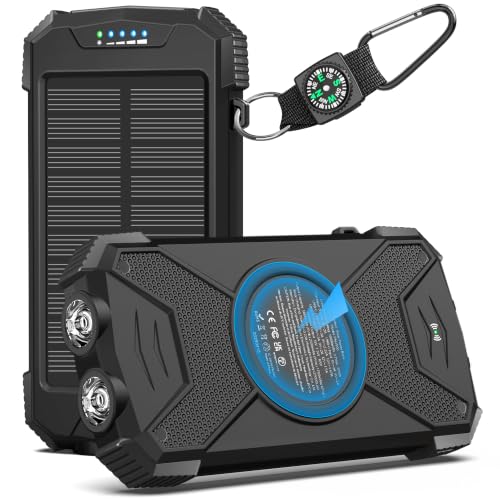
The BLAVOR Solar Power Bank 10,000mAh is a rugged portable charger engineered for outdoor enthusiasts, campers, travelers, and emergency-prep users who need durable off-grid backup power. Built around a 10,000mAh Lithium-cobalt battery pack, this unit combines traditional wired power with a wireless charging surface and an emergency solar panel. It best suits American smartphone users, hikers, and commuters seeking a resilient secondary power source that can withstand unpredictable weather while keeping essential mobile gear operational.
In terms of charging performance, the unit features an upgraded USB-C output supporting up to 20W fast charging alongside wireless charging functionality. According to manufacturer claims, the 20W wired connection can power an iPhone 15 up to 65% in approximately 30 minutes, with broad compatibility spanning iPhone, iPad, Samsung Galaxy, and other USB-powered mobile devices. The manufacturer also estimates that a fully charged 10,000mAh battery can recharge an iPhone 8 up to 3.6 times, an iPhone 14 Pro up to 2.2 times, or an iPad Air once. Users can charge up to three devices simultaneously using the available wired and wireless outputs, though connecting multiple devices will divide overall output power.
The physical design emphasizes field durability, featuring flame-retardant ABS and PC construction wrapped in a rubberized protective coating with waterproof silicone port sealing. Measuring 5.9 x 3.1 x 0.8 inches and weighing roughly 0.58 pounds, the battery pack remains comfortably portable for backpacks, daypacks, or glove compartments. It carries an IPX5 water-resistance rating along with dustproof and shockproof qualities to endure outdoor exposure. Dual integrated super-bright flashlights provide nighttime visibility around camp, while the included compass carabiner lets hikers secure the charger directly to exterior pack webbing.
Routine operation is straightforward, with dedicated ports for wired connections and a dedicated surface for wireless charging. Recharging the internal battery pack is primarily completed through its wired input for speed and consistency before heading out on trips. While the integrated solar panel provides an auxiliary method to harvest sunlight, solar inputs on compact hand-held chargers are inherently gradual and best reserved for emergency top-offs rather than daily replenishments. The lightweight profile and included attachment clip make it simple to monitor battery status while trekking or commuting.
Important practical limitations should be weighed before relying solely on this charger in remote locations. First, the 20W peak output is optimized for smartphones, earbuds, and small tablets, meaning it is not designed to power USB-C laptops that require higher wattage profiles. Second, simultaneous multi-device charging will naturally distribute the power budget, reducing individual port speeds across connected gear. Finally, the nominal 10,000mAh capacity will experience standard conversion and circuit losses during wired and wireless transfers, so delivered energy will be lower than the raw battery cell rating.
For hikers, road trippers, and emergency-kit planners wanting an affordable, weather-resistant charger with fast wired and wireless options, the BLAVOR 10,000mAh Solar Power Bank is a practical and versatile choice. Everyday commuters who only need pocketable power for office use may prefer a slimmer, non-rugged power bank without exterior outdoor tools. However, for outdoor recreation and reliable emergency backup, its combination of 20W USB-C output, IPX5 protection, integrated dual flashlights, and durable Lithium-cobalt construction offers solid utility.
The BLAVOR portable charger delivers power through a 20W USB-C fast-charging output as well as an integrated wireless charging pad. This dual-format design accommodates modern smartphones such as iPhone and Samsung Galaxy devices, along with portable accessories like wireless earbuds. The charger supports powering up to three devices simultaneously, providing flexible backup options during outdoor outings or power outages.
Because total power is shared when multiple devices are connected, the fastest charging rates are achieved when plugging a single device directly into the 20W USB-C port. Actual charging speeds will always depend on device reception limits, cable capability, and operating temperatures.
Engineered for outdoor survival and demanding environments, the charger features an IPX5 water-resistant, dustproof, and shock-resistant chassis. The housing combines flame-retardant ABS and PC materials with internal silicone seals and a tactile rubber skin-feel exterior to resist drops and adverse weather.
BLAVOR utilizes a Lithium-cobalt battery composition, which the manufacturer states provides 50% more cycle life compared to standard lithium-polymer cells. Integrated dual super-bright flashlights and an included compass carabiner deliver functional utility for nighttime navigation and gear attachment.

Pros
- Heavy-duty IP68 waterproof and shockproof build withstands harsh outdoor conditions and 2-meter drops.
- Smart digital display reveals precise battery percentage and live charging current in milliamps.
- Integrated 420-lumen camping lantern features five lighting modes and a standard tripod socket.
- Dual USB-C and USB-A output ports support simultaneous charging for mobile devices.
Cons
- Weighing 1.03 pounds and measuring over 8.8 inches long, the bulky form factor is not pocket-friendly.
- Manufacturer specifications do not detail exact maximum wattage output figures for the USB-C PD port.
- Ports and seals must be thoroughly dried after water exposure before connecting charging cables.
The aswayke 20,000mAh Rugged Power Bank is an outdoor-focused portable charger engineered for campers, hikers, overland travelers, and home emergency kits. Unlike slim portable chargers designed primarily for light office commutes, this device merges high-capacity power storage with heavy-duty structural defense and an integrated 420-lumen camping lantern. It is tailored for users who need dependable backup energy in environments where rain, dirt, mud, and accidental drops are frequent hazards.
In terms of charging performance, the internal battery pack offers a listed 20,000mAh nominal capacity equipped with fast-charging USB-C Power Delivery and a standard USB-A output port. The manufacturer notes that this capacity is capable of delivering up to five full charges for standard smartphones, though real-world delivered energy depends on conversion efficiency, ambient temperature, and device charging limits. The dual-port arrangement supports simultaneous charging, allowing users to keep a primary smartphone powered up while simultaneously topping off a tablet, GPS navigator, or headlamp.
Durability is the standout aspect of the brown 3.2mm ABS and polycarbonate shockproof housing. It carries an IP68 rating, which indicates resistance to dust ingress and the ability to withstand water submersion up to 1.5 meters for up to 30 minutes. In addition to surviving 2-meter drops, the housing incorporates a standard threaded tripod mount on its base. This mount allows users to attach the power bank to outdoor tripods or hang it inside tents, turning the 420-lumen light into a hands-free campsite area lamp or night photography fill light across five selectable settings: High, Soft, Warm, SOS, and Strobe.
Routine operation and device monitoring are handled via an integrated digital display screen. Rather than relying on simple four-stage LED dots, the screen provides an exact battery percentage from 0 to 100 percent along with live readouts of input current while recharging and output current while powering connected electronics. The bidirectional USB-C port handles both output to devices and input recharging for the power bank itself, connecting easily to standard USB-C wall adapters, car sockets, or compatible solar panels.
Despite its broad outdoor utility, the unit has clear physical tradeoffs. At 8.85 by 3.1 by 3.3 inches and a weight of 1.03 pounds, it is significantly bulkier than standard 20,000mAh commuter battery packs and is best carried in a backpack, tackle box, or vehicle console rather than a pocket. Furthermore, because specific maximum wattage outputs are not explicitly detailed beyond general USB-C PD support, it is best suited for phones, tablets, and small electronic gear rather than power-demanding USB-C laptops. Users must also ensure all ports are completely dry before plugging in cables after any water exposure.
For outdoor adventurers, field personnel, and survival-kit builders looking for an all-weather charging hub with built-in emergency lighting, this aswayke model offers a strong blend of durability, capacity, and hands-free functionality. Commuters seeking a minimal everyday-carry pack should consider smaller pocket alternatives, but those prioritizing drop resistance, water protection, and clear current monitoring will find solid value backed by the manufacturer's 6-month warranty.
The aswayke power bank is constructed from a reinforced 3.2mm ABS and polycarbonate composite designed to resist impact damage from drops up to 2 meters. Its IP68 ingress protection rating ensures internal electrical components remain shielded against fine sand, trail dust, and complete water submersion up to 1.5 meters for 30 minutes, provided the port covers are sealed.
The integrated 420-lumen lantern illuminates areas up to 50 square meters and offers five distinct operational modes. Users can cycle between High, Soft, Warm, Strobe, and SOS signals depending on whether they need soft tent lighting, trail navigation, or emergency signaling. A built-in standard tripod socket on the base adds functional flexibility, letting users mount the unit to camping tripods or photography rigs for stable overhead illumination.
Connection options include a bidirectional USB-C port alongside a standard USB-A port, providing compatibility with both modern USB-C charging cables and legacy USB-A accessories. The USB-C port supports Power Delivery fast charging for compatible smartphones and tablets, while also serving as the primary input port for recharging the 20,000mAh internal cell.
The built-in digital display removes guesswork by presenting real-time power metrics directly on the face of the unit. In addition to a precise 0 to 100 percent remaining battery level indicator, the display shows real-time input current in milliamps when recharging the battery pack and output current in milliamps when powering connected devices.

Pros
- Fast 45W maximum output supports rapid charging for compatible modern smartphones and tablets.
- Built-in braided USB-C cable reduces travel clutter and prevents forgotten cords.
- Significantly smaller footprint than standard 20,000mAh power banks, weighing just 11.5 ounces.
- Supports charging up to three devices simultaneously.
- Integrated flashlight provides extra everyday carry and emergency utility.
Cons
- At 11.5 ounces and 1.1 inches thick, it is noticeably heavier than small single-charge pocket power banks.
- Power distribution per port during simultaneous three-device charging is not detailed in manufacturer specifications.
- Integrated cable is exclusively USB-C, requiring extra cords for devices using Lightning or micro-USB connectors.
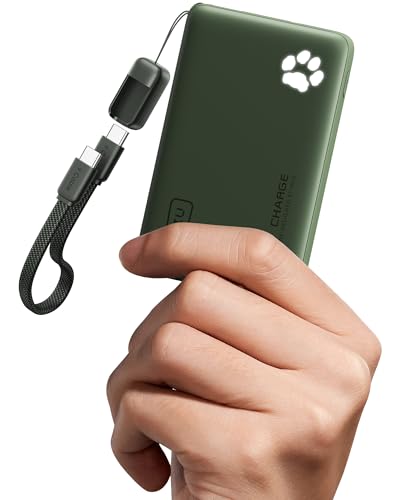
The INIU 45W 20000mAh Portable Charger is a high-capacity external battery pack engineered for users who need fast mobile power in a reduced form factor. It is primarily built to supply rapid wired backup to modern smartphones, tablets, and mobile electronics during travel, long work shifts, or outdoor activities away from AC outlets. This model best suits commuters, frequent flyers, students, and everyday mobile users who want substantial battery reserve without carrying bulky standard-sized 20,000mAh bricks or juggling loose charging cables.
Charging capability centers on a maximum 45W power output and a 20,000mAh nominal battery capacity. According to manufacturer specifications, the 45W charging output can boost an iPhone 17 Pro from 20% to 76% in approximately 30 minutes, representing a roughly 15-minute speed advantage over conventional 22.5W alternatives. INIU estimates the total battery capacity can deliver approximately four full charges for mobile phones or two full charges for tablets, though actual delivered energy will naturally vary due to normal voltage conversion losses and device battery conditions. The battery pack can also support simultaneous charging for up to three devices at once, making it practical for users managing a smartphone, tablet, and accessory concurrently.
Physical design is optimized around space-saving battery architecture and integrated cable management. Utilizing what INIU terms TinyCell high-density battery technology, the chassis measures 4.5 by 2.9 by 1.1 inches and weighs roughly 11.5 ounces, making it approximately 30% smaller than conventional power banks with equivalent capacity. A key convenience feature is the integrated braided USB-C cable, which the manufacturer states has been tested for over 10,000 bends to resist long-term wear. Additionally, a built-in LED flashlight is integrated into the enclosure, providing practical auxiliary lighting for emergencies, power outages, or late-night gear checks.
Everyday handling and travel routines benefit directly from the all-in-one cable design. Because the primary braided USB-C cable is permanently attached, users do not need to pack dedicated charging cords for USB-C handsets or worry about tangled cords inside backpacks and crossbody bags. At 11.5 ounces, the unit carries a weight comparable to a 330ml beverage can, allowing it to pack into daypacks, tote bags, or carry-on luggage without excessive drag. The manufacturer lists the 20,000mAh capacity as TSA-compliant for airline travel, though passengers should always review specific airline carry-on policies regarding lithium battery packs before flight departures.
Despite its space savings, buyers should consider several practical tradeoffs. Although compact for a 20,000mAh battery pack, an 11.5-ounce weight and 1.1-inch thickness remain substantially bulkier than minimalist 5,000mAh or 10,000mAh pocket chargers designed strictly for single top-ups. Furthermore, while the unit can charge up to three devices at once, the product data does not specify exact per-port wattage splits when all connections are active simultaneously. The integrated cable is also limited to USB-C, meaning users charging Lightning-based Apple gear or micro-USB accessories must carry separate cables to connect to additional available ports. Laptop compatibility is likewise not explicitly detailed by the manufacturer, so users seeking dedicated laptop power should look for units with confirmed high-wattage computer support.
For travelers, commuters, and mobile professionals needing multi-day battery reserves with fast 45W wired replenishment, the INIU 45W 20000mAh Portable Charger represents a highly practical and self-contained power solution. Shoppers looking for an ultralight, featherweight pocket battery may prefer a smaller 5,000mAh or 10,000mAh model, while notebook users requiring guaranteed high-wattage PC charging should seek verified laptop-grade chargers. However, for everyday smartphone and tablet owners wanting high-speed charging, integrated cable convenience, and emergency backup in a reduced footprint, this portable battery pack delivers strong overall utility.
This portable charger features an integrated braided USB-C cable alongside additional connectivity supporting simultaneous power for up to three devices. The permanently attached cable avoids the hassle of carrying loose cords for USB-C phones and tablets, with the manufacturer citing a durability rating exceeding 10,000 bends.
Delivering up to 45W of output power, the charger is designed to boost compatible devices significantly faster than older 22.5W models. While charging multiple devices simultaneously offers broad convenience on road trips or commutes, charging speeds will adjust across connected devices based on overall power requirements.
Measuring 4.5 by 2.9 by 1.1 inches and weighing 11.5 ounces, this model incorporates TinyCell high-density technology to achieve a frame roughly 30% smaller than traditional 20,000mAh power banks. This compact profile fits securely into backpacks, shoulder bags, and carry-on luggage without consuming excessive space.
The manufacturer highlights TSA compliance for the 20,000mAh battery size, making it a reliable backup option for air travelers and long commutes. In addition to providing device recharges throughout long travel days, the built-in flashlight offers useful emergency visibility during power interruptions or dark transit environments.

Pros
- High 165W total output with 100W-capable USB-C connections readily handles compatible USB-C laptops and tablets.
- Dual built-in USB-C cables minimize cord clutter and streamline mobile travel charging.
- Meets the 100Wh airline boundary, allowing compliant storage in carry-on baggage for flights.
- Powers up to four devices at the same time across integrated cables, an extra USB-C port, and a USB-A port.
Cons
- A 100W or higher wall charger is required for the fastest power bank recharge speeds and is not included.
- The elongated 6.18-inch by 2.13-inch body is bulkier and heavier than single-charge pocket power banks.
- Charging four devices simultaneously splits the total 165W output across active ports.
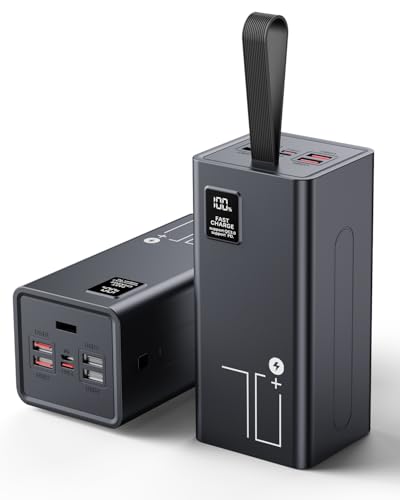
The Anker 25,000mAh Laptop Power Bank is a heavy-duty portable charging station engineered specifically for mobile professionals, commuters, and airline travelers who need dependable power for power-hungry hardware. Combining high-wattage throughput with built-in cord management, this external battery eliminates the friction of carrying tangled charging cables. It is primarily built to keep USB-C laptops, tablets, and smartphones running through long travel days, cross-country flights, or remote work sessions where wall outlets are out of reach.
In terms of charging performance, the unit boasts a substantial 25,000mAh nominal capacity and delivers up to 165W in combined output. For laptop users, the battery pack features three USB-C connections-comprising two integrated USB-C cables and one open USB-C port-each capable of supplying up to 100W individually. In total, the unit can power up to four devices at once by pairing the dual built-in cables with its auxiliary USB-C port and USB-A port, letting users simultaneously charge a laptop, a smartphone, wireless earbuds, and an additional accessory.
The physical design prioritizes travel utility with its clever integrated cable management. Anker equipped the battery pack with an extendable 2.3-foot retractable USB-C cable tested for up to 20,000 retractions, alongside a secondary 0.98-foot USB-C cable that securely loops to function as a carrying strap rated for over 20,000 bends. Measuring 6.18 by 2.13 by 1.93 inches and weighing approximately 0.66 pounds, the durable black chassis fits neatly into briefcase compartments, carry-on bags, or laptop backpacks without snagging loose cords.
Operating and maintaining this power bank is straightforward, though recharging efficiency depends on your existing wall charger. To achieve the fastest possible replenishment of the 25,000mAh capacity, the manufacturer recommends pairing the unit with a 100W or higher USB-C wall charger. For flyers, this battery pack complies with the standard 100Wh airline limit, qualifying it for regular carry-on baggage on domestic and international flights, though passengers should always store lithium battery packs in their carry-on luggage rather than checked bags.
While the feature set is extensive, prospective buyers should account for a few practical limitations. Achieving the advertised ultra-fast power bank recharge requires purchasing a high-wattage 100W adapter separately, as no wall charger is included in the box. Additionally, while individual USB-C lines can deliver up to 100W on single-device duty, connecting four devices simultaneously distributes the 165W aggregate ceiling, which reduces the wattage supplied to individual ports under heavy simultaneous loads.
The Anker 25,000mAh 165W Laptop Power Bank is an outstanding investment for frequent flyers, remote knowledge workers, and multi-device tech users who require dependable laptop-grade charging on the move. Everyday smartphone users seeking a lightweight pocket companion may find its high capacity and elongated frame larger than necessary. However, for anyone who demands sustained 100W laptop output, four-way multi-device versatility, and integrated retractable cables, this model represents top-tier travel convenience.
One of the primary highlights of the Anker 25,000mAh Laptop Power Bank is its integrated dual-cable system, engineered to end the hassle of forgotten charging cords. The main built-in USB-C cable extends up to 2.3 feet and features a smooth retraction mechanism tested to withstand 20,000 retractions, giving you plenty of slack to comfortably work on a laptop at an airport gate or coffee shop desk.
Complementing the retractable cord is a secondary 0.98-foot USB-C cable engineered for heavy duty. This shorter cord doubles as a built-in carrying handle and strap, rated to endure more than 20,000 structural bends. Together, these integrated lines allow travelers to leave loose cords packed away while keeping modern USB-C laptops, tablets, and phones fully charged.
Navigating airport security with high-capacity electronics requires attention to battery ratings, and the Anker 25,000mAh power bank is explicitly built to satisfy standard transit guidelines. The battery pack complies with the common 100Wh airline restriction, making it eligible for carry-on luggage across major commercial airlines.
As with all lithium-ion power sources, passengers must keep the unit in their carry-on bags or personal items rather than checked luggage. With its rugged carry strap, protective storage pouch, and retractable cable, the unit provides reliable backup power for transcontinental flights, long road trips, and off-grid camping without exceeding travel safety thresholds.

Frequently Asked Questions
What battery capacity is ideal for multi-day backpacking trips?
A battery capacity between 10,000mAh and 20,000mAh works best for most multi-day backpacking trips. A 10,000mAh pack typically weighs around 6 to 8 ounces while delivering enough energy to recharge a modern phone twice, keeping pack base weight modest. Longer excursions involving headlamps and satellite communicators often benefit from a 20,000mAh pack with USB-C Power Delivery to keep several devices running smoothly.
Can solar panels on a portable charger replenish the battery on the trail?
Solar panels on compact power banks provide emergency trickle charging rather than primary power replenishment. Small integrated solar panels capture modest current under direct sunlight, requiring dozens of hours of clear exposure to fill a depleted 10,000mAh battery pack. Hikers should view integrated solar panels as an emergency backup feature and start each hike with a fully charged battery pack.
Does fast charging drain a power bank faster in cold weather?
Yes, higher output charging creates slightly higher conversion heat, and cold temperatures temporarily reduce internal chemical efficiency. Drawing higher wattage through USB-C fast charging lowers the total delivered watt-hours compared to steady standard rates. Storing the battery pack inside your sleeping bag or jacket pocket helps maintain warmer cell temperatures and preserves usable capacity.
What water resistance rating should a trail power bank have?
An IPX5 to IP68 rating is recommended to safeguard portable chargers against rain, mud, and stream splashes. IPX5 resists sustained low-pressure water sprays, while IP68 housings survive brief submersion as long as rubber port seals stay closed. If you hike with standard non-waterproof models such as a budget Anker power bank, keeping the device inside a sealed dry sack provides critical moisture protection.
Why does nominal mAh capacity differ from actual delivered energy on the trail?
Nominal capacity reflects internal cell storage at approximately 3.7 volts, whereas charging a smartphone requires boosting that voltage to 5 volts or higher. This internal voltage conversion, alongside circuit resistance, results in usable delivered energy around 65 to 70 percent of stated mAh. Looking at the listed watt-hour (Wh) rating provides a more accurate metric of total energy available for your trail electronics.
How do integrated charging cables benefit backcountry hikers?
Integrated cables eliminate the risk of misplacing cords while reducing loose wire clutter in your backpack. Power banks with built-in USB-C cords guarantee a dedicated connection is always available for cameras, phones, and lights. Hikers who prefer all-in-one charging designs also explore alternatives like a wall plug power bank when stopping at town hostels between trail sections.



Write Your Review
No reviews yet. Be the first to share your experience!