


Staring at a flashing red battery icon during a long flight or daily commute brings instant frustration. Carrying backup power solves that anxiety, but travelers must balance capacity against airline safety limits. A clear specs comparison of power bank features helps clarify how nominal milliamp-hour ratings translate into actual energy. That distinction is essential when evaluating power banks under 100wh, especially since commercial flight regulations restrict carry-on lithium packs above one hundred watt-hours without airline approval.
Careful review of manufacturer specifications and user feedback reveals how output ports and charging protocols influence daily performance. Reliable portable chargers must supply steady power without overheating, whether utilizing USB-C Power Delivery or integrated cables. Modular options like the GOODaaa Portable Charger offer grab-and-go ease for everyday carry, while high-capacity units handle demanding backup duties. Selecting the right portable charger output wattage ensures your phone, tablet, and accessories remain charged throughout busy schedules.

Pros
- Huge 80,000 mAh capacity can power up to eight devices simultaneously across seven ports and one wireless pad
- Fast 35W USB-C PD output delivers rapid charging for compatible phones, Switch consoles, and small electronics
- Durable IP66 weather-resistant construction with a 300-lumen LED light and SOS strobe for outdoor safety
- UL-certified battery cells paired with built-in short-circuit and temperature protection mechanisms
Cons
- At roughly 2.25 pounds with an 80,000 mAh capacity, it is strictly not approved for commercial airline travel
- The 5W built-in solar panel provides only slow trickle charging intended strictly for off-grid emergencies
- Heavier and bulkier form factor is suited for vehicle camping or home prep rather than everyday pocket carry
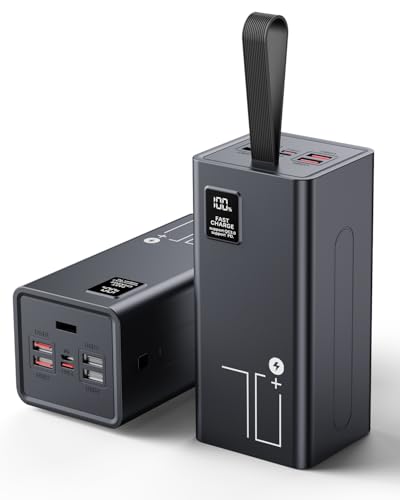
The Feidyns 80000mAh Power Bank is an ultra-high-capacity rugged portable charging station engineered specifically for prolonged off-grid power, outdoor camping, and disaster preparedness. Instead of targeting commuters looking for a pocket-sized battery pack, this unit functions as a centralized power hub capable of keeping essential electronics running for days at a time. It best suits campers, outdoor enthusiasts, road trippers, and emergency-preparedness planners who require multi-day reliability and multi-device support far from traditional electrical outlets.
Charging performance is anchored by a 35W USB-C Power Delivery port alongside Quick Charge 3.0 compatibility, which the manufacturer states can charge an iPhone to 50% in roughly 18 minutes. The battery pack also integrates a 15W wireless charging pad directly on its top housing, alongside seven output ports to recharge as many as eight devices simultaneously. The internal circuitry automatically manages power delivery across connected devices, adapting down to 7.5W for low-power gear like AirPods or up to 35W for compatible handheld devices such as gaming consoles and VR headsets. Shoppers should keep in mind that the 80,000 mAh rating reflects nominal internal battery capacity, and natural voltage conversion will affect the total delivered energy reaching connected gear.
Physical durability and outdoor readiness are prominent strengths of the exterior design. The enclosure features an IP66 water and dust protection rating, helping it withstand rainstorms, splashes, and campsite dirt. A high-output 300-lumen LED flashlight is built directly into the housing, offering both standard illumination and an SOS emergency strobe mode for night-time trail safety or unexpected power outages. The unit also includes an integrated military-grade carrying strap rated to withstand up to 200 pounds of pulling force, making it easy to lash to outdoor gear or carry around a campsite.
Operating and monitoring the power bank is straightforward thanks to its dedicated indicator array. Four blue LEDs track battery reserves in 25%, 50%, 75%, and 100% stages, while dedicated top status lights flash red during active wireless charging and green when the solar panel is capturing sunlight. For initial setup, the manufacturer instructs users to fully charge the unit to 100% and completely drain it to 0% three consecutive times to calibrate the cells. Routine recharging should be done via a high-wattage wall charger or car outlet, as the 5W built-in solar panel is designed exclusively as an emergency power trickle when no other electrical source exists.
The primary tradeoff of this high-capacity unit centers on portability and travel compliance. Because of its massive 80,000 mAh capacity and 2.25-pound weight, this power bank is explicitly not approved for commercial airline flights under standard FAA and international aviation battery rules. Furthermore, while the solar panel provides peace of mind in survival scenarios, charging an 80,000 mAh battery solely via sunlight takes an extensive amount of time. Its footprint makes it ideal for vehicle storage, camping bins, or storm kits rather than everyday backpack commuting.
The Feidyns 80000mAh Power Bank represents a compelling choice for outdoor adventurers, overland campers, and families building a resilient emergency kit. Users needing a lightweight battery for daily pocket carry or air travel should look to a standard sub-100Wh portable charger instead. For buyers whose top priority is dependable multi-day energy storage, simultaneous multi-device capability, and rugged weather protection in remote settings, this heavy-duty power bank offers outstanding utility.
The integrated solar panel on the Feidyns power bank provides a rated 5W emergency input designed to capture ambient sunlight when grid power is completely unavailable. The manufacturer explicitly emphasizes that solar input should be treated as an emergency backup method rather than a primary everyday recharge solution. Given the massive 80,000 mAh internal capacity, complete solar replenishment requires prolonged sun exposure, making wired wall or vehicle charging the recommended primary recharge method prior to heading outdoors.
Beyond auxiliary solar collection, the charger incorporates critical survival tools including a 300-lumen emergency LED light. This lighting system features an SOS strobe mode to assist with nighttime visibility, outdoor roadside breakdowns, and emergency signaling. For long-term emergency kit storage, the manufacturer recommends keeping the battery pack stored at approximately 50% charge to maximize cell preservation and long-term shelf life.
A critical consideration for prospective buyers is that the Feidyns 80000mAh Power Bank is not approved for commercial airline travel. Standard FAA and international aviation safety regulations restrict spare lithium-ion batteries over 100Wh to 160Wh without explicit airline pre-approval, and batteries exceeding 160Wh are strictly prohibited from passenger aircraft cabins and checked baggage alike. With an 80,000 mAh nominal capacity, this unit substantially exceeds allowable passenger flight limits.
Consequently, this battery pack is best suited for ground transportation, overland travel, RV trips, boating, car camping, and residential emergency backup. Road trippers and campers can readily transport the 2.25-pound device in a vehicle or backpack, but flyers must select a smaller, flight-compliant power bank rated at or below 100Wh for carry-on luggage.
Pros
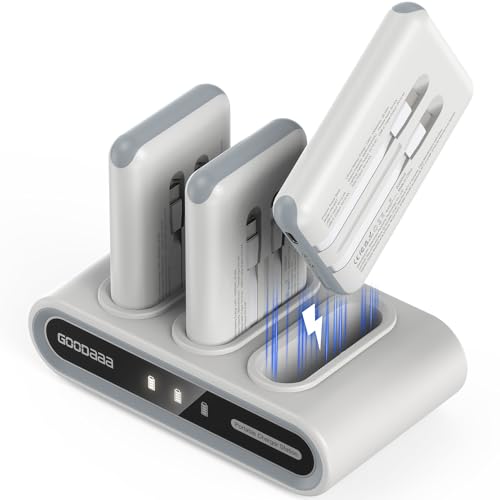
- Three power banks and a docking station create a convenient always-ready charging ecosystem for households or small groups
- Built-in USB-C and iOS cables mean most smartphone users can charge without packing extra cables
- Each 10,000mAh unit is slim and lightweight enough for everyday carry in a pocket or bag
- Four-color LED battery indicator provides a quick visual check of remaining charge without needing a screen
- Includes 140 themed sticker patterns for personalization, which is a thoughtful touch for families with multiple users
Cons
- No specific fast-charging protocol such as USB Power Delivery or Quick Charge is listed, so charging speeds may be standard rather than fast
- The product does not list specific output wattage, making it difficult to evaluate charging speed compared to competing power banks
- At three units plus a docking station, the complete set takes up more desk or counter space than a single power bank solution
The GOODaaa 3-Pack 10000mAh Portable Charger is a charging station system designed for families, shared households, and small teams who want multiple power banks ready to grab at any time. Rather than a single standalone power bank, this product is a coordinated kit: three individual 10,000mAh slim battery packs plus a docking station that charges all three simultaneously. Each power bank comes with built-in USB-C and iOS cables as well as a USB-C port, which means the entire set can theoretically support up to nine device connections at once. GOODaaa positions this as a grab-and-go solution where you dock a depleted unit when you come home and pick up a fully charged one on your way out.
Each power bank lists a nominal battery capacity of 10,000mAh. That figure represents the internal battery cell capacity, not the exact amount of energy delivered to a connected device - voltage conversion, cable resistance, and other factors always reduce usable output. The product description does not specify output wattage, supported fast-charging protocols like USB Power Delivery or Quick Charge, or exact charging times. Without those details, buyers should expect standard USB charging speeds rather than rapid fast-charging performance. The built-in cables cover USB-C and iOS connectors, which addresses the two most common smartphone cable types in the U.S. market. However, no Lightning-to-USB-C cable specification or data-transfer capability is mentioned, and no laptop compatibility is listed.
Build quality centers on a slim, lightweight form factor. Each power bank measures 4.3 x 2.6 x 0.7 inches and weighs 6.42 oz, which is compact enough to slip into a jeans pocket or a small purse compartment. The docking station itself measures 6.69 x 3.82 x 5.28 inches and uses what GOODaaa calls "thimble" charging contacts - metal contact points that transfer current when each power bank is seated in its dock slot. The manufacturer states these contacts are safety-certified to remain below 45 degrees Celsius (113 degrees Fahrenheit) during operation. A slight warmth during docking is described as normal operating behavior. The kit also includes seven sheets of themed stickers (140 patterns total) so family members can personalize and identify their own power bank.
Daily use follows a straightforward routine: dock all three power banks on the station, let them charge, and grab one whenever you leave. The four-color LED system on each unit shifts through Red, Green, Blue, and Cyan to indicate battery level from 25% to 100%, which provides a quick visual status check without needing a digital display. On the docking station, a battery icon glows dimly while charging and remains steady when full. The manufacturer describes a smart chip inside each unit that provides overcharge protection and short-circuit protection. No additional certifications such as UL or FCC are specified in the product data.
The most notable limitation is the lack of listed output wattage or supported fast-charging standards. Buyers who need USB Power Delivery, PPS, or Quick Charge for faster phone or tablet charging will want to confirm these capabilities before purchasing, as the product data does not mention them. The built-in cables are convenient but may not be replaceable if damaged, and no information is provided about cable length. The system also does not list laptop charging support, wireless charging, or magnetic attachment. For users who primarily need a single high-output power bank rather than a multi-unit family system, a standalone fast-charging USB-C power bank may be a better fit.
The GOODaaa 3-Pack Portable Charger is best suited for families, couples, roommates, or small office teams who want a shared charging station where multiple people can always grab a ready-to-go power bank. The built-in cables and grab-and-go docking concept solve two common frustrations: forgetting to charge your power bank and forgetting to pack a cable. For solo users, single-device fast chargers, or anyone who needs high-wattage USB-C PD output, a different product category would likely serve better. The strongest reason to choose this set is the convenience of always having a charged, cable-equipped power bank waiting by the door.
Each GOODaaa 10,000mAh power bank in this three-pack includes built-in USB-C and iOS cables. This means most iPhone and Android smartphone users can charge their devices directly from the power bank without carrying a separate cable. The addition of a USB-C port on each unit provides a third connection option, which could be used for charging a USB-C device with your own cable or potentially for recharging the power bank itself when away from the dock. The product data does not specify whether the USB-C port functions as input, output, or both, so buyers should verify this detail if USB-C input charging away from the dock is important to them.
Built-in cables are a practical advantage for commuters, students, and travelers who want to minimize what they carry. The tradeoff is that integrated cables typically cannot be replaced if they wear out or break, unlike detachable cable setups. No cable length is specified in the product data. For users who rely on a single cable type - such as USB-C only - the extra iOS cable adds versatility for lending to friends or family members with different devices, which reinforces this product's family-oriented design.
Each individual GOODaaa power bank measures 4.3 x 2.6 x 0.7 inches and weighs 6.42 oz, making it one of the slimmer 10,000mAh options available. At under 0.7 inches thick, the unit can fit in a back pocket, a jacket pocket, or a small bag compartment without adding significant bulk. The 6.42 oz weight is roughly equivalent to a small smartphone, so carrying one throughout the day should not feel burdensome for most users.
The docking station measures 6.69 x 3.82 x 5.28 inches, which is compact enough for a nightstand, entryway table, kitchen counter, or office desk. It serves as a centralized home base rather than a travel accessory. For road trips, the docking station could potentially ride in a car's center console area, though no car-charger adapter or 12V compatibility is mentioned. The overall system is designed so the portable units travel with you while the dock stays at home or in the office.
GOODaaa describes a smart chip inside each power bank that provides overcharge protection and short-circuit protection. The docking station uses metal thimble contact points for current transfer, and the manufacturer states all units are safety-certified to remain below 45 degrees Celsius (113 degrees Fahrenheit) during charging. A slight warmth during dock charging is described as normal operating behavior rather than a defect.
No specific third-party safety certifications such as UL, ETL, or FCC are listed in the available product data. The four-color LED indicator system also serves as a monitoring tool, letting users visually confirm that charging is progressing normally. As with any lithium battery product, users should avoid exposing the power banks to extreme heat, direct sunlight for extended periods, or physical damage, and should not attempt to open or modify the units.
Essential Questions About Power Banks Under 100wh
Can you take power banks under 100wh on an airplane?
Yes, portable chargers rated under 100Wh are permitted in carry-on baggage by major aviation authorities without special airline approval. A typical 10,000mAh battery pack operates at roughly 37Wh, placing models like the GOODaaa Portable Charger well within carry-on limits. However, massive units like the Feidyns 80000mAh Power Bank 35W Fast Charging exceed 100Wh and are not permitted on commercial flights. Always check the printed watt-hour rating before flying, and never place spare lithium batteries into checked baggage.
How do you convert milliamp-hours to watt-hours on a power bank?
You calculate watt-hours by multiplying milliamp-hours by nominal cell voltage (typically 3.7V) and dividing that result by 1,000. A 10,000mAh battery yields approximately 37Wh, sitting well below airline restriction thresholds. Nominal capacity differs from delivered capacity because voltage conversion creates normal energy losses during device charging. Looking for the official printed Wh rating on the casing gives the most accurate confirmation for travel compliance.
Does a higher mAh rating mean the power bank charges your devices faster?
No, milliamp-hours measure total stored energy rather than how quickly a battery recharges connected devices. Charging speed depends on port wattage and supported protocols like USB Power Delivery or Quick Charge. A higher milliamp-hour rating simply delivers power longer, but it doesn’t automatically speed up your charge, which requires matching output wattage with your device limits.
Can power banks under 100wh charge USB-C laptops?
Only portable chargers delivering sufficient USB-C Power Delivery wattage can successfully power compatible laptops. Compact 10,000mAh power banks often provide modest outputs suited for phones, tablets, or earbuds, which won’t keep a power-hungry laptop running under heavy workloads. USB-C laptops generally require at least 30W to 65W to charge effectively during operation. Always verify that both your power bank output and charging cable meet your laptop power requirements.
What are the main tradeoffs between slim daily power banks and high-capacity emergency chargers?
Portability and weight represent the primary differences between slim daily battery packs and high-capacity emergency chargers. Slim 10,000mAh chargers weigh under 7 ounces and slip easily into pockets for daily commuting. In contrast, massive emergency chargers often weigh over 2 pounds and feature heavy frames with solar panels. Exploring dedicated solar power bank options helps clarify when emergency outdoor utility outweighs everyday pocket carry.






Write Your Review
No reviews yet. Be the first to share your experience!