


Keeping Your Gear Alive Off-Grid and On the Road
Running out of power halfway through a camping trip or losing laptop battery during a layover is the kind of frustration that sticks with you. That’s exactly where the Anker Power Bank SOLIX lineup earns its place. This collection spans compact DC power stations like the SOLIX C200 (192Wh) and C300 (288Wh), all the way up to the heavy-duty SOLIX S2000 with its 2,010Wh capacity and 1,500W continuous output. It also includes Anker’s Prime and laptop-focused power banks built for USB-C PD fast charging and airline-friendly portability. After carefully analyzing the listed product specifications, battery capacity, Wh ratings, port configurations, and LiFePO4 battery longevity, this guide breaks down what each model actually delivers so you can match the right unit to your needs. If you’re looking for something specifically sized for an iPhone, check out our guide on Anker power banks for iPhone.
The range here covers a lot of ground. Smaller DC stations like the SOLIX C200 offer 200W output with 5 ports and a 39% smaller footprint than similar units, while the SOLIX C1000 pushes 1,056Wh with SurgePad technology rated for up to 2,400W output across 11 ports. The Anker Prime Power Bank at 26,250mAh (99.75Wh) stands out with 300W total output, 140W max single-port delivery, and a 250W dual USB-C input that can hit 50% in just 13 minutes. Whether you need solar recharging for off-grid trips, USB-C PD 3.1 for laptop charging, or a high-capacity portable power station for home backup, there’s a specific model here built for that job. For those who need something more pocket-friendly, our ultra-compact Anker power bank roundup may be a better fit.
Top Products

Pros
- Dual 140W bidirectional USB-C ports easily power high-demand laptops and enable ultra-fast power station recharging
- Long-lasting LiFePO4 battery chemistry ensures excellent cycle life, thermal safety, and reliable multi-year performance
- Compact 6.17-pound build packs 7 versatile DC ports into a form factor roughly 30 percent smaller than comparable stations
- Flexible recharge options include dual USB-C wall charging, 12V vehicle socket power, and up to 100W solar input
Cons
- DC-only architecture omits standard 120V AC wall outlets, so it cannot run conventional AC-powered household appliances
- First-time activation requires an 18W or higher USB-C wall adapter, which is not included in the packaging
- The matching shoulder carry strap shown in marketing materials is sold separately
The Anker SOLIX C300 DC Portable Power Station is a specialized, DC-centric mobile energy hub tailored for smartphone power users, digital nomads, vehicle campers, and outdoor adventurers. Unlike traditional heavy power stations that integrate bulky AC inverters, this unit strips away 120V household plugs in favor of an ultra-efficient, lightweight DC footprint. Delivering a maximum output of 300W and a 288Wh battery reserve, it is specifically configured to keep modern consumer electronics, cameras, drones, and USB-C laptops powered during off-grid journeys, road trips, and emergency power shortages.
Charging capability is the primary strength of this unit, highlighted by its 7 dedicated DC output ports. Users receive two bidirectional 140W USB-C ports leveraging the USB Power Delivery 3.1 standard, one 100W USB-C port, one 15W USB-C port, two 12W USB-A ports, and a 120W 12V car cigarette-lighter socket. This port configuration allows users to fast-charge power-hungry devices like modern MacBooks, Windows USB-C notebooks, flagship Samsung Galaxy and iPhone devices, and portable 12V camping coolers simultaneously. The stated 288Wh energy capacity represents nominal stored energy, and actual delivered energy will naturally vary depending on operating temperatures, cable resistance, and device voltage-conversion overhead.
In terms of build quality and battery durability, Anker utilizes premium lithium iron phosphate (LiFePO4) battery cells supported by smart temperature control and an impact-resistant enclosure. LiFePO4 chemistry is widely appreciated for superior thermal stability and significantly extended cycle longevity compared to standard lithium-ion batteries, supported here by a 3-year manufacturer guarantee. Weighing approximately 6.17 pounds and measuring 4.89 x 7.87 x 4.72 inches, the dark gray chassis is around 30 percent smaller than comparable-capacity power stations, making it exceptionally easy to stow in a backpack, trunk organizer, or camper van storage cubby.
Managing power and replenishing the station is remarkably straightforward, though initial setup requires careful attention. To activate the C300 DC for the first time, users must connect an 18W or higher USB-C wall charger specifically to either the USB-C2 or USB-C3 port. Routine recharging can be completed to 80 percent in about an hour when using dual PD 3.1 USB-C inputs. Alternatively, users can recharge off-grid via a 12V car outlet or compatible solar panels up to 100W, such as Anker 60W or 100W solar panels. The station is not compatible with low-voltage 5V/3A solar panels like the PS30 or large-format panels like the PS200 and PS400.
Buyers should carefully evaluate the inherent tradeoffs of a dedicated DC power station before purchasing. The most significant limitation is the total absence of standard three-prong AC wall outlets, which means appliances like blenders, AC-only power tools, or standard plug-in fan heaters cannot be powered. Additionally, Anker includes a high-capacity 60cm 140W USB-C cable in the box, but a high-wattage wall adapter and the shoulder carry strap must be sourced separately. For users whose gear consists entirely of USB-charged electronics and 12V equipment, eliminating the AC inverter saves significant weight and prevents idle conversion losses.
For remote professionals, content creators, campers, and multi-device travelers who have transitioned to USB-C charging, the Anker SOLIX C300 DC is one of the most practical and dense portable batteries on the market. It eliminates inverter bulk while providing top-tier 140W single-port charging performance that pocket-sized power banks simply cannot sustain. Shoppers who strictly require standard AC wall receptacles should explore full-sized hybrid power stations, but anyone seeking dependable, high-wattage DC charging in a 6-pound package will find immense value in this station.
The Anker SOLIX C300 DC features an extensive DC-only port array designed to eliminate port contention across multi-device setups. The station provides four USB-C ports, two USB-A ports, and a 12V car auxiliary port, supporting up to 7 devices simultaneously up to a total output ceiling of 300W.
High-demand hardware is supported by two bidirectional USB-C ports rated for up to 140W each via USB PD 3.1. An additional 100W USB-C port provides dedicated fast charging for an additional laptop or tablet, while a 15W USB-C port handles lower-draw accessories such as smartwatches or wireless earbuds. Legacy gear connects via dual 12W USB-A ports, while camping accessories and portable refrigerators can draw up to 120W from the integrated 12V car socket.
Recharging flexibility is a central design pillar of the Anker SOLIX C300 DC, offering three primary pathways to replenish its 288Wh LiFePO4 battery pack. When using compatible high-wattage dual USB-C Power Delivery 3.1 inputs, the station can charge from zero to 80 percent in approximately one hour.
For outdoor use and off-grid scenarios, the unit supports up to 100W of solar input, with recommended compatibility for Anker 60W and 100W solar panels. The manufacturer explicitly notes that panels outputting 5V/3A USB-C (such as the PS30) as well as oversized panels like the PS200 and PS400 are not supported. Recharging can also be completed through a standard 12V vehicle auxiliary socket during road travel.

Pros
- Massive 300W combined total output with up to 140W single-port delivery for laptops
- Industry-leading 250W dual-port recharge capability minimizes power bank downtime
- Integrated digital display and app control provide real-time status and power management
- Includes a high-wattage 240W USB-C cable and carrying pouch in the package
- Sub-100Wh capacity rating (99.75Wh) aligns with general commercial airline battery guidelines
Cons
- Substantial weight of roughly 1.32 pounds makes it noticeably bulky for casual pocket carry
- Achieving maximum 250W recharge speeds requires separate high-output dual USB-C wall adapters
- Manufacturer explicitly notes that this power bank is not compatible with Starlink Mini
The Anker Prime Power Bank (26,250mAh, 300W) is a high-output portable charging station designed specifically for power users, business travelers, and remote workers who need to run demanding electronic equipment away from wall outlets. Engineered primarily as a multi-device charging solution, its central appeal is the ability to deliver high-wattage USB-C Power Delivery to power-intensive laptops, tablets, and smartphones simultaneously without severe power throttling.
Charging performance is led by a combined 300W maximum output distributed across two USB-C ports and one USB-A port. For single-device demands, the primary USB-C connection outputs up to 140W when connected with an appropriate 5A cable, which the manufacturer states can charge a MacBook Pro (M4 Pro) to 50 percent in 27 minutes or an iPhone 16 Pro to 50 percent in 26 minutes. The nominal battery capacity is listed at 26,250mAh with an energy rating of 99.75Wh. Usable energy transferred to connected electronics will naturally be lower than nominal capacity due to internal voltage conversions, cable resistance, and device charging overhead.
The build quality reflects a premium, solid desktop-and-travel aesthetic finished in Phantom Gray, measuring 6.3 by 2.5 by 1.5 inches and weighing approximately 1.32 pounds. A built-in smart color display clearly exhibits real-time power draw, individual port outputs, remaining battery percentage, and battery health details. Additionally, onboard Bluetooth allows connectivity to a dedicated mobile app, giving users the uncommon ability to view active diagnostic metrics and manually customize power allocations directly from their smartphone.
Recharging the power bank is exceptionally fast thanks to Anker's dual-port input design, which accepts up to 250W of total input power. The manufacturer notes that this input speed can restore the battery to 40 percent in 10 minutes or 50 percent in just 13 minutes, making it well suited for quick airport layovers or brief morning turnarounds. The package includes a 3.3-foot 240W-rated USB-C to USB-C charging cable, a travel pouch, and a 24-month warranty, though the high-wattage wall adapters required to hit peak recharge speeds must be supplied separately.
In terms of practical limitations, the device's 1.32-pound weight and 1.5-inch thickness make it distinctly larger than standard everyday-carry phone batteries, requiring space in a briefcase or backpack rather than a pocket. Furthermore, the manufacturer explicitly lists that this battery pack is not compatible with the Starlink Mini. Users should also remember that achieving full 140W single-port charging or 250W dual-port recharging requires high-grade cables and compatible high-power input sources.
This power bank is an outstanding choice for digital nomads, content creators, and corporate travelers who depend on high-wattage USB-C laptops and require rapid battery replenishment on demanding schedules. Casual smartphone users seeking a lightweight pocket charger for occasional phone top-ups should consider a smaller, lower-capacity power bank instead. For users requiring maximum power delivery, comprehensive telemetry, and rapid turnaround speeds, this model offers exceptional portable capability.
The core capability of this power bank is its 300W aggregate output across three ports, enabling simultaneous high-speed power distribution without drastic drops in performance. The two USB-C ports provide modern high-wattage Power Delivery profiles, while the legacy USB-A port supports smaller peripherals such as wireless earbuds, smartwatches, or secondary mobile devices.
With a maximum single-port rating of 140W, the charger provides sufficient throughput to keep demanding workstations like Apple MacBook Pro laptops operating at full processing capacity under heavy workloads. Device-level charging rates will always depend on the specific intake capabilities of the receiving hardware, cable ratings, and ambient thermal conditions.
An integrated full-color smart screen eliminates guesswork by presenting real-time operating metrics directly on the face of the unit. The display reports active input and output wattages on every individual port, current internal charge levels, and estimated time to full recharge or depletion.
For users seeking greater control, built-in app pairing lets you monitor diagnostics from a connected mobile device. The application enables manual adjustments to output thresholds, allowing users to prioritize specific ports depending on whether a laptop or phone requires urgent charging priority.
The Anker Prime power bank is built with a stated energy capacity of 99.75Wh, placing it just below the standard 100Wh threshold established by the Federal Aviation Administration (FAA) and Transportation Security Administration (TSA) for passenger carry-on baggage.
While this capacity makes it viable for air transit in carry-on luggage, travelers should always store spare lithium-ion batteries in cabin baggage rather than checked bags. Because airline policies and regional civil aviation authorities can enforce varying guidelines, confirming rules with your specific carrier before international departure is recommended.

Pros
- Substantial 288Wh LiFePO4 capacity with dual 140W USB-C PD 3.1 ports for demanding modern laptops and phones.
- Dedicated DC-only design keeps the unit lightweight at 6.17 pounds while avoiding the internal standby idle loss of AC inverters.
- Seven device-charging ports enable extensive multi-device setups across USB-C, USB-A, and a 120W 12V auxiliary car socket.
- Fast and flexible recharge methods, including 50-minute 80% AC recharging and clean off-grid solar replenishment with the bundled 60W panel.
Cons
- Does not include standard 120V AC household wall outlets, requiring adapters for conventional three-prong appliances.
- The shoulder carrying strap shown in promotional concepts is sold separately and not included in the box.
- Solar charging input does not support Anker SOLIX PS30, PS200, or PS400 solar panels, or standard 5V-3A USB-C panels.
The Anker SOLIX C300 DC is a high-capacity portable power station built specifically for outdoor campers, road trippers, mobile professionals, and emergency preparedness. Unlike conventional portable power stations that house bulky AC inverters to power household wall plugs, this model focuses entirely on direct-current (DC) power delivery. Built around a 288Wh energy reservoir paired with an included 60W foldable solar panel, it provides an ultra-compact, high-efficiency charging hub for travelers and remote workers who primarily carry modern USB-C laptops, tablets, phones, and 12V automotive gear.
Charging capability is a primary strength of this system, offering seven total DC ports and an aggregate power output of up to 300W. The connector lineup features two bidirectional 140W USB-C ports with USB Power Delivery 3.1 technology, one 100W USB-C port, one 15W USB-C port, two 12W USB-A ports, and a regulated 120W car auxiliary socket. This layout allows users to charge multiple high-draw devices simultaneously without requiring separate wall adapters. The dual 140W USB-C connections are particularly valuable for owners of compatible higher-draw USB-C laptops, delivering peak single-port output to match demanding mobile workloads, though actual power delivery will always adapt to the specific charging limits of connected devices.
Durability and portability are central to the physical design of the SOLIX C300 DC. It utilizes long-lasting LiFePO4 (lithium iron phosphate) battery cells, which are known for excellent thermal stability and longevity. The dark gray enclosure measures approximately 7.87 by 4.88 by 4.72 inches and weighs 6.17 pounds, giving it a footprint that the manufacturer states is about 30 percent smaller than comparable capacity power stations. Internal smart temperature control manages heat dissipation during prolonged charging sessions, while the impact-resistant exterior stands up to routine travel handling in backpacks, trunks, or campsite tables.
Recharging the SOLIX C300 DC is designed for minimal downtime whether at home or deep off-grid. When plugged into a wall outlet, the unit can recharge to 80 percent in as little as 50 minutes. In off-grid environments, the included 60W solar panel can restore the battery in approximately 4 hours of strong, direct sunlight via the included solar-to-XT-60 cable and extension cord. Users can also recharge the station through a vehicle auxiliary port or via the bidirectional 140W USB-C port, and Anker bundles a 60cm 140W USB-C to USB-C cable to ensure full-speed connectivity straight out of the box.
Shoppers should consider a few clear functional boundaries before buying. Because this is a dedicated DC power station, it completely omits standard three-prong AC wall sockets, meaning users cannot plug in standard household appliances, hair tools, or electronics that rely strictly on AC power without a separate 12V inverter. Furthermore, solar compatibility is intentionally specific; the power station does not support larger Anker SOLIX panels such as the PS200 or PS400, nor does it work with 5V-3A USB-C panels or the PS30. Carrying convenience is also slightly affected by the fact that the shoulder strap must be purchased separately.
The Anker SOLIX C300 DC is best suited to tech-heavy campers, road trippers, field photographers, and remote workers whose modern gear runs on USB-C, USB-A, and 12V DC power. By cutting out the heavy, inefficient AC inverter, Anker delivers a high-capacity 288Wh battery pack that is lighter, faster-charging, and far more portable than traditional generators. Buyers who depend on standard three-prong AC wall plugs will need an inverter-equipped alternative, but those seeking serious off-grid USB-C PD 3.1 power with included solar generation will find this bundle exceptionally practical.
The Anker SOLIX C300 DC provides seven dedicated DC output ports engineered to handle diverse charging demands simultaneously. The front panel features two bidirectional 140W USB-C ports with PD 3.1 support, capable of powering high-draw USB-C laptops or recharging the internal battery pack at high speeds. These are complemented by a third 100W USB-C port, a 15W USB-C port, and two 12W USB-A ports for legacy cables and everyday accessories.
In addition to its USB array, the station includes a regulated 12V/10A (120W) car auxiliary socket. This port allows users to run portable 12V camping gear, tire inflators, vehicle coolers, or small DC-powered electronics. With a cumulative output ceiling of 300W across all ports, users can distribute power across multiple devices, making it an efficient multi-device charging hub for shared workspaces, family road trips, and outdoor basecamps.
Recharging versatility is a standout attribute of the SOLIX C300 DC, offering four distinct methods to replenish its 288Wh LiFePO4 battery pack. Connecting to a standard AC wall outlet allows the unit to reach an 80 percent charge in just 50 minutes. For vehicle travel, the station can be topped up using a 12V car socket, while users with high-output USB-C wall adapters can take advantage of the bidirectional 140W PD 3.1 USB-C input.
The bundled 60W solar panel provides dependable off-grid replenishment, capable of recharging the station in about 4 hours under direct, unshaded sunlight. The kit includes both an XT-60 solar charging cable and a dedicated extension cable to allow optimal panel placement in the sun while keeping the power station cool in the shade. Users should note that solar charging requires panels matching the station's DC input specifications, as it is incompatible with Anker PS30, PS200, PS400, or generic 5V-3A USB-C solar panels.

Pros
- Long-lasting LiFePO4 battery chemistry rated for 3,000 cycles before reaching 80 percent capacity
- Rapid AC wall recharging reaches 80 percent in 43 minutes and 100 percent in under an hour
- SurgePad technology supports high-draw appliances up to 2400W across 11 ports
- Fast 600W solar input allows full off-grid recharging in approximately 1.8 hours
Cons
- Weighs 27.59 pounds, requiring two hands or vehicle transport rather than standard backpack carry
- Activating the UltraFast AC recharging feature requires pairing with a smartphone and the Anker app
- The 1,056Wh energy capacity substantially exceeds standard commercial airline carry-on limits
The Anker SOLIX C1000 is a heavy-duty 1,056Wh portable power station designed to provide reliable electricity during residential power outages, off-grid camping trips, and RV travel. Unlike compact handheld power banks meant purely for smartphones, this unit serves as a mobile energy hub capable of running household appliances, mobile workstations, and multiple personal electronics at the same time. It is best suited for homeowners seeking emergency backup, road-trippers, campers, and remote workers who need substantial power away from conventional wall outlets.
Real-world power capability centers around its 1,056Wh LiFePO4 battery pack and proprietary SurgePad technology, which allows the unit to deliver up to 2400W of total output. This elevated output enables the station to power high-draw appliances such as coffee makers, portable refrigerators, power tools, and electric cookers without tripping overload protections. With 11 versatile output ports, users can simultaneously charge laptops, tablets, smartphones, and camera gear while keeping vital household equipment running during an emergency.
In terms of physical build and design, the SOLIX C1000 features a dark gray housing measuring 14.8 by 8.07 by 11.02 inches and weighing 27.59 pounds. The manufacturer engineered the enclosure to be roughly 15 percent smaller than typical 1kWh power stations on the market, incorporating sturdy integrated carry handles on either side to make vehicle loading straightforward. The LiFePO4 battery chemistry inside is rated for 3,000 cycles over a 10-year lifespan, offering significantly better thermal stability and cycle life than traditional lithium-ion alternatives.
Recharging the power station is exceptionally fast thanks to Anker UltraFast technology. When connected to a standard AC wall outlet, the unit can reach an 80 percent charge in 43 minutes and a 100 percent charge in under an hour within an operating temperature range of 68 to 122 degrees Fahrenheit. For off-grid users, the C1000 supports up to 600W of solar input to achieve a full charge in approximately 1.8 hours under optimal sun conditions. The package also includes a 12V car charging cable, allowing travelers to top up the battery directly from their vehicle during road trips.
Despite its versatile performance, there are realistic limitations to consider before purchasing. At nearly 28 pounds, this station is intended for basecamp setups, job sites, and vehicle-based travel rather than lightweight hiking or daily commuting. Furthermore, accessing the maximum UltraFast AC charging profile requires using a smartphone with the Anker app, which may be an extra step for users preferring plug-and-play operation. Additionally, because the battery capacity stands at 1,056Wh, it far exceeds the standard 100Wh to 160Wh limits permitted on commercial passenger flights, confining its use to ground transit.
For homeowners and outdoor adventurers who need dependable, high-output backup power with rapid turnaround times, the Anker SOLIX C1000 represents a well-balanced investment. The combination of durable LiFePO4 cells, 2400W SurgePad appliance support, and sub-one-hour wall recharging makes it one of the most practical portable power stations in the 1kWh class. Shoppers seeking a pocket-sized charger for everyday smartphone carry should look toward smaller portable chargers, but those needing serious off-grid utility will find the C1000 highly capable.
The Anker SOLIX C1000 delivers substantial electrical output through its 11 ports, backed by Anker SurgePad technology that pushes output up to 2400W. This high threshold allows the station to operate approximately 99 percent of common consumer appliances, including high-wattage heating elements, power tools, and refrigeration equipment that normally overload smaller power banks.
Recharging performance is equally rapid, providing an 80 percent battery replenish in just 43 minutes when connected to an AC wall outlet with the UltraFast mode enabled via the companion app. For off-grid situations, the integrated solar charge controller accepts up to 600W of solar panel input, enabling a full recharge in 1.8 hours given ideal environmental conditions.
Equipped with a 1,056Wh lithium iron phosphate (LiFePO4) battery pack, the SOLIX C1000 is built for extended durability, retaining operational reliability through 3,000 complete charge cycles over an estimated 10-year lifespan. This chemistry provides enhanced thermal stability and resistance to degradation compared to conventional lithium-ion cells.
Measuring 14.8 by 8.07 by 11.02 inches and weighing 27.59 pounds, the unit is engineered to be 15 percent more compact than standard 1kWh competitors. While the built-in handles ensure manageable transport between a garage, vehicle trunk, or campsite, its total weight and capacity require transport via ground vehicles rather than commercial air travel.

Pros
- Massive 192Wh energy capacity paired with high-efficiency 140W bidirectional USB-C PD 3.1 charging
- Five dedicated DC ports allow multiple laptops, phones, and tablets to charge at the same time up to 200W aggregate output
- Durable LiFePO4 battery chemistry rated for 3,000 cycles delivers years of dependable daily or outdoor use
- Versatile recharging options through high-wattage USB-C, 12V car sockets, or compatible solar panels up to 100W
- Noticeably smaller and more compact than traditional AC-equipped power stations of similar battery size
Cons
- DC-only architecture lacks standard 120V AC wall plug outlets, restricting use strictly to USB-powered gear
- At 192Wh, the battery capacity exceeds standard 100Wh airline passenger carry-on limits without special airline carrier approval
- Wall charging block, solar panels, and shoulder carry strap are not included and must be purchased separately
The Anker SOLIX C200 DC is a dedicated DC portable power station and high-capacity battery bank designed for outdoor campers, field creators, road trippers, and remote professionals who need serious off-grid USB charging. Unlike bulky traditional power stations that house heavy internal AC inverters, this unit focuses entirely on high-efficiency DC power delivery. Built with a 192Wh energy capacity and a 200W maximum system output, it bridges the gap between pocket-sized portable chargers and oversized power stations, making it an excellent match for users powering multiple mobile workstations, cameras, drones, and mobile devices off the grid.
The port array offers exceptional charging capability centered around modern USB-C Power Delivery standards. It features five DC ports: one two-way 140W USB-C port supporting USB PD 3.1, a second 100W USB-C port, a 15W USB-C port, and two 12W USB-A connections. The primary 140W USB-C port is capable of driving high-demand USB-C laptops at full speed while simultaneously allowing smaller devices to top up from the secondary ports. Because it supplies up to 200W of aggregate DC output, multi-device charging remains fast and dependable, though individual port wattages adjust to stay within the total 200W operational limit.
Under the hood, the SOLIX C200 DC utilizes premium LiFePO4 (LFP) battery cells rated for 3,000 charge cycles before reaching 80% of original capacity. This chemistry offers significantly longer service life and thermal stability compared to conventional lithium-ion alternatives, backed by a 3-year manufacturer warranty. The dark gray exterior measures 3.94 x 7.28 x 4.33 inches and weighs approximately 4.19 pounds, presenting a form factor that Anker reports is 39% smaller than typical power stations with equivalent battery capacity. The housing includes integrated attachment points for an optional carrying strap, keeping the layout clean and functional on picnic tables, camp benches, or mobile workdesks.
Recharging the internal 192Wh battery is versatile and fast, offering three distinct input methods to keep downtime low. Using the 140W bidirectional USB-C port with a compatible high-output wall charger, the power station can reach an 80% charge in approximately 1.3 hours according to manufacturer specifications. When operating off-grid, users can recharge via a 12V vehicle socket or connect a compatible solar panel supporting up to 100W solar input, such as Anker 60W or 100W panels. Note that the unit is not compatible with low-voltage 5V/3A USB-C solar chargers or high-voltage arrays like the PS200 and PS400, so matching solar gear correctly is essential for field deployment.
The most significant limitation to consider is that the SOLIX C200 DC is strictly a DC power source without any 120V AC wall plug outlets. If you require standard three-prong AC power for household appliances, CPAP machines requiring AC plugs, or older power tools, you will need a conventional inverter power station instead. Additionally, because its 192Wh battery exceeds the standard 100Wh capacity limit typically enforced by commercial airlines for carry-on luggage, travelers should check airline policies before planning air travel. Shoppers should also note that a wall charging adapter, solar panels, and the shoulder carry strap must be acquired separately.
For campers, digital nomads, and emergency-prep kits looking to ditch the bulk of heavy inverters while securing heavy-duty USB charging, the Anker SOLIX C200 DC offers outstanding capability. Its combination of 140W USB PD 3.1 output, durable LFP battery cells, and solar recharging support makes it one of the most capable DC-focused mobile power hubs available. If your portable tech ecosystem is already centered on USB-C and USB-A devices, this portable power station delivers reliable, long-cycle power in a remarkably manageable footprint.
The Anker SOLIX C200 DC is built around a robust 200W total DC power architecture that easily handles demanding electronics. The centerpiece is its two-way 140W USB-C port, which utilizes USB Power Delivery 3.1 to deliver high wattage to compatible laptops, tablets, and handheld devices. A secondary 100W USB-C port provides ample sustained power for an additional notebook or high-speed tablet, while the third 15W USB-C port and dual 12W USB-A ports accommodate smartphones, headphones, action cameras, and smartwatches.
When utilizing multiple ports simultaneously, the power station dynamically manages output to stay within its 200W ceiling. This generous total wattage threshold ensures that charging multiple devices at once does not result in the steep speed drops commonly experienced on smaller power banks. Furthermore, the 140W port acts as a bidirectional channel, meaning that recharging the station itself is equally rapid when paired with an 18W or higher USB-C wall charger or high-output laptop charger.
Weighing approximately 4.19 pounds and measuring 3.94 x 7.28 x 4.33 inches, the SOLIX C200 DC is engineered to maximize energy density in a compact form factor. By eliminating bulky internal AC inverters and heavy transformers, Anker reduced the overall chassis volume by roughly 39% compared to conventional portable power stations with similar capacity. This condensed footprint makes it simple to pack inside a camping tote, camper van cabinet, or backpack gear bin.
Long-term durability is reinforced by the integration of LiFePO4 (LFP) battery chemistry, which provides up to 3,000 charge cycles before experiencing standard battery degradation. The rugged dark gray shell resists typical outdoor scuffs, while dedicated mounting anchors allow users to add an optional shoulder strap for hands-free transport around the campsite or job site.

Pros
- Dual high-wattage USB-C ports (140W and 100W) handle demanding laptops and tablets simultaneously
- Recharges to 80% in only 50 minutes from a wall outlet, with flexible solar, car, and USB-C recharging options
- Durable LiFePO4 battery chemistry backed by a 3-year warranty for reliable long-term use
- Compact 4.19-pound design is 39% smaller than typical power stations in this capacity range
- Includes a 60W solar panel and necessary cables right out of the box for off-grid backup
Cons
- Features DC outputs only and lacks standard 120V AC household wall outlets
- The matching shoulder carry strap is sold separately and not included in the box
- Solar input is capped at 60W and explicitly incompatible with Anker SOLIX PS30, PS200, or PS400 panels
The Anker SOLIX C200 DC Portable Power Station with 60W Solar Panel is a specialized, high-capacity DC power hub designed for mobile tech users, campers, road trippers, and remote professionals. Unlike bulkier emergency generators that feature heavy internal AC inverters, this unit focuses entirely on high-efficiency DC and USB power delivery. Featuring a 192Wh energy capacity and an overall 200W output threshold, it is engineered for travelers who need to keep USB-C laptops, smartphones, tablets, cameras, and handheld electronics powered off the grid.
Charging performance is anchored by an advanced five-port DC configuration. The primary connection is a bidirectional 140W USB-C port supporting the USB Power Delivery (PD) 3.1 standard, capable of delivering serious charging wattage to compatible power-hungry notebooks. A second USB-C port supplies up to 100W, a third USB-C port provides 15W for smaller accessories, and dual USB-A ports offer 12W each for legacy cables. With up to 200W of total simultaneous output, the SOLIX C200 DC easily distributes power across multiple devices without requiring separate wall bricks for each gadget.
In terms of physical design, the SOLIX C200 DC is roughly 39% smaller than comparable portable power stations, measuring approximately 7.28 by 3.94 by 4.33 inches and weighing 4.19 pounds. The housing features a durable dark gray finish, integrated attachment points for an optional carry strap, and a clear layout that keeps all five charging ports accessible on the front panel. Under the hood, Anker utilizes Lithium Iron Phosphate (LiFePO4/LFP) battery chemistry, which is well-regarded for its thermal stability, extended cycle lifespan, and safety, reinforced by a 3-year manufacturer warranty.
Recharging versatility is a major highlight for travelers and outdoor enthusiasts. When connected to a wall outlet, the station can recharge to 80% in approximately 50 minutes. For off-grid travel, the included 60W solar panel connects via an included solar-to-XT-60 cable and extension cord, fully replenishing the battery in about 4 hours under direct sunlight. Users can also recharge via a vehicle 12V auxiliary port or through the bidirectional 140W USB-C port. The box includes a 60cm 140W USB-C to USB-C charging cable, meaning users have high-speed cabling ready immediately.
The most important limitation to consider is that the SOLIX C200 DC is strictly a DC power station with no 120V AC household plug outlets. It cannot power small kitchen appliances, CPAP machines requiring standard AC plugs, or tools that rely on a standard wall plug. Additionally, the solar input is limited to 60W, and the manufacturer explicitly notes that this station is not compatible with Anker SOLIX PS30, PS200, or PS400 solar panels. Shoppers should also be aware that while the chassis supports a shoulder strap for transport, the strap itself is sold separately.
The Anker SOLIX C200 DC bundle is an outstanding choice for digital nomads, outdoor photographers, campers, and road travelers who primarily charge modern USB-C and USB-A devices. Its combination of 140W PD 3.1 charging, durable LiFePO4 cells, 50-minute wall recharge, and bundled 60W solar panel delivers exceptional portable convenience. Buyers needing traditional three-prong AC wall outlets should consider an inverter-equipped generator instead, but those focused on clean, high-speed DC mobile power will find this system exceptionally capable.
The Anker SOLIX C200 DC offers five dedicated DC outputs to power a full workstation away from an electrical outlet. The main port is a 140W USB-C port using the PD 3.1 protocol, which operates bidirectionally for both high-speed device charging and power bank recharging. It is accompanied by a secondary 100W USB-C port, a 15W USB-C port, and two 12W USB-A ports, delivering a shared maximum output of up to 200W across connected devices.
Recharging flexibility allows users to replenish the 192Wh battery through several distinct methods. From an AC wall outlet, the unit can reach an 80% charge level in just 50 minutes. When traveling off-grid, the bundled 60W solar panel and XT-60 cable can replenish the station in approximately 4 hours in strong sunlight. Recharging is also supported via standard 12V car auxiliary outlets or through high-wattage USB-C PD 3.1 chargers using the included 140W USB-C cable.
At the core of the SOLIX C200 DC is a 192Wh Lithium Iron Phosphate (LiFePO4) battery pack. LFP chemistry offers distinct advantages in durability, maintaining a longer operating lifespan and superior thermal stability compared to conventional lithium-ion cells. Anker pairs this robust battery design with a 3-year manufacturer warranty for dependable multi-year performance on the road or in emergency readiness kits.
The bundled 60W solar panel provides an eco-friendly charging option for camping, van life, and field work. The package includes both an extension cable and a solar-to-XT-60 charging cable for straightforward outdoor setup. Note that the solar input circuitry is engineered specifically for matching 60W solar inputs and is explicitly incompatible with Anker SOLIX PS30 5V/3A USB-C panels, PS200 panels, and PS400 panels.

Pros
- High 165W total output with 100W-capable USB-C connections readily handles compatible USB-C laptops and tablets.
- Dual built-in USB-C cables minimize cord clutter and streamline mobile travel charging.
- Meets the 100Wh airline boundary, allowing compliant storage in carry-on baggage for flights.
- Powers up to four devices at the same time across integrated cables, an extra USB-C port, and a USB-A port.
Cons
- A 100W or higher wall charger is required for the fastest power bank recharge speeds and is not included.
- The elongated 6.18-inch by 2.13-inch body is bulkier and heavier than single-charge pocket power banks.
- Charging four devices simultaneously splits the total 165W output across active ports.
The Anker 25,000mAh Laptop Power Bank is a heavy-duty portable charging station engineered specifically for mobile professionals, commuters, and airline travelers who need dependable power for power-hungry hardware. Combining high-wattage throughput with built-in cord management, this external battery eliminates the friction of carrying tangled charging cables. It is primarily built to keep USB-C laptops, tablets, and smartphones running through long travel days, cross-country flights, or remote work sessions where wall outlets are out of reach.
In terms of charging performance, the unit boasts a substantial 25,000mAh nominal capacity and delivers up to 165W in combined output. For laptop users, the battery pack features three USB-C connections-comprising two integrated USB-C cables and one open USB-C port-each capable of supplying up to 100W individually. In total, the unit can power up to four devices at once by pairing the dual built-in cables with its auxiliary USB-C port and USB-A port, letting users simultaneously charge a laptop, a smartphone, wireless earbuds, and an additional accessory.
The physical design prioritizes travel utility with its clever integrated cable management. Anker equipped the battery pack with an extendable 2.3-foot retractable USB-C cable tested for up to 20,000 retractions, alongside a secondary 0.98-foot USB-C cable that securely loops to function as a carrying strap rated for over 20,000 bends. Measuring 6.18 by 2.13 by 1.93 inches and weighing approximately 0.66 pounds, the durable black chassis fits neatly into briefcase compartments, carry-on bags, or laptop backpacks without snagging loose cords.
Operating and maintaining this power bank is straightforward, though recharging efficiency depends on your existing wall charger. To achieve the fastest possible replenishment of the 25,000mAh capacity, the manufacturer recommends pairing the unit with a 100W or higher USB-C wall charger. For flyers, this battery pack complies with the standard 100Wh airline limit, qualifying it for regular carry-on baggage on domestic and international flights, though passengers should always store lithium battery packs in their carry-on luggage rather than checked bags.
While the feature set is extensive, prospective buyers should account for a few practical limitations. Achieving the advertised ultra-fast power bank recharge requires purchasing a high-wattage 100W adapter separately, as no wall charger is included in the box. Additionally, while individual USB-C lines can deliver up to 100W on single-device duty, connecting four devices simultaneously distributes the 165W aggregate ceiling, which reduces the wattage supplied to individual ports under heavy simultaneous loads.
The Anker 25,000mAh 165W Laptop Power Bank is an outstanding investment for frequent flyers, remote knowledge workers, and multi-device tech users who require dependable laptop-grade charging on the move. Everyday smartphone users seeking a lightweight pocket companion may find its high capacity and elongated frame larger than necessary. However, for anyone who demands sustained 100W laptop output, four-way multi-device versatility, and integrated retractable cables, this model represents top-tier travel convenience.
One of the primary highlights of the Anker 25,000mAh Laptop Power Bank is its integrated dual-cable system, engineered to end the hassle of forgotten charging cords. The main built-in USB-C cable extends up to 2.3 feet and features a smooth retraction mechanism tested to withstand 20,000 retractions, giving you plenty of slack to comfortably work on a laptop at an airport gate or coffee shop desk.
Complementing the retractable cord is a secondary 0.98-foot USB-C cable engineered for heavy duty. This shorter cord doubles as a built-in carrying handle and strap, rated to endure more than 20,000 structural bends. Together, these integrated lines allow travelers to leave loose cords packed away while keeping modern USB-C laptops, tablets, and phones fully charged.
Navigating airport security with high-capacity electronics requires attention to battery ratings, and the Anker 25,000mAh power bank is explicitly built to satisfy standard transit guidelines. The battery pack complies with the common 100Wh airline restriction, making it eligible for carry-on luggage across major commercial airlines.
As with all lithium-ion power sources, passengers must keep the unit in their carry-on bags or personal items rather than checked luggage. With its rugged carry strap, protective storage pouch, and retractable cable, the unit provides reliable backup power for transcontinental flights, long road trips, and off-grid camping without exceeding travel safety thresholds.

Pros
- Dual 140W bidirectional USB-C ports allow rapid charging for high-demand laptops and the station itself.
- Fast AC wall recharge restores the internal battery to 80% capacity in about 50 minutes.
- Long-lasting LiFePO4 battery cells deliver up to 3,000 cycles for extended long-term durability.
- Versatile eight-port selection accommodates AC appliances, car accessories, and standard USB devices simultaneously.
- Whisper-quiet 25dB cooling operation prevents disruption during quiet work or camping hours.
Cons
- Weighing 9.1 pounds with a 288Wh capacity, it is too heavy for backpackers and exceeds standard airline carry-on battery limits.
- The shoulder carrying strap is sold separately rather than included in the retail package.
- Solar recharging is limited to 100W maximum input and lacks compatibility with certain low-voltage USB-C solar panels and high-wattage solar arrays.
The Anker SOLIX C300 is a compact 288Wh portable power station engineered to bridge the gap between heavy tabletop generators and handheld battery packs. Designed specifically for road trippers, car campers, content creators, and remote workers who need off-grid electricity, this unit delivers versatile portable power in an upright format. With 300W continuous AC output (600W surge) alongside dedicated DC and USB outputs, it serves users needing sustained energy for laptops, cameras, mobile devices, and small appliances far from standard wall outlets.
Charging capability centers on eight physical ports tailored for both modern USB-C electronics and standard household gear. The power station integrates two bidirectional USB-C ports supporting up to 140W each via USB Power Delivery 3.1, making them capable of fast-charging compatible high-wattage laptops, tablets, and smartphones. An additional 15W USB-C port and a 12W USB-A port manage auxiliary tech such as wireless earbuds and smartwatches, while three AC outlets share up to 300W for small electronics. A 120W car socket supports portable coolers, 12V camping accessories, or drone battery chargers.
Built with durable, impact-resistant housing in a dark gray finish, the SOLIX C300 measures 4.88 x 4.72 x 7.87 inches and weighs roughly 9.1 pounds. At the core of the power station is a premium LiFePO4 (lithium iron phosphate) battery system designed to endure 3,000 cycles before reaching 80% of original capacity. This cell chemistry provides roughly a decade of regular use, backed by manufacturer smart temperature monitoring and a 5-year warranty. An integrated top handle aids portability, though the optional shoulder strap must be purchased separately.
Recharging the power station itself is straightforward and adaptable to varied environments. When connected to a standard AC wall receptacle, the internal battery can recharge to 80% in approximately 50 minutes. For outdoor or vehicle travel, users can replenish power using a compatible 12V car socket, bidirectional 140W USB-C input, or a compatible solar panel rated up to 100W. Daily operation remains notably quiet, producing only 25dB of operating noise at a distance of 3.3 feet, making it unobtrusive during overnight tent use or quiet mobile office sessions.
Despite its versatile output and relatively compact footprint, the SOLIX C300 has distinct operational boundaries. At 288Wh and over 9 pounds, it significantly exceeds standard domestic and international airline carry-on energy limits, restricting its travel utility strictly to road and ground transportation. The 300W AC inverter rating also means high-draw heating appliances like hair dryers, electric kettles, and full-sized microwaves will exceed the unit's capacity. Additionally, solar input is limited to 100W and does not support Anker SOLIX PS30 5V panels or higher-wattage PS200 and PS400 solar setups.
The Anker SOLIX C300 is an excellent investment for vehicle travelers, remote digital professionals, and campsite weekenders seeking a reliable, high-cycle LiFePO4 backup supply. Its standout advantage is the dual 140W USB-C capability, providing desktop-class charging speeds without needing dedicated AC wall bricks. Shoppers who require pocket-sized everyday carry chargers, airline-approved flight power, or heavy-duty appliance backup should seek smaller power banks or larger 1000Wh home generators instead.
The Anker SOLIX C300 features eight versatile ports distributed across its front panel to power multiple devices simultaneously. The port array includes three grounded 300W AC wall-style sockets, two 140W USB-C ports with PD 3.1 support, one 15W USB-C port, one 12W USB-A port, and a protected 120W 12V car auxiliary outlet.
The dual 140W USB-C ports operate bidirectionally, allowing users to charge high-draw laptops and recharge the power station through the same interface. Meanwhile, the combination of legacy USB-A and lower-wattage USB-C ensures smaller accessories such as smartwatches, portable lights, and GPS units can recharge safely without consuming high-draw outlets.
The power station utilizes a 288Wh LiFePO4 battery pack engineered for longevity, retaining capacity through 3,000 complete charging cycles. LiFePO4 chemistry provides enhanced thermal stability and extended operational life compared to conventional lithium-ion cells, supported by internal smart temperature regulation to safeguard against overheating.
Replenishing the battery offers exceptional flexibility across four distinct input pathways. Fast AC wall recharging restores 80% capacity in approximately 50 minutes, while users on the road can recharge through a 12V car port, a high-wattage USB-C PD input, or a compatible solar panel up to 100W for sustained off-grid energy.
Pros
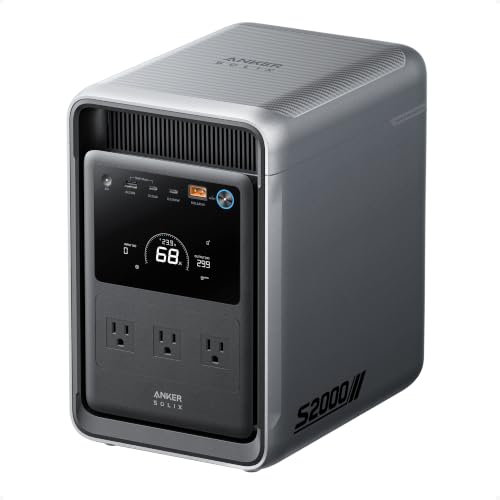
- Substantial 2,010Wh capacity paired with long-lasting 10,000-cycle LFP battery chemistry.
- Noticeably lighter and smaller than standard 2kWh units at 35.7 pounds.
- Fast sub-10ms UPS switchover protects home office hardware during sudden blackouts.
- Dual-sided outlet arrangement keeps workspace and appliance cords tidy.
- Flexible recharging options with six supported methods, including up to 400W solar input.
Cons
- Does not include a dedicated 12V DC car-style accessory port.
- Continuous 1,500W output limit cannot run multiple high-draw heating appliances at the same time.
- Solar input is capped at 400W, which means slower solar recharging than higher-wattage solar generators.
The Anker SOLIX S2000 is a high-capacity 2,010Wh portable power station designed for residential emergency backup, remote work continuity, and off-grid outdoor travel. Built for homeowners, mobile creators, campers, and office workers seeking dependable power away from the grid, it balances high-capacity storage with manageable dimensions. Unlike bulkier emergency generators, this unit relies on an internal battery system that can operate safely indoors without fumes or engine noise.
In terms of electrical performance, the S2000 provides 1,500W of continuous AC output with a 3,000W peak surge rating, which is sufficient to power approximately 99% of common home essentials. The battery system utilizes 314Ah lithium iron phosphate (LFP) cells rated for an extensive 10,000 charge cycles, which the manufacturer estimates at a 15-year lifespan. Thanks to an efficient architecture with a low 6W idle draw, the unit can keep a standard refrigerator powered for up to 35 hours during a power failure. For desktop setups, the power station functions as an uninterruptible power supply with a sub-10 millisecond switchover time to prevent connected computers and network gear from shutting down during an outage.
Physically, the power station measures 8.19 by 11.1 by 12.7 inches and weighs 35.7 pounds. The manufacturer notes this form factor is 30% smaller and 25% lighter than the typical industry average for 2kWh power stations, making it easier to stow in a vehicle trunk or closet. The external layout features eight total outlets strategically divided across the front and rear panels. This dual-sided design allows users to plug permanent, always-on hardware into the back while keeping the front accessible for temporary electronics, creating a cleaner workspace without cord clutter.
Recharging the S2000 is straightforward and accommodates multiple environments through six distinct methods. Users can replenish the internal battery via standard AC wall power, solar panels at up to 400W, combined AC plus solar input, an external generator, an alternator charger, or a basic 12V car socket. This range of inputs provides practical flexibility for home emergency readiness as well as extended road trips and camping where wall outlets are not accessible.
Realistic limitations are primarily tied to continuous load and specific port options. With a continuous output rating of 1,500W, the S2000 cannot sustain simultaneous operation of multiple high-wattage heating appliances, such as running a heavy-duty microwave and a space heater at the same time. In addition, the unit does not include a 12V DC port, which may inconvenience users who rely on native 12V car cooler plugs without using an AC adapter. Solar charging is also limited to 400W maximum input, which will take longer to refill the 2,010Wh battery under sunlight compared to stations supporting 800W or higher solar arrays.
For homeowners wanting dependable refrigerator backup during storm seasons, remote professionals requiring reliable battery backup with sub-10ms UPS switching, and road trippers wanting substantial off-grid energy in a manageable footprint, the Anker SOLIX S2000 is a very capable option. Buyers who need more than 1,500W of sustained continuous power or native 12V DC ports will need to evaluate larger power stations, but those seeking long battery cycle life and easy portability in the 2kWh class will find strong practical value here.
The Anker SOLIX S2000 centers around a 2,010Wh energy capacity powered by heavy-duty 314Ah LFP battery cells. These cells are rated for 10,000 charge cycles, representing an estimated 15-year lifespan under typical operational conditions. Compared to traditional lithium-ion chemistries with lower cycle ratings, LFP chemistry provides enhanced cycle longevity for long-term ownership.
The power station delivers 1,500W of continuous power and handles momentary spikes up to 3,000W. Efficiency optimizations and a low 6W idle draw allow it to sustain a residential refrigerator for up to 35 hours, though actual runtimes will vary based on appliance efficiency, compressor duty cycles, and ambient temperatures.
With eight outlets positioned across the front and rear surfaces, the S2000 provides an organized layout for multiple devices. Everyday electronics can plug into the front face, while continuous appliances or desktop workstations plug neatly into the rear panel to avoid visible cable clutter.
The integrated UPS function features a fast transfer time of under 10 milliseconds. When connected between a wall outlet and critical office hardware, it switches to internal battery power seamlessly during grid dropouts, helping prevent data loss and abrupt system shutdowns.
The S2000 supports six different methods to recharge its 2,010Wh battery pack, catering to home preparedness and mobile travel. Users can charge via standard AC wall outlets, solar panels, combined AC and solar power, traditional gas generators, vehicle alternator chargers, or standard vehicle accessory sockets.
When using solar power off-grid, the system accepts up to 400W of solar input. While sufficient for steady daylight top-ups, users planning extended off-grid stays should account for the 400W input cap when calculating daily energy replacement.
FAQs
What’s the difference between an Anker SOLIX power station and an Anker power bank?
An Anker SOLIX power station is a larger portable battery with higher Wh capacity (192Wh to 2,010Wh in this lineup), multiple port types including car sockets and sometimes AC outlets, and support for solar panel recharging. An Anker power bank like the Prime 26,250mAh or the 25,000mAh Laptop model is smaller, lighter, and designed primarily for charging phones, tablets, and USB-C laptops on the go. Power stations suit camping, RV use, and home backup. Power banks suit commuting, air travel, and everyday carry. The product you need depends on how much energy (Wh) your devices require and whether you need AC outlets or just USB ports.
Can the Anker SOLIX C300 DC charge a laptop?
Yes, the SOLIX C300 DC includes two 140W USB-C ports that support two-way charging, which can deliver enough wattage for many USB-C laptops. But actual laptop compatibility depends on the laptop’s own USB-C charging requirements and the cable used. A laptop that draws more than 140W from a single port would not charge at full speed. The C300 DC does not include AC outlets, so devices that require a standard wall plug won’t work with this model. The full C300 Portable Power Station (with AC) does offer three AC outlets rated at 300W total.
Is the Anker Prime Power Bank airline-friendly?
The Anker Prime Power Bank (26,250mAh) lists a capacity of 99.75Wh, which falls under the 100Wh threshold that many airlines reference for carry-on lithium batteries. That said, airline policies vary by carrier and region, so it’s always worth confirming with your specific airline before flying. The product description identifies it as TSA-approved capacity. Larger SOLIX power stations with Wh ratings well above 100Wh are generally not suitable for air travel in carry-on or checked luggage.
How fast can the SOLIX C1000 recharge itself?
The Anker SOLIX C1000 can reach 80% in about 43 minutes using its UltraFast recharging mode via AC input, with a full charge in under an hour. This feature requires the Anker app and an operating temperature between 68-122 degrees F. It also supports up to 600W solar recharging, which can fully charge the 1,056Wh battery in roughly 1.8 hours under ideal conditions. Car charging is another option since a car charging cable is included in the box.
Do the SOLIX C200 and C300 DC models use LiFePO4 batteries?
Yes. Both the SOLIX C200 DC (192Wh) and SOLIX C300 DC (288Wh) use LiFePO4 (LFP) battery chemistry, which is known for longer cycle life compared to standard lithium-ion cells. The C200 DC lists 3,000 battery cycles, and both models come with a 3-year warranty. LiFePO4 batteries tend to handle more charge-discharge cycles before significant capacity loss, which matters if you plan to use the station regularly for camping or as a backup power source. For buyers who want to explore other oversized Anker power bank options, we’ve covered those separately.
What solar panels work with the Anker SOLIX power stations?
Anker recommends their 100W or 60W solar panels for the SOLIX C200 DC, C300 DC, and C300 models. The C200 DC supports up to 100W solar input, while the C1000 supports up to 600W solar input and the S2000 handles up to 400W solar input. An important limitation: none of these stations are compatible with the Anker SOLIX PS30 or other 5V/3A USB-C panels, the PS200, or the PS400. The C200 and C300 bundles that include a 60W solar panel come with the necessary solar-to-XT-60 charging cable and extension cable in the box.
Does the Anker 25,000mAh Laptop Power Bank include charging cables?
Yes. The Anker Laptop Power Bank (25,000mAh, 165W) has two built-in USB-C cables, one retractable up to 2.3 ft and another 0.98 ft cable that doubles as a carrying strap. It also includes a USB-A port and a USB-C port for a total of four simultaneous device connections. A protective pouch is included, but a wall charger is not. For fastest recharging of the power bank itself, Anker recommends using a 100W or higher USB-C charger. If you’re curious about Anker power banks with jump-start features, we’ve reviewed those in a separate guide.






Write Your Review
No reviews yet. Be the first to share your experience!